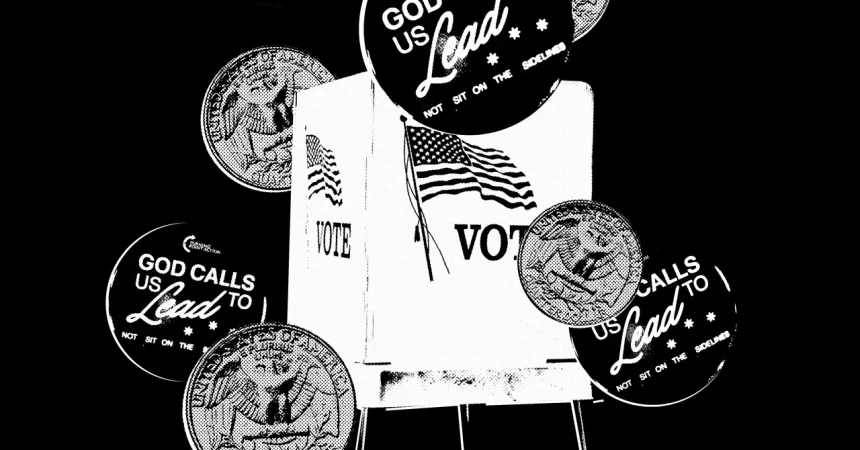
The report opens with a striking and somber premise: a year after the assassination of Turning Point cofounder Charlie Kirk, the conservative grassroots machine he helped build is now preparing to pour tens of millions of dollars into the upcoming midterm elections. According to sources familiar with the organization’s plans, Turning Point intends to use its considerable financial muscle to help Republican candidates in key congressional and gubernatorial races, with a particular emphasis on three states: New Hampshire, Arizona, and Nevada. These three battlegrounds are seen as essential not only for the current midterm cycle but also for the longer-term goal of building a durable Republican electoral foundation. The exact figures are still fluid, but sources told WIRED that Turning Point’s super PAC is looking to spend between $15 million and $20 million on advertising across those three priority states alone. That advertising blitz would be supplemented by a much larger field operation, run through a 501(c)(4) nonprofit, whose spending could not be precisely determined but is estimated to reach tens of millions of dollars more. The combined investment is designed to support both voter contact and digital outreach, adding yet another layer to the already formidable network of outside super PACs and party committees aligned with the Republican cause.
The strategic focus on New Hampshire, Arizona, and Nevada reflects a careful reading of the electoral map. In New Hampshire, the retirement of Democratic Senator Jeanne Shaheen has created an open seat that Republicans believe they can flip. The race has quickly become one of the most closely watched Senate contests in the country, with former Republican Senator John Sununu squaring off against Democratic Representative Chris Pappas. The Cook Political Report currently rates the seat as “Lean Democrat,” which means that even a small shift in turnout or enthusiasm could make the difference. Turning Point’s decision to invest heavily in this race suggests that Republicans see a genuine opportunity to break through in a state that has often leaned blue in recent cycles. In Arizona, the organization has been particularly focused on the governor’s race, where Democratic incumbent Katie Hobbs is facing a challenge from Republican Representative Andy Biggs. Biggs has aligned himself closely with former President Donald Trump and endorsed Trump’s false claims about a stolen 2020 election, making the race a potent test of how much the Republican base’s energy can overcome broader voter dissatisfaction. Nevada, meanwhile, remains a perennial swing state where narrow margins have decided major races for years. In addition to these three priority states, Turning Point plans to deploy full-time field staff in seven other states where Democrats could potentially pick up seats, ensuring that the organization’s presence is felt far beyond the headline battlegrounds. This is not a scattered effort; it is a coordinated, multi-state operation designed to shape the playing field from top to bottom.
The timing of this cash injection is no accident. Republican groups have been scrambling to counter a wave of Democratic momentum fueled by public discontent over the ongoing Iran war and persistently high prices at home. Polls have shown a tightening national environment, and the possibility of a Democrat-controlled Senate has become increasingly real. In this context, Turning Point’s spending is part of a larger Republican response, one that has drawn in the former president’s political operation as well. After facing criticism for not spending earlier in the cycle, Trump’s team has shifted into gear. His main super PAC, MAGA Inc., recently poured $10 million into advertising in the Texas Senate race, a sign that even traditionally safe seats are now receiving attention. More strikingly, a new entity called No Going Back PAC Inc. has reserved at least $47 million in advertising across six Senate races and one House race, an indication of how much money is moving through the Republican ecosystem in the final stretch. The precise degree of coordination between Trump’s operation, MAGA Inc., and outside groups like Turning Point remains unclear, but sources say there has been extensive data sharing to ensure that everyone is targeting the same voters. The goal is simple: to build a unified voter-identification and turnout system that can overcome the headwinds of an unpopular president and a restless electorate.
Turnout is expected to be the deciding factor in November, and Turning Point has made it clear to Trump’s inner circle that its field operation will prioritize one essential task: reminding Trump supporters to actually show up on Election Day. This may sound basic, but in a midterm environment where complacency can be deadly, the difference between a voter staying home and a voter casting a ballot can determine control of the Senate, governorships, and the House. What makes Turning Point’s midterm strategy particularly interesting is that the organization has historically been focused on presidential elections. Its decision to invest so heavily in midterm races is not simply about the immediate results; it is also an effort to build long-term infrastructure for the Republican ticket in 2028. The focus on New Hampshire, Arizona, and Nevada is especially telling in this regard. According to sources, Turning Point’s leadership has concluded that winning those three states in a future presidential race would offset the need to capture traditional blue-wall states like Pennsylvania, Michigan, or Wisconsin. In other words, the midterm ground game is being designed with an eye toward the next presidential cycle, even as the current election looms. As one Republican strategist might put it, the day after the midterms is the first day of the presidential election, and the party is already campaigning for the next round.
The broader Republican landscape, however, is anything but comfortable. Trump’s approval rating has now sunk to 40 percent or below, a historically dangerous level for any party holding the White House going into a midterm. This has created a profound dilemma for Republican candidates and officials, who must decide how closely to embrace the former president. On one hand, they need to energize the base, and no one does that better than Trump. On the other hand, tying themselves too tightly to a deeply polarizing figure risks alienating the moderate and independent voters who will decide the closest races. This tension is on full display with the upcoming Republican “midterm convention” in Texas. Party conventions are normally reserved for presidential election years, but Trump and other top officials are set to headline this week’s event anyway, in a bid to boost vulnerable Republicans and fire up the grassroots. One of the main attractions will be Texas Senate nominee Ken Paxton, who faces a surprisingly competitive race and needs every bit of energy and money the party can muster. The convention represents both an opportunity and a gamble: it could generate the enthusiasm Republicans desperately need, but it also risks turning the midterms into a referendum on Trump himself, a prospect that worries many strategists. The report describes this as being caught between a rock and a hard place, and the description fits.
Taken together, the convergence of Turning Point’s massive investment, Trump’s late-stage spending spree, and the high-stakes Texas convention paints a vivid picture of a party trying to navigate an extraordinarily hostile environment. The Republican base remains deeply motivated, and the organizational infrastructure being built by Turning Point and its allies could prove decisive in the narrowest races. But the headwinds are real: an unpopular president, a volatile international crisis, economic anxiety, and a resurgent Democratic fundraising machine. The money pouring into the midterms is not just about winning seats in November; it is about positioning for the next decade of American politics. Turning Point’s decision to prioritize New Hampshire, Arizona, and Nevada is a bet that the Republican Party can build a new electoral map, one that no longer depends on the industrial Midwest. Whether that bet pays off will depend on how well the party can translate cash and field staff into actual votes. In the end, the human story behind all these numbers is one of urgency, anxiety, and hope. Activists on the ground are working long hours, candidates are fighting for every last undecided voter, and operatives are staring at polling data late into the night. The midterms are more than a political event; they are a test of whether the movement Charlie Kirk helped build can survive and expand beyond his presence. And as the report makes clear, for many Republicans, the campaign never really ends. The day after the midterms, the 2028 race begins.