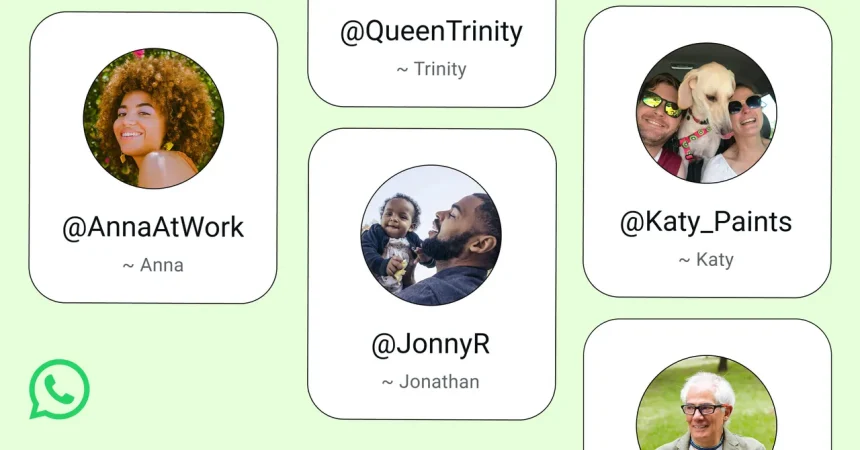
For years, WhatsApp users have been clamoring for a way to communicate without handing out their personal phone numbers like business cards. Whether you’re meeting someone new for a transaction, joining a professional group, or just chatting with a casual acquaintance, the requirement to share your digits has always been a significant privacy hurdle. Thankfully, WhatsApp is finally addressing this by rolling out its highly anticipated username feature. This transition, moving the app out of beta and into the hands of its three billion global users, marks a fundamental shift in how we approach secure messaging. It is a long-overdue evolution that promises to make digital interactions feel far more guarded and controlled.
The race to secure your ideal handle is effectively beginning this week, creating a bit of a digital “gold rush” for those who value their online branding. WhatsApp is making the process quite intuitive: if a notification pops up, you simply need to head over to your Settings, click into the Account tab, and locate the new Username section. From there, the choice is yours. You can either use the built-in generator to spark some inspiration or opt to port over a handle you already use on platforms like Instagram or Facebook. It is a flexible, user-centric system that gives you the keys to your own identity, allowing you to change, update, or completely delete your handle whenever your preferences evolve.
At the heart of this rollout is a strong emphasis on privacy, a value that Alice Newton-Rex, WhatsApp’s VP of Product, describes as the primary motivation for the change. The most vital takeaway is that these usernames aren’t just for show; they are a defensive layer designed to decouple your identity from your physical phone number. Unlike some social media platforms where your profile might be discoverable on a public index, WhatsApp has intentionally avoided creating a searchable directory of usernames. This means nobody can simply “look up” your handle to stalk your profile or find your account. You maintain the gatekeeping power, ensuring that your most private contact information stays truly private.
WhatsApp has even doubled down on security by introducing an optional, robust verification method: the four-digit key. If you are particularly concerned about unwanted solicitations, you can choose to require that anyone attempting to message you via your username must also input a unique four-digit code. This acts as a digital handshake, ensuring that only people who know you—or who you have explicitly shared this code with—can reach your inbox. Through this feature, the company is effectively giving power back to the user, moving away from a forced-transparency model toward one that prioritizes individual comfort and safety above all else.
It is worth noting that this move places WhatsApp in direct competition with privacy-focused apps like Signal, which pioneered the username model earlier in 2024. While WhatsApp has long been the titan of global messaging, they have clearly been observant of the trends set by more niche, secure platforms. Users have shown a persistent preference for “burner” style connectivity, where they can interact with different communities without the permanent, irreversible nature of a phone number. By adopting these methods, WhatsApp is acknowledging that the modern user is becoming increasingly savvy about digital footprints, and they are adapting their architecture to match that higher bar of expectation.
Ultimately, while the decision to adopt a username remains entirely optional, it represents a massive step forward for the platform’s accessibility. You aren’t being forced to reinvent your digital persona, nor are you being pushed into a public database. Instead, you are being offered a tool that enhances the privacy of your everyday communications. As this feature rolls out, keep an eye on your notification center, as the opportunity to claim your preferred name won’t last forever. In a digital landscape where our phone numbers have become synonymous with our identities, this shift by WhatsApp is a welcome, human-focused correction that puts the user back in the driver’s seat.