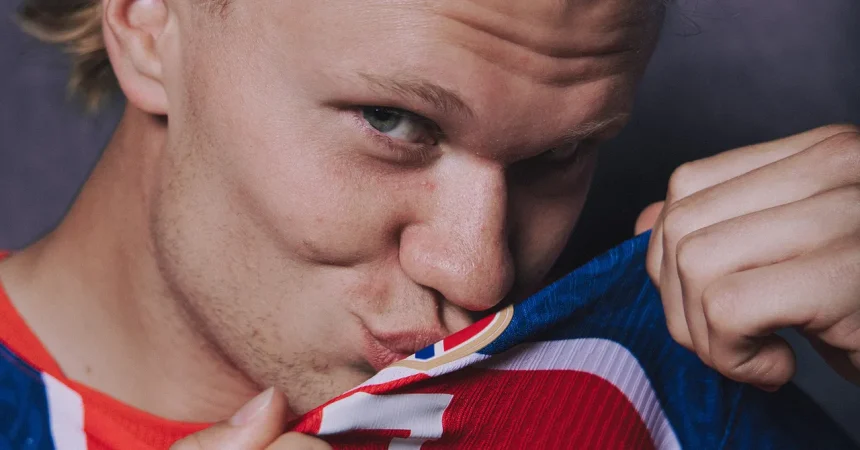
The viral video of Erling Haaland mid-chew, flinching at his own restaurant-window reflection, felt perfectly in character for the Norwegian striker—so much so that 31 million people on X bought it as gospel during the recent World Cup frenzy. But it was a complete fabrication. The footage was actually a slapstick skit by Chinese comedian Jin Long, repurposed and deepfaked to mirror Haaland’s likeness. Even after fact-checkers debunked it, the video continued to circulate with undiminished momentum. This wasn’t merely a technological trick; it was a testament to the fact that, in the digital age, the “character” of an athlete has become more potent and more “real” to the public than the human being living behind the persona.
We are witnessing a fundamental shift in how fame operates in the 21st century. The traditional celebrity model, which required a rigid, protective grip on one’s public image, has collapsed. Today’s stars are essentially open-source characters. Haaland’s accidental meme-hood illustrates this new reality: icons are now so vividly defined by their quirks, memes, and digital footprints that they have become malleable archetypes. Once an athlete’s personality is established enough to be distilled into a “vibe” or a recurring joke, the public no longer needs the real person to generate content. The digital avatar—whether AI-generated or fan-edited—becomes an extension of the star, operating with a life and agency entirely its own.
Haaland’s trajectory in China serves as the perfect case study for this phenomenon. Long before the viral reflection video, fans there had already adopted him into their digital culture, rechristening him “Habao” (or “Ha Baby”). They celebrated the amusing contrast between his ruthless, machine-like performance on the pitch and his goofy, “golden retriever” energy off it. As his popularity skyrocketed, Haaland lean-in, opening official accounts and embracing the meme-ification. The viral fake was simply the latest, most sophisticated artifact in a larger ecosystem of fan-generated lore. In sports, stars are no longer just athletes; they are narrative-heavy characters being shaped, edited, and remixed by a global audience that demands constant imaginative output.
This evolution is fundamentally changing the relationship between fans and the sports they consume. Data suggests that younger generations feel a significantly stronger, more personal bond with individual athletes than they do with the traditional, static concepts of team or league. The athlete is the new protagonist in a fan-driven story, and the “fanon”—the lore and character development created by the audience—is now being actively synthesized through AI. When fans create or share this content, they aren’t just consuming sports; they are participating in the invention of a legend. The truth of a video clip matters less than whether it serves the “truth” of the character that the fans have collectively built.
While there is a pervasive and valid fear surrounding the dangers of deepfakes, the Haaland incident points to a more nuanced, even cynical reality: the internet is often complicit in its own deception. When a deepfake feels “right”—when it aligns perfectly with the, often exaggerated, quirks we attribute to a star—the audience doesn’t just tolerate the fiction; they champion it. We have seen this repeated with everything from the “Balenciaga Pope” to digital clones of Tom Cruise and Drake. It turns out that if an audience loves the subject enough, they are more than happy to suspend their disbelief and lean into the hallucination. The “fake” becomes a form of fan art, a digital supplement to the celebrity we already feel we know intimately.
Ultimately, the Haaland-ification of sports stardom proves that we have entered an era where authenticity is increasingly taking a backseat to narrative consistency. As AI tools become more powerful and accessible, the line between what an athlete did and what a fan imagined them doing will continue to blur. We are moving toward a future where our icons exist in a state of constant, fluid transition, living both on the grass of a stadium and in the cloud of our collective imagination. In this world, the celebrity is no longer just a person; they are a shared platform, a digital brand managed as much by their audience’s desires as by their own actions. As long as the content feels “true to character,” the public is content to let the dream roll on.