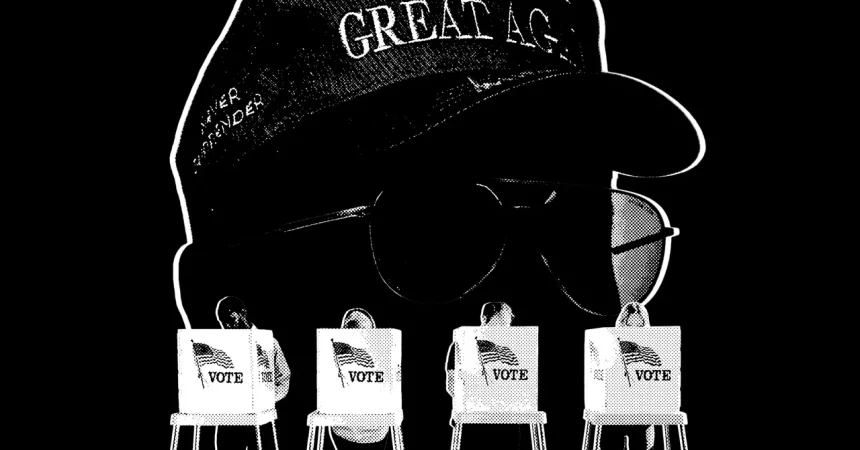
Political spending is often described in cold, eye-glazing sums, but at ground level it is a series of choices: which voters to panic, which rival to define, which medium to trust with the message. America PAC, the super PAC most closely tied to Elon Musk, has made some telling choices in recent weeks. Its largest single expenditures have not been massive television buys or grand rallies, but two $1.3 million digital media buys opposing a candidate named Talarico. Digital advertising is the not-so-secret weapon of modern politics. It can be aimed at tiny slices of the electorate, tested on the fly, and tweaked based on what seems to work. A television ad might reach everyone in a media market; a digital ad can reach only the undecided voters in a suburban district who regularly scroll through social media. America PAC’s willingness to spend its biggest chunks of money this way says a great deal about its philosophy: it is more interested in installing doubt in the minds of a few thousand crucial voters than in speaking to everyone else. It also reflects the awkward reality that the group has not put any money into television ads. That part of the battle is being handled by other conservative groups, especially MAGA Inc., the Trump-affiliated super PAC. In effect, there is a division of labor. The old-school television war is left to the operatives who know how to book airtime and produce thirty-second spots. The digital war is left to the new-money people who believe that data is more valuable than production values. For ordinary voters, the result can be disorienting. They may see a television ad paid for by one group, then a social media post from another, then a text message from a third, all pushing the same negative message about a candidate. The coordination is not formal—campaigns and super PACs are legally barred from working together—but the shared goal is unmistakable. And in a single congressional district, a few carefully placed digital ads can make a candidate seem despised, even if the broader public has never heard of him. That is what makes America PAC’s largest expenditures so revealing: they are not about building a movement. They are about killing an opponent.
While America PAC works the digital shadows, the airwaves are being flooded by an even larger operation with a more traditional approach. Texas PAC, the super PAC affiliated with the Senate Republican Conference, has booked the lion’s share of television advertising in the closing weeks of the election. Punchbowl News reported last month that Texas PAC had already reserved around $120 million in ad time and was looking to buy another $100 million in slots before November 3. Those figures are jaw-dropping, even by modern campaign standards. In a single state, a single outside group can spend more money on television than many candidates spend on their entire campaigns. The scale is hard to comprehend until you think about what it actually means in practice. For months, voters in Texas will sit down to watch the local news, a football game, or an old sitcom, only to be confronted with another political ad. Many of these ads will be negative, because negative ads tend to be more memorable. They will feature ominous music, carefully selected clips, and a narrator who makes every candidate sound either dangerous or incompetent. The group behind those ads is not the candidate’s campaign, but a super PAC that can accept unlimited donations. The Senate Republican Conference’s decision to push so much money into Texas PAC suggests that the path to a Senate majority runs through Texas, or at least that Republicans believe it does. It also suggests a certain urgency. If the race were comfortably in hand, there would be no need to book $120 million and then try to buy another $100 million. The fact that Texas PAC wanted more airtime even after making the initial reservation indicates that the battle is close, and that both sides are willing to spend whatever it takes to dominate the final days. For Texas voters, the result is a barrage of conflicting messages. One ad says the Republican candidate will save the country; the next says the same candidate will betray it. It is enough to make anyone want to mute the television until Election Day. But the saturation is the strategy. The super PAC wants voters to feel as if they have seen the same message so many times that it must be true. This is not campaigning in the old sense of introducing a candidate to the public. It is branding, repetition, and exhaustion. And while America PAC focuses on digital precision, Texas PAC is engaged in the opposite approach: overwhelming the entire state with enough television advertising to make the message inescapable. Together, these two strategies cover both ends of the political spectrum, from the surgical hit to the carpet bomb.
In Ohio, the contrast between attack and support spending is even more pronounced, and it exposes the central problem facing Republican Senate candidate Jon Husted. America PAC has spent $3.3 million against Democrat Sherrod Brown, while spending only $1.6 million in support of Husted. That means more than two-thirds of America PAC’s Ohio spending has been devoted to tearing down Brown rather than building up Husted. The reason is not hard to find. Husted has been struggling to escape his past support for data centers, a subject that has become politically radioactive in a state where voters are furious about rising costs. Data centers are the giant warehouses that power the internet, housing thousands of computer servers that run around the clock. They consume enormous amounts of electricity, and they require expensive upgrades to the local power grid. For years, politicians cheered them as the future. But as energy bills have spiked and communities have realized that data centers create relatively few permanent jobs, the public mood has soured. Husted, because of a planned Nvidia data center project in Ohio that will be leased by OpenAI, and because of his earlier support for data centers while serving in state government, has become the human face of the controversy. Brown and his allies have hammered the issue relentlessly, casting Husted as the champion of giant corporations at the expense of ordinary ratepayers. The attack has stuck. In fact, it has become so effective that a memo from the Senate Republicans’ campaign arm in August admitted that the data center issue was, in the words of the memo, “tying an anchor around the neck of Husted’s public polling.” That is an extraordinary admission from the people charged with electing him. It means that every time Husted tries to talk about inflation, or health care, or border security, there is an opponent standing behind him whispering the words “data centers.” It means that voters are bringing the issue up at town halls and in focus groups. It means that the Republican’s internal data shows an issue that could sink the campaign. Husted has tried to counter by arguing that data center decisions should be made locally, but that is a difficult position to defend when he supported them at the state level in the past. He cannot simply disown the projects he once championed, because that would make him look weak and hypocritical. He also cannot embrace them fully, because the voters he needs in November are the ones most angry about them. So he is stuck, and the outside money reflects it. America PAC’s heavy spending against Brown is an attempt to change the subject, to make the race a referendum on Brown rather than on Husted. But the internal admission about the anchor suggests that the Republican brain trust knows how dangerous the problem has become.
The political challenge facing Husted grew even more awkward this week when his own party leader jumped into the data center fight on the wrong side. At a rally in Ohio, Donald Trump was asked about the issue and, seemingly unable to resist the urge to cheer on economic development, declared to the crowd: “We want them.” It was a moment of pure Trump instinct: big, bold, and indifferent to the nuance of local politics. For Husted, it was a nightmare. The whole point of his recent strategy has been to distance himself from the data center projects that are driving up utility bills and infuriating voters. He wants to say that this is a complex issue, that decisions should be made locally, that he understands the frustration. And then the former president, the most powerful force in the Republican Party, steps onto a stage in Ohio and basically endorses the exact thing voters are angry about. Husted’s campaign immediately tried to walk the line, responding that the decision about data centers should be a “local decision.” That is the kind of verbal tightrope act that makes political consultants nervous. It tries to acknowledge Trump’s enthusiasm while also leaving Husted room to distance himself from the consequences. But in the real world, the clip of Trump saying “We want them” is going to be played over and over in Ohio. Democratic ads will cut it together with Husted’s old support for data centers, and the message will be simple: both Trump and Husted are on the side of the big corporations, and the voter is stuck paying the bill. The fact that Husted’s campaign has to correct or clarify a statement from the leader of his own party is a sign of how difficult the political environment has become. It is one thing to fight against the opposing party’s attacks. It is another to fight against a friendly fire comment that reinforces the opposition’s central message. Brown’s strategy has been so effective that Republicans can no longer control the conversation about Husted’s record. They are forced to spend precious time and energy responding to an issue that, a few years ago, would have been seen as a positive for any politician who supported it. The data center fight is a reminder that in politics, the same decision that looks like wisdom at one moment can look like malpractice a few years later. Husted’s past support may have been good policy and good politics at the state capitol. But now, with utility bills rising and voters looking for someone to blame, it has become a millstone. And no amount of outside money, not even America PAC’s millions, can easily lift an anchor once it has been tied around a candidate’s neck.
In Iowa, the same pattern of aggressive negative spending is playing out on a smaller scale, but the ratio is even more lopsided. America PAC has spent $1.5 million hitting Democratic candidate Josh Turek, while spending only about $100,000 supporting Republican Ashley Hinson. According to WIRED’s tracker, that is the biggest disparity in the country for Musk’s political operation. To put it bluntly, America PAC has spent roughly fourteen times more attacking Turek than it has spent supporting Hinson. That is a striking number, and it offers a clear window into the group’s worldview. The goal is not to build Hinson into a beloved figure. The goal is to make Turek unacceptable to enough voters that Hinson wins by default. This is not an accident. In modern campaign strategy, negative advertising is often more effective than positive advertising, particularly in races where the electorate is polarized and few voters are genuinely undecided. People may not remember a candidate’s five-point plan for rural broadband, but they will remember an ad that suggests the other candidate is corrupt, dangerous, or weak. America PAC’s decision to invest so heavily against Turek suggests that the group believes the race will be decided by voters who are already predisposed to support a Republican but need to be given a reason to stay home or to vote for Hinson without enthusiasm. The human effect of this strategy is hard to measure but easy to imagine. A voter in Iowa sees a barrage of negative ads about Turek, hears some about Hinson, and gradually begins to associate the Democratic candidate with everything that is wrong with the country. It is a formula that has been used for generations, but the digital scale of America PAC’s operation makes it even more potent. The group can identify the same small group of undecided voters again and again, showing them the same message across every platform until it becomes impossible to ignore. The fact that so much money is being spent on the negative side also reflects a broader truth about the current political moment: more and more donors are giving to tear down candidates they fear than to lift up candidates they love. It is easier to raise $1.5 million against someone than to raise $1.5 million for someone. Enthusiasm for a positive agenda is a good thing, but anger and fear are stronger motivators. That is why America PAC’s largest expenditures in Iowa have been focused on the Democratic opponent, not the Republican candidate. And it is why Hinson’s campaign may be hoping that the attacks do their job quietly, in the background, while she spends her own time presenting herself as a reasonable alternative. If the strategy works, no one will ever know exactly which voters were convinced by those digital ads. If it fails, the missing $1.4 million in support might be an easy thing to blame.
Taken together, these numbers paint a portrait of the modern political machine, one in which super PACs are not merely helpers but central protagonists. America PAC operates like a startup: fast, data-driven, and willing to spend heavily on digital attacks while leaving television to older, more established players. Texas PAC operates like a traditional political war machine, booking more than $100 million in airtime and trying to buy even more. In Ohio, the millions spent against Sherrod Brown are a response to a Republican candidate who has found himself trapped by his own record on data centers, an issue that has become so toxic that it is dragging down his polling. In Iowa, the enormous disparity between attacks on Josh Turek and support for Ashley Hinson reveals a cynical but effective theory of campaigning: it is often easier and more rewarding to make people dislike the opponent than to make them like your candidate. For voters, all of this adds up to a final stretch in which the airwaves and the internet are saturated with messages designed to manipulate their emotions. The ads emphasize fear, anger, and distrust. They remind voters of everything they hate about the other side. They rarely ask voters to dream or to be inspired. Instead, they rely on the simple math of negative partisanship: if you can convince even a small number of people that the other candidate is unacceptable, you might be able to tip a close election. The humans behind those decisions are not necessarily sinister. They are political operatives and donors who believe they are defending their country from the other side. But the result is an exhausting experience for ordinary Americans, who must sort through a blizzard of half-truths, misleading clips, and carefully timed attacks. The money spent by America PAC, Texas PAC, and other groups will be gone after Election Day, but the feelings they create may last longer: cynicism about politics, distrust of candidates, and the sense that whoever wins, the real power belongs to the people who pay for the ads. In the end, the largest expenditures against Talarico, Brown, Turek, and countless others are not just financial entries in a campaign finance report. They are attempts to shape the reality voters inhabit in the few weeks before they cast their ballots. The question is whether voters will see through the barrage, or whether the targeted digital ads and the massive television buys will do exactly what they were designed to do. That is the human story behind all the numbers: a battle for attention, fought with billions of dollars, in which every click, every view, and every vote is treated as a prize worth fighting for.