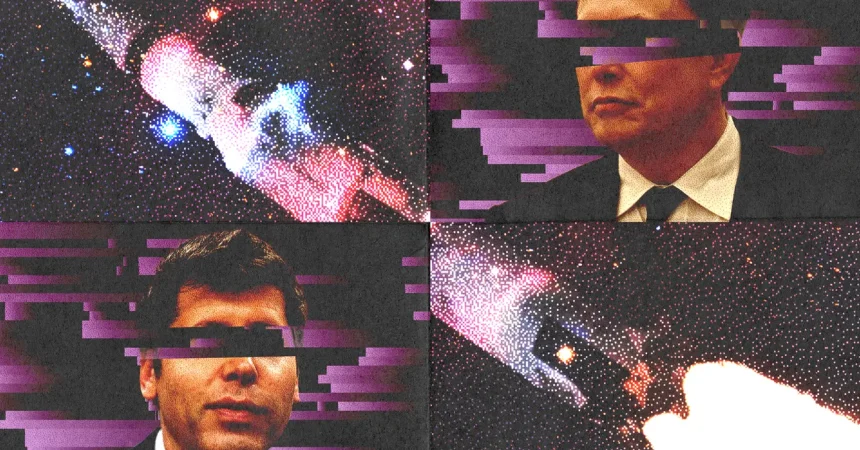
For over a century, the dream of colonizing distant planets has served as a mirror for our own history, frequently used by science fiction writers to critique the dark realities of terrestrial imperialism. While historical figures like Cecil Rhodes once mused about annexing the planets to expand their empires, authors utilized the vastness of space to highlight the absurdity and cruelty of human conquest. It is against this backdrop of literary social commentary that figures like Elon Musk and Jeff Bezos formed their early impressions of space travel. However, where many saw a cautionary tale about the dangers of unchecked power and expansion, these future moguls saw a roadmap for their own ambitions, seemingly missing the irony embedded in the very stories that fueled their imaginations.
Elon Musk’s relationship with Douglas Adams’ The Hitchhiker’s Guide to the Galaxy is a fascinating study in interpretation. As a young man growing up in South Africa, Musk embraced the book’s central philosophy—the necessity of asking the right questions—as a guiding principle for life. Yet, as he transitioned from a precocious youth to one of the most powerful and wealthy figures in history, he seemingly bypassed the book’s biting satire of figures precisely like himself. Instead of recognizing the cautionary subtext, Musk leaned into the aesthetic of the novel, even proposing to name a SpaceX vessel the Heart of Gold—the very ship belonging to the story’s absurd, megalomaniacal antihero, Zaphod Beeblebrox.
The character of Zaphod Beeblebrox serves as a brilliant, if unintended, parody of the modern tech billionaire. As a two-headed, three-armed figurehead of the Imperial Galactic Government, Beeblebrox exists primarily to distract the public from the shadowy corporations that actually pull the strings of the universe. Adams describes his role not as one of leadership, but of “finely judged outrage,” a description that feels eerily resonant in our current era of social media-driven billionaire antics. Most telling is Beeblebrox’s encounter with the “Total Perspective Vortex,” a machine designed to destroy the mind by showing the subject their own insignificance in the vast cosmos. While it annihilates everyone else, Beeblebrox survives by concluding that he is, in fact, the most important being in the universe—a level of ego-centrism that seems to have been the only takeaway Musk adopted.
This disconnect between the author’s intent and the billionaire’s reality became strikingly apparent when Musk launched a Tesla Roadster into orbit. By placing a copy of Isaac Asimov’s Foundation inside the car and mounting a “DON’T PANIC” sign on the dashboard, Musk signaled a deep, earnest devotion to his childhood science fiction heroes. Yet, in his pursuit of “custom-made luxury planet-building” on Mars, he effectively turned a spoof of galactic imperialism into his own personal manifest destiny. By dressing his ambition in the imagery of his favorite books, he transformed the very critique that Adams had leveled against the powerful into a branding exercise for the new frontier of space privatization.
Jeff Bezos shares a similar, albeit more grounded, origin story tied to the optimism of the mid-20th century. Born in the same era as the Mariner 4 probe, Bezos matured during a time when space was shifting from a nationalistic endeavor to a realm of individual billionaire potential. By the 1990s, as both he and Musk were accumulating the vast capital required to turn science fiction into industry, the scientific community began to seriously entertain the possibility of terraforming Mars. Books like Kim Stanley Robinson’s Mars trilogy provided the intellectual framework for this, offering a vision of scientists—not colonizers—remaking a planet to sustain human life, a nuance that is often stripped away in the discourse of the current “space race.”
The transition from 1990s aerospace theories, like those found in Robert Zubrin’s The Case for Mars, to our present-day reality marks a shift in how we view the heavens. Zubrin’s assertion that a small outpost could be established with existing technology sparked a fire, turning Mars from a cold, distant curiosity into an achievable “second home.” However, as we look at the current trajectory of these ambitions, one must wonder if we have learned the lessons the literature tried to teach us. We are no longer merely reading about the vanity of Galactic Presidents or the dangers of space-bound imperialism; we are watching the people who built their fortunes on these stories try to turn the fiction into a reality, often ignoring the very warnings that made those stories masterpieces in the first place.