Imagine a robot that doesn’t beep and buzz with metal limbs, but instead moves with the slow, gentle give of a living creature. What if a robot could be squishy? That question, once the stuff of playful science fiction, is now being taken seriously by engineers and biologists alike. Soft, flexible robots are not a novelty project or a strange academic joke; they represent a genuine shift in how we think about machines. Traditional robots are built for strength, speed, and precision, often from steel and silicon, and they excel in factories where the environment is controlled and predictable. But the real world is rarely that neat. A robot that needs to help a surgeon, slip through rubble to find a survivor, or simply hold a ripe tomato without crushing it needs a different kind of physical intelligence. It needs to be delicate. It needs to be adaptable. And in many cases, it needs to be something that can bend and stretch like human muscle. That is why soft robotics has become such an exciting field. By replacing rigid links and gears with pliable materials, researchers are creating machines that can move more naturally, feel more sensitively, and interact with the world in ways that hard machines simply cannot. The ultimate inspiration, of course, is the human body. Our arms, hands, and fingers are remarkably soft, and yet they are capable of lifting heavy objects, tying shoelaces, playing instruments, and delivering the gentlest touch. Soft robots are trying to imitate that combination of strength and tenderness, often by designing actuators—the parts of a robot that make it move—out of materials that bend and swell rather than spin and slide. The goal is not to replace industrial robots, but to open up entirely new places where machines can be useful: inside our bodies, on our skin, around fragile objects, and in environments that are too unpredictable for rigid automation. We are still in the early days, but the direction is clear: the robots of the future may not look like us, but they could feel much more like us.
At the heart of this quiet revolution is the soft actuator, a component that converts energy from electricity, heat, light, or chemical reactions into mechanical motion. In a conventional robot, this job is done by motors that rotate shafts and pull cables, all supported by a rigid frame. A soft actuator, by contrast, is often made out of elastomers, hydrogels, or other flexible materials that change shape when stimulated. Some bend when heated, like artificial muscles. Others swell when exposed to moisture or change shape in response to an electric field. There are even soft actuators that use air pressure to inflate small chambers, making them curl and flex like a human finger. What makes these devices so compelling is not just their material composition, but their ability to do the things muscles do: generate force, absorb impact, and provide feedback about their surroundings. Many soft actuators are designed to be “tactile,” meaning they have a fine-tuned sense of touch. The human hand, after all, is not just a tool for grabbing; it is an extraordinary sensory organ. It can feel the difference between a silk scarf and a piece of sandpaper, detect the warmth of another person’s skin, and adjust its grip on a fragile glass without even thinking. For a robot to do similar things, it needs to be soft enough to share physical contact without causing harm, and sensitive enough to know how hard it is pressing. That is why researchers are building actuators with embedded sensors, responsive skins, and materials that can change their stiffness on demand. Think of an actuator that is floppy when it needs to wrap around an object, but becomes rigid once it has a secure hold—like the way an octopus can stiffen its arms. This kind of adaptability could be transformative. Soft actuators could be woven into clothing to help people move, or built into surgical tools that navigate the body’s tight and delicate spaces. They could power prosthetics that feel like a natural extension of the body, or provide the gentle touch needed to harvest ripe fruit without bruising it. But the most exciting possibilities may come from a very different direction: making these soft machines not just flexible, but alive.
Among the most fascinating developments in soft robotics is the rise of bioactuators, machines that use living cells to produce movement. Unlike conventional synthetic actuators, which rely on engineered materials responding to external inputs, bioactuators take advantage of the natural machinery of life. Muscle cells can be grown in a lab and attached to tiny scaffolds, where they contract when stimulated, essentially turning a biological process into a mechanical force. The idea is not entirely new—scientists have been experimenting with tiny biohybrid robots powered by beating heart cells or swimming sperm-like structures for years. But these early efforts were mostly limited to very small systems, often requiring carefully controlled conditions to keep the cells alive. What makes bioactuators so appealing is that they are inherently self-healing, energy-efficient, and exquisitely responsive to their environment. A living cell can sense chemical signals, react to temperature changes, and repair itself after damage—all things that synthetic materials struggle to do. If you can build a robot powered by living cells, you might be able to create machines that can grow, adapt, and eventually be biodegradable, leaving no electronic waste behind. But working with living cells is also extremely challenging. Cells need nutrients, oxygen, and the right temperature. They must be kept sterile, and they can be unpredictable. Unlike a motor that behaves exactly the same every time you switch it on, a living cell is a system in constant flux, responding to its environment in ways that are difficult to model. Still, researchers have been drawn to the challenge, not only because of the potential applications but because of the deeper scientific questions it raises. What happens when we stop thinking of robots as purely mechanical and start thinking of them as hybrid organisms—part engineered device, part living being? How can we design materials that support life and also perform useful functions? And what can these living machines teach us about the nature of movement, sensing, and autonomy? These are the questions that push the field forward, and they are at the heart of a new project from Delft University of Technology in the Netherlands.
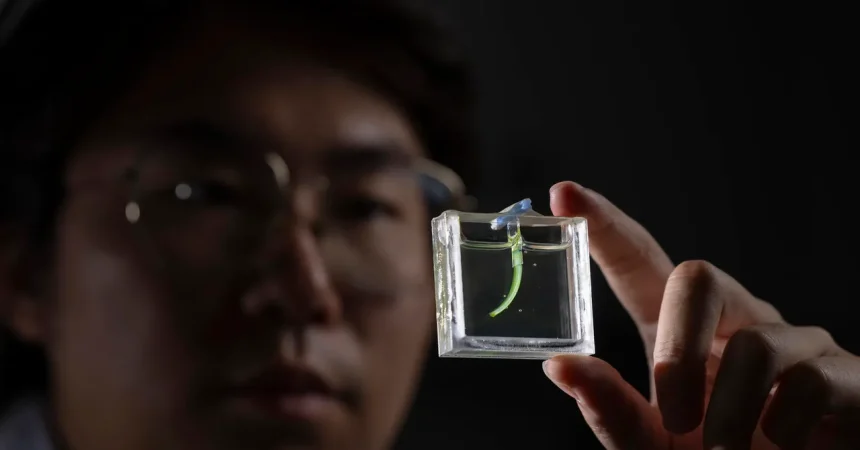
That project is a soft robotic arm that carries algae on its surface—and the algae, through the simple act of photosynthesis, make the arm move. Led by researcher Marie-Eve Aubin-Tam, the Delft team has created a striking demonstration of what happens when living cells are integrated directly into a functional material. The arm is soft and flexible, covered in a layer of microorganisms that are essentially tiny solar-powered engines. When light shines on the algae, they photosynthesize, converting sunlight into chemical energy. That biological activity drives the movement of the arm, bending it in a way that requires no motors, no wires, and no external power source beyond light itself. It is a beautiful and almost poetic idea: a robot that moves because the microbes living on its skin are doing what microbes have always done—harvesting energy from the sun. There is no artificial intelligence controlling the arm, no complex computer program telling it what to do. The movement emerges naturally from the living layer on its surface. Aubin-Tam explained that the team did not begin with a specific application in mind. “Our goal has always been to bring the research of living materials to new levels,” she said in a press release. “We wanted to explore what becomes possible when living cells are integrated into functional materials.” That kind of open-ended curiosity is essential to scientific breakthroughs, but it also makes the project representative of a broader trend in materials science. Instead of designing a material from scratch and then looking for a use, researchers are beginning to work the other way: growing materials, training them, and letting life itself provide the function. The algae-covered arm is not yet a product, and it may not become one. But it demonstrates that the boundary between a machine and a living organism is not as solid as we once believed. The robot does not just mimic life; it actually contains life, and relies on it for its most basic function. In that sense, the project is less about building a better robot and more about redefining what a robot can be.
So where could this lead? It is tempting to dismiss the algae arm as a small lab curiosity, but it points toward a future in which living materials are used to solve real-world problems. Imagine soft robots that can swim in the ocean, powered by the sunlight they absorb, carrying sensors to monitor water quality or coral reef health. Because they are made of biodegradable materials and live cells, they would disappear harmlessly at the end of their mission, leaving no plastic debris behind. Imagine medical devices implanted in the body that use living cells to generate small, gentle movements—perhaps helping to deliver drugs, hold tissue in place, or stimulate healing. Because they are soft and alive, they would be less likely to trigger inflammation or rejection than a rigid metal device. Imagine wearable robots that blend into clothing and move with the human body, powered by nothing more than body heat or light, assisting people with mobility challenges without making them feel like they are pinned inside a machine. There are also broader environmental possibilities. The use of photosynthetic organisms is especially attractive because it means the robot’s fuel source is clean, renewable, and literally everywhere the sun shines. If a robot can be powered by algae, it does not need batteries, charging stations, or a constant supply of electricity. It just needs light. Of course, there are significant hurdles to overcome before these visions become practical. Living cells are fragile and require the right conditions to thrive, which limits where and when bioactuators can operate. They also move slowly and generate relatively small forces, so they may never replace motors for heavy lifting or high-speed tasks. And integrating living cells into engineered systems raises questions about reliability, safety, and control—how do you stop a living robot from responding to unexpected signals, or keep it from growing out of bounds? Yet the field is young, and every project like the algae arm brings us closer to understanding how to design with life, rather than in spite of it. It is not about making life more mechanical; it is about making machines more alive.
In the end, what makes the Delft project so appealing is not just the clever engineering, but the way it changes the emotional and intellectual feel of robotics. We are used to thinking of robots as cold, hard, and separate from us. They are built, programmed, and controlled. They do exactly what we tell them to do, and no more. But a squishy robot covered in algae is something else entirely. It is a reminder that the living world is full of motion, and most of it has nothing to do with motors. A seed unfolds in the soil. A leaf leans toward the sun. A muscle contracts without conscious thought. All of these are acts of soft actuation, powered by life itself. By building machines that harness these processes, we are not just inventing new technology; we are learning to collaborate with biology in a much deeper way. The researchers at Delft don’t yet know where their living materials will end up. They are not promising a specific device or a fixed timeline. Instead, they are asking us to imagine what becomes possible when we stop separating the machine from the organism, and start letting life do the engineering. It is a humble and open-ended goal, but that is exactly what makes it exciting. The squishy robot is not a final product. It is a beginning—a soft, green, sun-loving beginning that invites us to rethink everything we thought we knew about the difference between a machine and a creature. Maybe, one day, our most helpful robots will be grown rather than built, fed by sunlight instead of plugged into the wall, and so tender in their touch that we forget they are machines at all. And when that day comes, we will look back at the little algae-powered arm in a Dutch laboratory and see the spark that started it all.