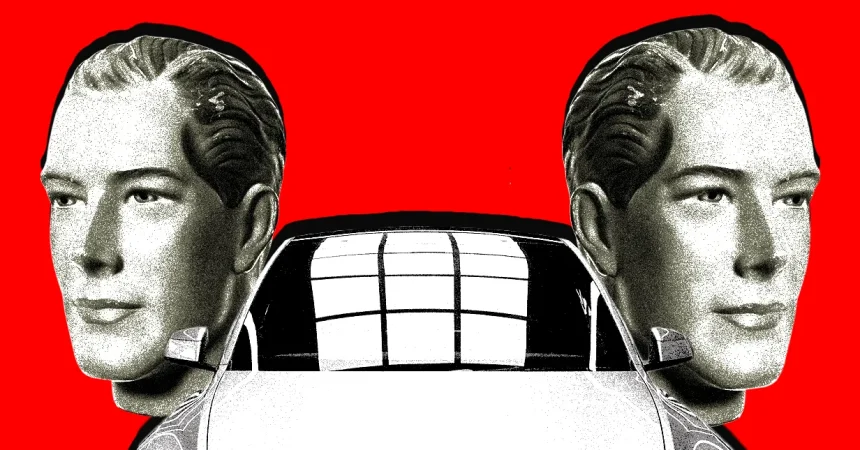
In the fast-evolving world of automotive technology, few things are as polarizing as Tesla’s driver-assistance systems. While these features are designed to serve as a high-tech co-pilot, a bizarre and concerning trend has emerged in China that turns the car’s advanced surveillance against itself. For as little as $30, enterprising Tesla owners online are purchasing tiny, eerily precise replicas of celebrity heads—Dwayne “The Rock” Johnson being a notorious favorite—designed to be suction-cupped to the ceiling or rearview mirror. These figurines aren’t mere dashboard ornaments; they are sophisticated “hacks” meant to mimic the presence of a human driver. Placed with pinpoint accuracy, these mini-heads trick the interior camera into believing the vehicle is being operated by an attentive, flesh-and-blood human, effectively silencing the car’s safety warnings and allowing the actual person behind the wheel to scroll through their phone, eat, or even doze off.
The emergence of these “passenger-bots” has sparked intense curiosity, turning into a digital rabbit hole that reveals a thriving underground culture of circumventing safety protocols. Browsing through platforms like Taobao, Xianyu, and Douyin, one finds dozens of variations ranging from Hollywood stars to local Chinese celebrities, often fashioned from repurposed dolls or custom-molded plastic. For a price point between $10 and $40, these items are sold as “Tesla autopilot assistants,” a term that hides the grave reality of their intended use. It is a striking example of human ingenuity applied to the wrong end of safety; while engineers work tirelessly to ensure the driver stays focused on the road, some owners are exerting just as much effort to ensure they don’t have to.
The effectiveness of these crude mannequins is, shockingly, quite high. One anonymous Tesla Model 3 owner shared his experience of using a bald, somewhat distorted miniature Dwayne Johnson head for over 250 miles of a long trip. Under normal circumstances, a Tesla is hyper-vigilant; it detects a wandering gaze or an empty hand on the steering wheel within seconds, issuing sharp alerts or disabling features entirely if the driver ignores the warning. Yet, with the figurine acting as a decoy for the cabin camera, this driver claimed he could go half an hour without a single interruption. In video footage he provided, the driver was seen filming the road with one hand and snacking with the other, his face completely masked by the plastic surrogate hovering above the rearview mirror, demonstrating how easily a simple physical barrier can bypass a multi-million-dollar surveillance system.
This cat-and-mouse game between manufacturers and drivers highlights the limitations of current driver-assistance technology and the reality of how these tools are actually used in the wild. Even though Tesla’s most advanced “Full Self-Driving (Supervised)” software hasn’t officially launched in China, the existing systems—which support cruise control and autosteer on highways—are not fully autonomous. They are built on the firm agreement that the driver remains the primary supervisor of the vehicle. When the car’s internal sensors detect that the driver is disengaged, it is meant to trigger a fail-safe. However, the driver community has turned this into a challenge, sharing tips on forums about the “ideal size” of these toys—often comparing them to ping-pong balls to ensure the camera’s focal length registers a human shape rather than a blurry blob.
Tesla’s response to such DIY meddling is firm, yet it faces the eternal struggle of keeping pace with internet-driven workarounds. The company’s policy is clear: if a driver fails to pay attention, the system can revoke access to driver-assistance features for up to a week, acting as a digital “timeout” for those who abuse the tech. Despite these penalties, the urge to exploit the system remains strong, not just in China but globally. From wearing specially tinted glasses to confuse gaze-tracking sensors, to attaching weights to steering wheels to simulate the sensation of a human grip, the history of Tesla’s Autopilot is littered with stories of users trying to outsmart the very guardrails meant to keep them alive.
Ultimately, these stories serve as a sobering reminder of the gap between convenience and safety. While an extra hour of rest on a long commute might be the immediate, selfish benefit for the individual driver, the societal cost is far higher. These “Dwayne Johnson” decoys are a playful facade for a dangerous reality: that software, no matter how advanced, is only as safe as the human behind it. When the driver becomes the target of a scam they’ve perpetrated on their own car, the technology ceases to be an asset for traffic safety and instead becomes an invitation to catastrophe. It’s a strange, modern-day cautionary tale where artificial intelligence is successfully duped by a $30 doll’s head, proving that while we can build smarter cars, we have yet to fully account for the unpredictability of human habits.