The spectacle of a UFC event on the White House lawn—complete with the garish, high-octane branding of Monster Energy—feels like the ultimate synthesis of Donald Trump’s lifelong aesthetic. It is a collision of worlds where pro-wrestling bravado meets the highest office in the land, a move that feels entirely on-brand for a former casino impresario who has always favored spectacle over subtlety. Yet, there is a strange irony in the lead-up to this event. Despite the grandiose promises and the Herculean efforts to frame this as an epoch-defining moment in American history, the reality of the card itself has struggled to live up to the bombastic marketing. It is a curious attempt to merge the dignity of the executive branch with the blood-and-guts theater of cage fighting, a move that has left many observers wondering if the “most historic sporting event in history” is perhaps trying a bit too hard to reinvent the reality.
The hype machine behind the event has been operating at full capacity, with UFC CEO Dana White promising viewers a transformative experience. From the outside, however, the event looks less like a historic milestone and more like a standard pay-per-view card simply relocated to a more exclusive piece of real estate. The irony is palpable: while the promotion insists on its unique, world-altering significance, the actual lineup of fighters—while professional and skilled—doesn’t fundamentally differ from any other high-end MMA card. By attempting to marry the White House’s historical gravitas with the raw, chaotic energy of the octagon, the organizers have created an atmosphere that feels less like a state occasion and more like an elaborate, expensive brand activation trapped within the constraints of American political tradition.
Adding to the surreal nature of the proceedings, figures like Marco Rubio have taken to the stage to offer historical interpretations that border on the absurd. Comparing the founding of the UFC to the moon landing is a reach that defies not only logic but also the well-documented history of mixed martial arts. The UFC was born from a specific niche of Brazilian jiu-jitsu and international wrestling traditions, yet the political rhetoric surrounding the event seeks to frame it as a uniquely American invention born of distinct national virtues. This revisionist history seems less about accuracy and more about political performance art. When diplomacy and sports-marketing merge, it creates a strange, unsettled middle ground where the facts of the sport’s lineage are sacrificed to fit a larger, more patriotic narrative that feels increasingly performative.
Even the partnerships underlying this move raise awkward questions about the limits of the White House’s influence in the world of global combat sports. The administration’s attempt to weave the UFC into the fabric of “sports diplomacy” glosses over the complicated reality of who the sport often courts and empowers. From the long-standing questions regarding ties to figures like Chechen warlord Ramzan Kadyrov to the nature of the sport itself, the relationship between the octagon and the state is fraught with contradictions. Dana White remains at the center of this storm, a man who has managed to brand human concussion-delivery systems like “Power Slap” as innovation, all while navigating his own personal scandals. He is, in many ways, the perfect face for this spectacle: a master of generating noise in an industry where, for better or worse, noise is the primary commodity.
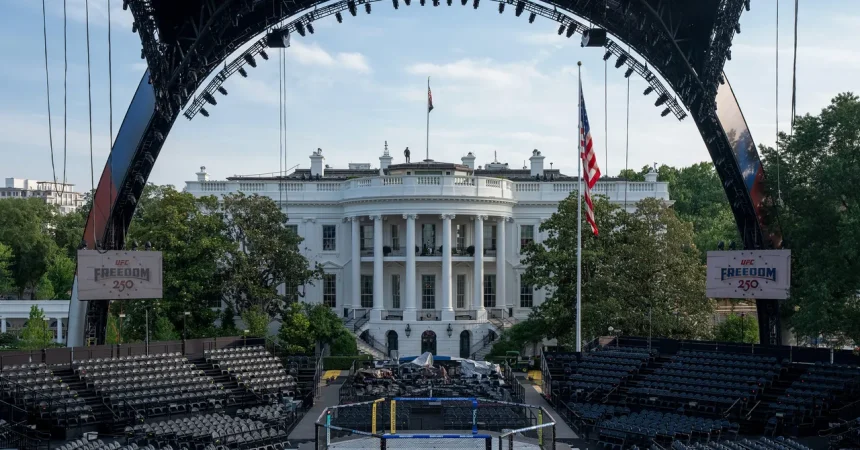
The expectations being set for viewership levels also highlight a disconnect between the promoter’s ego and the public’s reality. By invoking “Super Bowl-type numbers,” the organizers are chasing a level of cultural penetration that MMA, even at its absolute peak, simply hasn’t achieved. While Netflix might capture millions of screens, the gap between the reach of a specialized combat sport and a true, national-cultural monolith like the Super Bowl remains a chasm. There is a inherent tension in the way this event is being sold—it is a niche product being marketed as a mandatory American ritual. By dumping the visual clutter of a Las Vegas warehouse onto the manicured landscape of the South Lawn, the organizers have created a juxtaposition that is striking to look at, but perhaps fundamentally confused about what it is actually celebrating.
Ultimately, “UFC Freedom 250” will likely be a perfectly serviceable night of combat sports, provided the viewer is a fan of the technical grind of the octagon. The main event, featuring Ilia Topuria and Justin Gaethje, promises legitimate, high-level competition that any fight fan would appreciate. However, when the dust settles and the fighters leave the Oval Office entrance, the reality remains: this is a solid sporting event being asked to carry the weight of a monumental historical performance. It lacks the broad appeal to captivate the entire nation, and it lacks the nuance to justify its own self-serious hype. It is a bizarre, high-priced experiment in branding, serving as a reminder that in modern American life, the line between governance and entertainment has not just blurred—it has effectively disintegrated.