The landscape of global wealth has been fundamentally altered as Elon Musk has officially achieved a milestone once thought to be purely hypothetical: the status of the world’s first trillionaire. This unprecedented escalation in his personal fortune follows the highly anticipated public debut of his aerospace titan, SpaceX, on the Nasdaq exchange. As shares soared shortly after the opening bell, the company’s market capitalization surged past the $2 trillion mark, a staggering figure that effectively cemented Musk’s dominance at the pinnacle of the financial world. While the global economy is home to thousands of billionaires, Musk now stands alone in a category of his own, leaving even the most successful tech moguls of our time in his rearview mirror.
To understand how someone accumulates such a vast sum, it is necessary to move past the image of a bank account stuffed with liquid cash. Musk’s wealth is not sitting in a vault; it is almost entirely tethered to his ownership stakes in high-growth enterprises like Tesla and SpaceX. In just the last two years, his net worth has seen a meteoric rise, tripling to surpass the $400 billion mark before the SpaceX IPO provided the final boost to push him over the trillion-dollar threshold. Despite the sheer scale of these numbers, it is important to remember that these are paper gains. Much of this equity is subject to market fluctuations and restricted selling agreements, and Musk himself has publically pledged to eventually donate half of his fortune to philanthropic efforts.
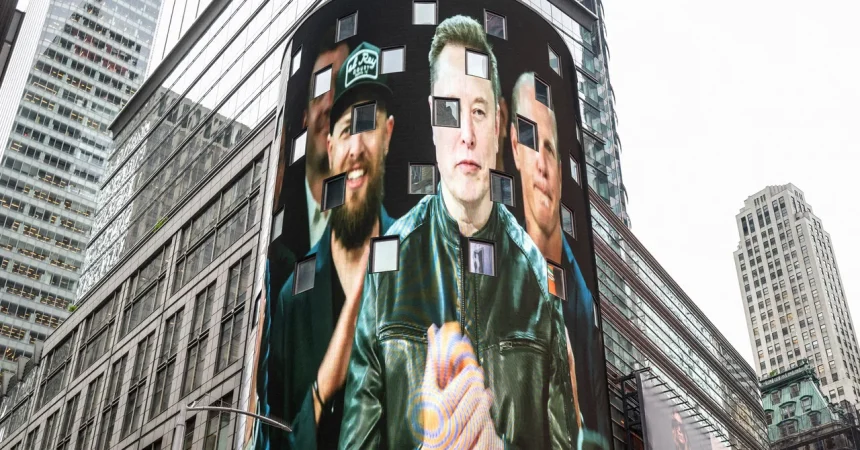
The rise of the world’s first trillionaire is not without deep social and political controversy. Musk remains a polarizing force whose influence extends far beyond balance sheets and stock prices. His active efforts to restructure the inner workings of the U.S. government, combined with his unfiltered and often combative presence on X (formerly Twitter), have earned him significant backlash. Critics frequently point to the proliferation of extremist rhetoric on his platform as a stain on his legacy, and the response to his new wealth has been visceral; in New York City’s Times Square, public demonstrations—including the inflation of a giant, mocking effigy—have highlighted the tension between his massive financial success and his frequently criticized public conduct.
It is worth noting that while Musk is currently the sole occupant of this financial stratosphere, the broader ecosystem of the ultra-wealthy remains crowded. Forbes and Bloomberg continue to track roughly 3,350 billionaires, a range that spans from titans like Jeff Bezos to cultural icons like Dr. Dre. However, the gap remains cavernous. Musk is currently more than three times wealthier than the founders of Google, and while upcoming IPOs from high-profile AI labs like OpenAI and Anthropic are expected to mint new billionaires, none are projected to come anywhere near his orbit. The scale of the wealth he controls is now comparable to the GDP of entire nations, shifting the conversation from individual achievement to the implications of such concentrated, singular power.
There is also a growing disconnect between the high-flying world of space exploration and the realities faced by average people on the ground. Wealth creation on this scale often ignores the “externalities” that come with industrial expansion. While retail investors may dream of catching a ride on the SpaceX wave, the financial reality remains that significant gains are rarely found in the frenzy of post-IPO trading. Meanwhile, the environmental realities of Musk’s xAI project—such as the massive, energy-sapping data centers rising in communities—remind us that the cost of such progress is often externalized to local residents who see little benefit from the billionaire’s soaring net worth.
As we look toward the future, it is clear that Musk’s reign at the top is not merely a matter of capital, but of a lack of competition. As long as SpaceX maintains its monopoly on ferrying cargo, data, and passengers into orbit with little interference from rival companies, its valuation will likely remain unassailable. Elon Musk has turned the pursuit of wealth into an exercise in vertical integration, controlling the infrastructure of the future across multiple domains. Whether this singular concentration of wealth is a sign of human ingenuity or a commentary on the lopsided nature of our modern economic system remains the defining question of his era. For now, he remains, quite literally, in a league of his own.