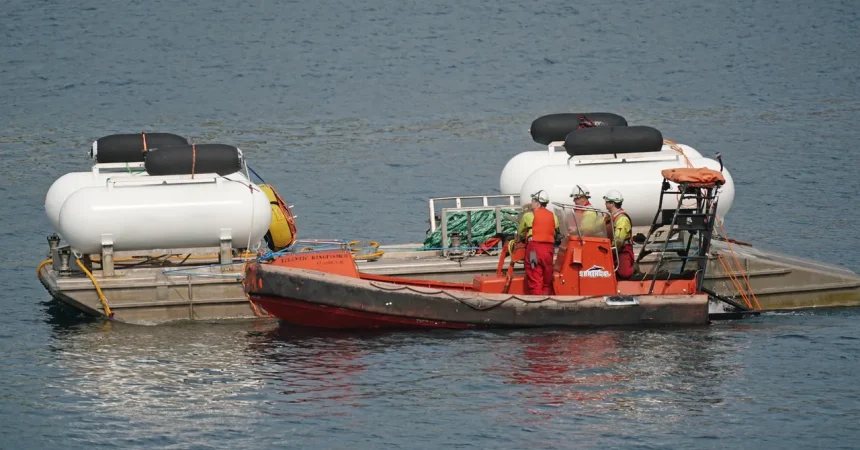
The tragic implosion of the Titan submersible in 2023 was not merely a mechanical failure; it was a systemic catastrophe born from administrative paralysis. A recent, scathing report from Canada’s Transportation Safety Board (TSB) exposes how OceanGate’s experimental vessel was allowed to operate in Canadian waters for years without being registered, flagged, or certified. TSB chair Yoan Marier hit the nail on the head, noting that while fragmented pieces of information existed across various federal agencies, there was a complete lack of accountability to “connect the dots.” Because no single authority took ownership of the situation, the Titan existed in a regulatory blind spot, effectively shielded from the oversight that might have prevented its doomed expedition to the Titanic wreckage.
The saga began with a paradox of bureaucratic confusion. Early on, OceanGate managed to entangle itself with government entities, even securing a tentative $25,000 research grant from Fisheries and Oceans Canada. Yet, when the company attempted to move forward, Global Affairs Canada blocked their research permit after OceanGate falsely claimed the government would act as a sponsor. This should have been a red flag, but instead of the government scrutinizing the operation’s safety, the interaction remained siloed. While the company was being investigated for permit inaccuracies, the fundamental question of whether the vehicle itself was fit for human cargo was never prioritized by the departments in charge.
The tension of this regulatory vacuum was felt most acutely by the passengers caught in the middle. During a failed 2021 voyage, the Titan suffered a structural setback, prompting the recovery vessel to return to St. John’s under a cloud of uncertainty. Rather than being met with safety inspectors concerned about the integrity of the carbon-fiber vessel, the passengers were swarmed by armed officers from the Canada Border Security Agency. The interrogation, which focused on Covid-19 protocols and paperwork rather than the life-or-death risks of the submersible, left passengers feeling intimidated and alienated. As lawyer David Concannon observed, the authorities were interested in customs duties and logistics, but they had “zero interest” in the sub itself.
The report reveals that this indifference was not an oversight, but a product of departmental mandate. Transport Canada, the agency ostensibly responsible for marine safety, essentially washed its hands of the Titan by classifying it as “cargo” rather than a vessel. By categorizing the submersible as equipment attached to a support ship, they bypassed their own jurisdictional duty to inspect its construction, insurance, and certification. This semantic loophole allowed OceanGate to skirt the rigorous safety requirements that govern maritime travel. The result was a chilling institutional apathy: the authorities were satisfied as long as the import paperwork was filed correctly, regardless of the fact that people were risking their lives in a vessel that had never been approved by a single regulatory body.
Communication failures were rampant and, ultimately, lethal. Even when researchers from Fisheries and Oceans Canada boarded the Titan and explicitly reported back that the vessel lacked insurance and certification, that critical information vanished into the bureaucratic ether. It never reached the marine safety regulators who had the power to shut the operation down. Over time, OceanGate interacted with at least ten different federal agencies—including the RCMP and the Department of National Defense—yet not one of these interactions triggered a unified safety review. Each department viewed OceanGate through a narrow, specialized lens, failing to recognize that they were all collectively hosting a dangerous, unverified experiment.
Ultimately, the Titan’s story is a sobering lesson on the dangers of “distributed responsibility.” When everyone is tasked with a small piece of the puzzle, but no one is tasked with the picture as a whole, disaster becomes not a possibility, but an inevitability. The TSB report serves as a harsh indictment of a system that prioritized administrative convenience and jurisdictional boundaries over human life. By treating the Titan as a piece of cargo rather than a manned vessel, the Canadian regulatory framework essentially invited the disaster to happen. The tragedy of the Titan is not just that a company dared to build an unsafe sub, but that a modern government, despite having the intel, systematically failed to stop them.