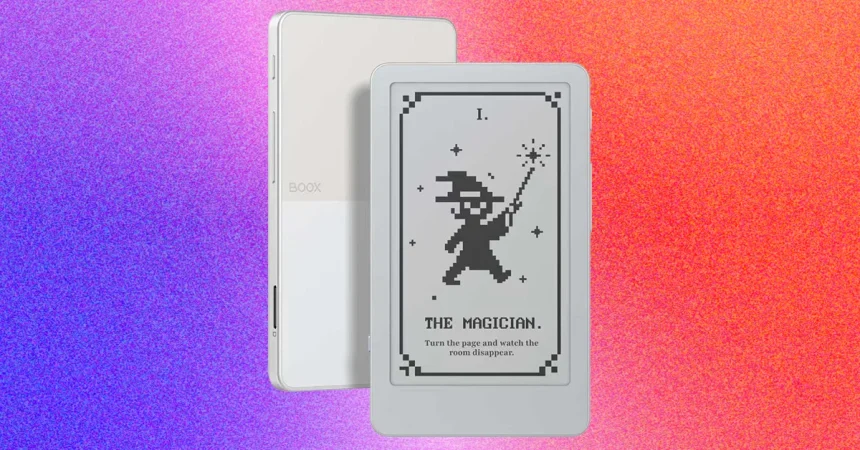
In an era defined by supersized displays, where smartphones continue to balloon into foldable phablets and tablets blur the line with laptops, there is a quiet counter-revolution happening in the world of e-readers. While our primary communication devices grow ever larger to accommodate streaming, gaming, and productivity, the humble e-reader is shrinking, carving out a niche for those who crave distraction-free text in the palm of their hand. Boox has been the standard-bearer for this movement, having found surprising success with its Palma line—a device that essentially looks like a sleek smartphone but runs on e-ink. Now, the company is doubling down on the concept of extreme miniaturization with its latest announcement: the Boox Picco. Preorders opened today, and this new device takes the “pocketable” philosophy to an almost absurdly charming extreme. Its screen measures just under four inches—3.97 inches to be exact—making it roughly the size of a playing card. That places it significantly smaller than the 4.3-inch Xteink X4 Pro I tested earlier this year, and it’s a veritable dwarf compared to the upcoming Boox Palma 3, which sports a comparatively gigantic 6.19-inch display. The Picco will retail for a very accessible $100 and is expected to ship in November, putting it squarely in the impulse-buy territory for tech enthusiasts and bookworms alike.
Let’s get into the physical hardware, because that’s where the Picco immediately makes its case. The device features a monochrome e-ink screen with a resolution of 235 pixels per inch. Now, 235 ppi isn’t going to compete with the retina-grade displays on modern phones, but for e-ink technology, it’s entirely sufficient for crisp, comfortable text rendering—think of the clarity you get from a standard paperback page. The front light is adjustable, offering a spectrum from warm to cool tones, which is an absolute necessity for reading in bed without disturbing a partner or for navigating a bright, sunlit park. One of the most intriguing specs is the inclusion of a microSD card slot that supports up to a staggering 2 terabytes of storage. While a 16GB card comes included, the thought of 2TB of e-books on a device the size of a credit card is almost comical—you could carry the entire Library of Congress in your pocket without breaking a sweat. For navigation, you get the best of both worlds: a responsive touchscreen for swiping through menus and tapping links, but also physical page-turning buttons mounted on the side. These buttons are a godsend for one-handed reading, allowing you to flip pages without shifting your grip or smudging the screen. The case itself also features a magnetic ring, designed so you can attach the Picco to the back of your smartphone. This is where my curiosity turns into cautious skepticism, because I had mixed results attaching an Xteink to my phone earlier this year—the fit was often awkward, and the magnet strength sometimes felt weak enough that the reader might go flying if I swung my bag too aggressively. The Picco’s smaller size might actually help here, though, as it reduces the overall leverage and weight pulling against the magnetic connection.
However, the physical design is only half the story; the software experience will determine whether the Picco is a delightful gadget or a frustrating gimmick. Boox has confirmed that the Picco will run a streamlined operating system specifically focused on reading and “digital utility tools,” marking it as the first in what they call the “Tiles” lineup. This is a direct and smart response to the clunky, confusing interfaces that plague many small e-readers from lesser-known brands. My experience with the Xteink X4 Pro earlier this year was a perfect example of this problem: the hardware felt great in my hand, but navigating the menu to actually find a book was a chore, and getting content onto the device was a convoluted process. Boox, by contrast, has a much stronger reputation for solid Android-based firmware, and the “Tiles” interface promises a curated grid of apps and functions rather than a bloated, messy desktop. While the Picco won’t have a built-in store like a Kindle or Kobo—you’ll have to sideload your content via Wi-Fi, USB-C file transfer, or the web—it does offer better flexibility for those who have existing libraries of DRM-free e-books. The real kicker, though, is the inclusion of three productivity apps: Pomodoro, Todo, and Countdown. This transforms the Picco from a mere reading device into a genuine focus tool. Imagine clipping it to the back of your phone, flipping it over to start a 25-minute Pomodoro timer while you work, and then turning it back to read a chapter during your break. It’s a tiny, distraction-free dashboard that actively encourages you to put down the phone and pick up a book—or at least a to-do list.
The magnetic attachment is perhaps the most defining and provocative feature of the Picco, as it fundamentally alters how you’ll interact with the device. Boox is betting that you’ll want this e-reader to be as ubiquitous as your phone itself, rather than something you dig out of a bag or a drawer. The concept is simple: stick the Picco to the back of your smartphone, and you have a permanent, second screen that offers a completely different kind of content. When you’re waiting in line at the grocery store, instead of scrolling through social media, you just flip the phone over and start reading a novel. When you’re sitting at your desk, the Picco becomes a tiny dashboard for your daily tasks and a countdown timer to keep you on schedule. It’s a fascinating psychological shift—the e-reader stops being a dedicated piece of equipment you have to remember to carry and becomes an integral extension of the device you never leave home without. However, the practicality hinges entirely on that magnetic ring. My past experience with a similar feature on the Xteink left me unimpressed; the magnet wasn’t strong enough to keep the device securely in place during a walk, and the offset alignment made the combination feel unwieldy in my pocket. I’m eager to see if Boox has engineered a better solution, because if the magnet is strong and the fit is flush, the Picco could genuinely become a daily carry for me.
When we look at the broader market, the Picco’s $100 price point is a masterstroke. It undercuts the larger Boox Palma 3 significantly, and it sits in a sweet spot where it’s affordable enough to be a secondary gadget rather than a primary investment. The competition in this micro-e-reader space is sparse. The Xteink X4 Pro, which I tested, offers a slightly larger 4.3-inch screen but suffers from a subpar user experience, while the even smaller Xteink X3 at 3.7 inches feels far too cramped for serious reading. Boox is stepping into this void with a brand that already commands respect among e-ink enthusiasts, known for their solid build quality and regular software updates. The trade-off, of course, is the lack of a built-in bookstore. Kindle and Kobo users can seamlessly purchase and sync books directly to their devices with a few taps, whereas Picco owners will need to manually transfer files—a process that is certainly not for the casual consumer. Yet, for the tinkerer, the minimalist, or the student who wants a distraction-free study tool that also lets them read their PDFs and textbooks, the Picco offers a compelling alternative. It’s a statement piece for the digital detox crowd: a tiny, focused device that says you’re serious about reducing screen time without abandoning digital convenience entirely.
Ultimately, the Boox Picco is a bold experiment in the philosophy of “less is more.” It challenges the notion that we need bigger screens to have better experiences, proposing instead that the most valuable screen is the one we always have with us—and the one that shows us nothing but the words we want to read. I’m genuinely intrigued to see it in action, to feel how the 3.97-inch display handles a dense novel, and to test whether the magnetic ring holds up to the rigors of daily life. Will it become my go-to reader over my phone? Probably not for long-form reading, where the tiny font might strain the eyes. But as a bedside companion, a commute buddy, or a focused work timer, it has immense potential. Boox’s gamble on the Picco could easily make it the surprise hit of the holiday season, outselling its larger sibling simply by being so charmingly portable and affordable. The success of this device will ultimately come down to the execution of that “Tiles” interface and the reliability of the magnetic attachment. If Boox has nailed those two critical details, the Picco might just become the little gadget that could—a tiny card of calm in a world of oversized, distracting screens. I’ll be putting it through its paces soon, and I’m looking forward to seeing whether this minuscule reader proves that sometimes, the best things really do come in small packages. Stay tuned for my full review, where I’ll dig into the battery life, the reading experience, and whether it can truly replace my habit of pulling out my phone every time I have a spare moment.