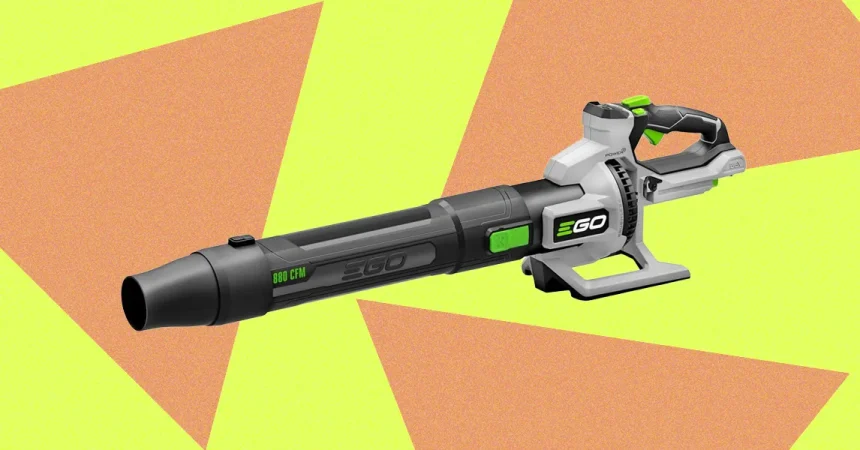
I’ll be honest: buying a leaf blower can feel less like shopping and more like deciphering a secret language written in volts, amp-hours, and cubic feet per minute. When I’m looking for a blower for leaf cleanup, the first thing I try to do is ignore the marketing noise and focus on what actually matters in real life. Voltage is where most of the shouting happens, and it’s easy to assume that an 80-volt blower must be twice as good as a 40-volt one. But that’s not really how it works. In the cordless power-tool world, an advertised “20-volt max” battery is essentially the same as an 18-volt battery—it’s just a different way of measuring the same nominal voltage. The same goes for 36-volt and 40-volt systems. So when you see a blower boasting a higher number, take it with a grain of salt. Unless you’re someone who wants one battery to power everything from a drill to a leaf blower, you’ll probably be happier with a blower that uses at least a 36-volt battery. That level of power is where cordless blowers start to feel like real alternatives to gas models. There are also some capable 18-volt blowers that use two batteries at once, which mimics the power of a 36-volt tool, or they run one battery after another to extend runtime. Those can be clever solutions, but they tend to cost more, and they only make sense if you already own the batteries and the charger. For smaller jobs, though, a standard single-battery 18- or 20-volt blower might be all you need. Clearing a patio, cleaning out the garage, blowing dust off a workbench, or drying a car after a wash—these are light tasks where a smaller, lighter blower can be perfect. The key is being honest about how you’ll actually use the tool.
Once you stop staring at the voltage number on the box, the next thing to look at is the battery’s amp-hour rating. Think of voltage as the size of the engine and amp-hours as the size of the gas tank. You need both to know how far you can go. A blower can have plenty of voltage, but if the battery is small, it’ll run out of breath quickly. Conversely, a larger battery will give you more runtime, but it will also cost more and add weight to the tool. Most leaf blower kits come with batteries rated from 4 to 8 amp-hours, and that’s a reasonable range for most yards. If you buy a blower as a bare tool and you already own batteries from the same brand, you can choose the capacity that fits the job. If you’re buying a complete kit, it’s worth checking what other battery sizes the manufacturer offers, because you may want to add a higher-capacity battery later for those big fall cleanups. One thing to keep in mind is that higher amp-hour batteries typically take longer to charge. That’s not a dealbreaker, but it does mean you might want two batteries so you can use one while the other charges. I’ve also learned that battery chemistry and age matter more than the number on the label. A brand-new 4-amp-hour battery can outperform an older 6-amp-hour battery that has seen better days. So don’t get too hung up on finding the single perfect battery. Instead, think about the whole system and how it fits into your life. If you already own a drill, a trimmer, or a chainsaw from a particular brand, the smartest move is usually to stay in that brand family and buy the blower as a bare tool. That way you’re not juggling multiple chargers and wall warts, and you can put the money you save toward a better battery.
The biggest mistake I see people make is underestimating the importance of the battery platform. When you buy a cordless leaf blower, you’re not just buying a tool—you’re buying into an entire ecosystem. In my opinion, chasing “the best” blower across different brands is rarely worth the trouble. The performance differences between top models are often small, and whatever gap exists can usually be closed by using a higher-capacity battery. If your garage is already stocked with one brand’s outdoor power equipment, it makes perfect sense to buy that brand’s blower as a bare tool and leverage the batteries you already have. Introducing a whole new battery and charger just to gain a tiny edge in airspeed is almost never a good trade. On the other hand, if you’re new to outdoor power equipment—and a leaf blower is a very common first purchase—you should look at the bigger picture. Some manufacturers stick to the basics: a blower, a mower, a string trimmer, a hedge trimmer. Others offer a much wider range of tools, from log splitters to snow blowers to portable power stations. Before you buy, think about what else you might want to power with that same battery in the coming years. Chances are, leaf cleanup won’t be your only chore. You’ll also want to edge the sidewalk, trim the hedges, or maybe blow snow off the driveway. A battery platform that can grow with you is worth a lot more than a slightly higher CFM number. Traditional 18-volt power-tool manufacturers, the ones known for drills and circular saws, all make leaf blowers that run on the same batteries as their other tools. That’s convenient, but their 18-volt blowers are not powerful enough to replace a gas unit for serious yard work. Ryobi, for example, uses 18-volt batteries across its traditional power tools and some outdoor equipment, but its most capable gas-alternative blowers run on a separate 40-volt platform. So even within the same brand, you might end up with two battery systems if you want both a drill and a serious blower. That’s okay, but it’s worth knowing before you commit.
After you’ve settled the power and battery questions, it’s time to look at the physical design of the blower itself. This is where a lot of people get disappointed, because a blower can look great on paper and still feel awkward in your hand. One of the first things I check is how the tubes connect. A blower has two or more connection points: where the tube meets the housing and where the nozzle attaches to the tube. Look for models with a detent at those junctions—a small, often brightly colored spring-loaded clip that snaps into place with a satisfying click when the parts come together. I’ve found that these detent connections hold much more securely and last longer than simple friction-fit attachments, which can loosen over time and rattle or even blow apart while you’re working. Another feature that has become popular recently is the stubby nozzle. These short tubes, usually only three to six inches long, were originally designed for car detailers who wanted to blow water out of crevices without a long wand getting in the way. The main blower attachment slides right over the stubby nozzle, so when you remove the long tube, you have a compact tool that’s much easier to maneuver around vehicles, under decks, or in tight corners. The trade-off is that the narrow nozzle doesn’t fit on the stubby tube, so you lose some air velocity. But for detail work and tight spaces, that shorter reach is a godsend. Weight is another factor that matters more than you might think. Across the board, a good battery-powered blower weighs about 10.5 pounds with the battery attached. If you need something lighter, look for an 18-volt model, but be ready to sacrifice some power. What’s more important than the raw weight is the balance. Some blowers are designed so that when you hold them at your side, the tool stays mostly level or tips slightly forward. Those models are much easier to use for long periods because you don’t have to fight to keep the nozzle up. The best ones let you make a slight twisting motion with your wrist to spread the stream of air, rather than requiring a constant awkward lift. Modern battery blowers also draw air in a straight line through the rear of the tool, unlike older gas models with air intakes on the side. Those offset intakes could create a twisting force that tired out your hand and even sucked in your pant leg. It’s a small detail, but it makes a huge difference in comfort.
Now let’s talk about the numbers that everyone loves to quote: CFM, MPH, and Newtons. It might sound counterintuitive, especially with so much marketing built around these specs, but I treat them as a guide rather than the final word. Cubic feet per minute tells you how much air the blower moves, while miles per hour tells you how fast that air is traveling. You need both to get the job done. A high CFM with low MPH will move a lot of air but won’t be able to dislodge wet, stuck leaves. A high MPH with low CFM will blow a powerful stream but only in a narrow path, so you’ll be sweeping back and forth forever. The problem is that there’s no universally accepted testing method for these specs when it comes to battery-powered blowers. The standard test that exists, ANSI/OPEI B175.2, applies only to gas-powered machines. That means each brand can test its blowers differently. Some measure MPH where the motor meets the tube, rather than at the end of the nozzle, which gives you a better idea of the actual airspeed you’ll feel in your hand. Others report CFM numbers measured in boost mode or turbo mode, rather than on the normal high setting you’d use most of the time. So two blowers with identical spec sheets can feel completely different in real-world use. Newtons, which measure force, are showing up more often on higher-voltage cordless blowers, and they’re probably the best apples-to-apples comparison we have for blowing power. But because there’s no testing standard for battery blowers, reporting Newtons is optional, and consumers have no way of knowing if the test was done consistently. A good midrange blower will produce around 20 Newtons, and models that produce more are generally higher-performing. Still, I treat Newtons as a rough indicator, not a guarantee. The best approach is to read reviews, watch videos, and if possible, try the blower in a store before you buy. Specs are useful, but they don’t capture the feel of the trigger, the sound of the motor, or how well the air actually moves leaves on a damp autumn morning.
Finally, there are the little extras that can be nice to have but shouldn’t be deciding factors. Some blowers come with a wide-tip nozzle that you can attach for clearing paved surfaces like patios and driveways, or for blowing water off a flat surface. I’ve used these, and they do work, but they’re not the game-changer that some marketing suggests. In practice, you’ll probably spend most of your time with the standard narrow nozzle, and if you need a wider air pattern, you can simply twist your hand back and forth to spread the stream. It’s not hard, and it doesn’t take much extra effort. The same goes for variable-speed triggers and cruise-control settings. Those are genuinely useful, but they’re so common now that they almost go without saying. What matters more is how the controls feel. Is the trigger easy to hold for long periods? Does the speed dial click into place or feel flimsy? Is the battery easy to slide in and out? These are the things that make a blower a joy to use or a frustrating tool that sits in the corner of the garage. At the end of the day, buying a leaf blower is about making your life easier. You want something that starts instantly, runs long enough to finish the job, and doesn’t leave your arms aching. You don’t need the absolute highest numbers on the spec sheet. You need a tool that fits your yard, your hands, and your existing battery collection. If you pay attention to voltage and amp-hours, choose a battery platform that makes sense for the future, and don’t get swept away by marketing hype, you’ll end up with a blower that serves you well for years. And that’s a lot more satisfying than winning an argument about CFM at a backyard barbecue.