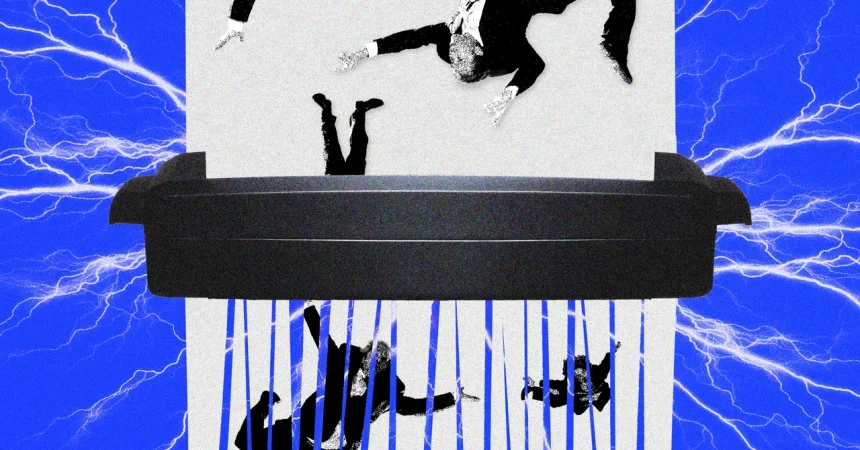
AT&T is stepping into one of the most profound transformations in its 150-year history, and the human cost is unmistakable. The telecommunications giant, which has already eliminated more than half of its workforce over the past decade, says it will keep cutting jobs as it prepares for an era defined by artificial intelligence. The company is also dismantling its old copper landline infrastructure floating on tradition and memory, while deploying AI to automate internal operations and customer-facing services. For the people inside AT&T, this means an unsettling future. There are nearly 131,000 employees today, and they can hear leadership’s message clearly: the company will not look the same in five years. Jeremy Legg, AT&T’s chief technology officer, put it bluntly. “We’re not going to have the same headcount in five years as we do today,” he told WIRED. Legg also pointed to a tangible benefit of the downsizing: a significant drop in electricity usage. That sounds efficient on paper, but for workers, it means uncertainty, realigned roles, and the quiet fear that their jobs are being designed out of existence. AT&T is not shrinking accidentally; it is shrinking strategically, aligning itself with the belief that fewer humans and smarter systems will make it more nimble, more profitable, and better equipped for the AI-powered future.
The financial pressure driving these decisions is real, and it is visible in AT&T’s own public disclosures. Last year, the company generated less revenue per employee than its chief competitors, Verizon and T-Mobile, both of which have also shed workers in recent months. That gap is an uncomfortable fact for executives who are judged on efficiency and shareholder returns. So the cuts are not just about technology replacing jobs; they are about matching the productivity metrics of rivals. AT&T cut around 8,000 people last year, and if it continues at that pace, its workforce could shrink to roughly 85,000 by 2030. A person close to the company described that figure as an internal target, although AT&T publicly called the number inaccurate. In the first half of this year alone, the company has already cut about 2,100 jobs. These are not just statistical reductions; each number represents a person with a mortgage, a family, a personal story. Meanwhile, CEO John Stankey is looking ahead to a leaner, bolder company, one he described at the Goldman Sachs Communacopia + Technology Conference as “dramatically different” and defined by a “fantastic” fiber internet service and a “kickass wireless network.” The language is confident and almost swaggering, but behind it is a painful reality: AT&T is trying to reinvent itself without allowing legacy sentiment to slow it down.
What makes this transition so significant is that AT&T is not a small startup experimenting with novelty. It is a 150-year-old institution deeply woven into the global economyisha. Legg says the company carries about 15 percent of the world’s internet traffic. That staggering responsibility sits atop systems that are decades old, some of which still depend on paper records and manual tasks. For example, when a customer wants to disconnect a phone line, the process has traditionally involved human agents shuffling files and navigating old databases. Much of that work is now being automatedched. The company is using AI for customer service, to locate the best sites for new cell towers, and to detect maintenance issues on existing infrastructure. A generative AI system called GeoModeler can adjust network settings in real time during rare events like extreme weather, protecting connectivity when it matters most. AT&T is also using AI to write software code and troubleshoot service issues. But the push toward innovation collides with the human element. For every automated process, there are employees wondering whether their expertise is still valued. The challenge is whether AT&T can truly innovate while cutting costs and, at the same time, keep up with the likes of Elon Musk and other bold actors in the tech world. There is a certain romance in reinvention, but there is also a weight to knowing that the old ways are being left behind, and with them, the people who kept the system alive.
The next phase of AT&T’s reorganization begins in earnest next year. The company plans to replace physical hardware at thousands of central hubs with cloud software from an Israeli startup called DriveNets, a company in which AT&T has invested. This is a major architectural shift. Instead of sending technicians out to physically adjust equipment, AT&T will be able to make changes remotely, in seconds, from a screen. Imagine a customer asking for faster internet; someday, that request won’t require a truck roll, just a few keystrokes. This kind of efficiency is seductive, especially to investors looking for signs that a legacy business can become an agile software company. But it also means that many roles, especially middle management and junior developer positions, are expected to vanish. These are often the jobs that help people begin careers in technology, the stepping stones to something bigger. Their disappearance will not be an abstract policy issue. It will be felt in the communities where AT&T has long been one of the largest employers, where a job at the phone company was once a ticket to a stable, middle-class life. There is nothing inevitable about this on a human level. The same technology can be used to enrich jobs, rather than simply eliminate them. But AT&T’s public strategy focuses on doing more with less, and that necessarily changes the relationship between the company and its workforce.
AT&T is also walking away from one of the most iconic pieces of twentieth-century infrastructure: the copper wire network that carried landline telephone calls and DSL internet for generations. This network is energy-intensive to operate, expensive to maintain, and increasingly viewed as a relic in an era of fiber optics and wireless services. Decommissioning copper is not as simple as cutting a cord. It requires approval from state and federal regulators because rural communities, in particular, may have no viable alternatives if the copper disappears. Local residents have protested in places where they feel abandoned by the company, fearing they will be left behind in the digital age. AT&T has tried to balance its business needs with public obligations, but the momentum toward decommissioning is clear. By the end of this year, AT&T expects that more than 85 percent of its existing footprint will no longer need to offer copper services. This shift saves energy and reduces costs, but it also signals the end of an era. For decades, the copper wire was the lifeline that connected people in hurricanes, in blackouts, in quiet rural homes where the only contact with the outside world came through a dial tone. The physical network is more than copper and plastic; it is a trust built over time. As it disappears, something intangible is lost, even as new, faster forms of connection take its place.
In the end, AT&T’s story is not just about a company making calculated bets on artificial intelligence. It is a reflection of what many legacy institutions are going through as AI reshapes work, technology, and expectations. For 25 years, telecom employment has been declining, but the arrival of powerful new tools has accelerated the trend and captured the imagination of investors who want to see costs fall and profits climb. AT&T’s leaders insist the company is heading toward a future that is more efficient, more capable, and more resilient. They see the elimination of manual processes and the retirement of old network gear as necessary steps forward. But the human dimension cannot be ignored. The employees who answered calls, climbed poles, maintained wires, and built the network are the reason AT&T has survived for 150 years. The communities that relied on its services and the technicians who stood by during storms and outages deserve more than a corporate catchphrase about being “dramatically different.” The real test of AT&T’s transformation will be whether it can balance the efficiencies of AI with a genuine commitment to the people who make its network human. If it succeeds, it may become a model for other companies navigating the same uncertain path. If it fails, it will be remembered as another business that chose productivity over people, progress over compassion. The future of AT&T, and the broader telecom industry, is being written now, and the fullest summary of that change is found in the lives of those who are both shaped by it and left holding the dial tone as it fades.