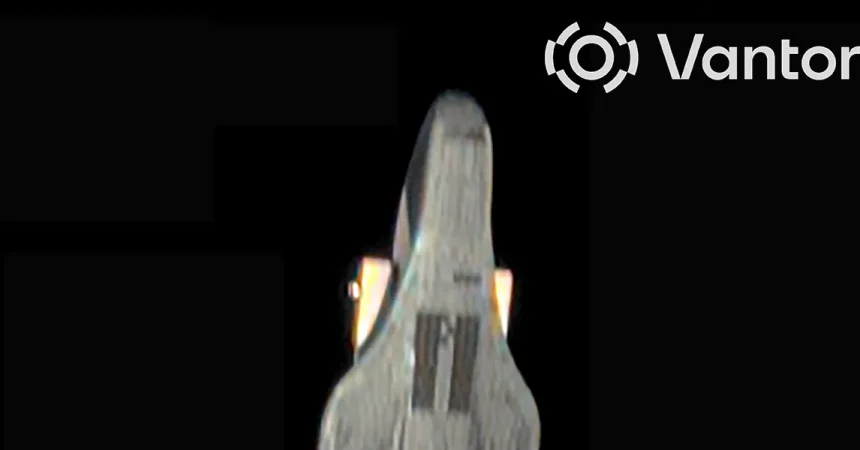
For years, the only thing we knew about China’s secretive spaceplane was that it existed. It was a rumor, a blip on tracking radars, a mystery moving silently through low-Earth orbit. Then, in 2024, a commercial satellite operated by a U.S.-owned company happened to pass close enough to snap a picture. Now, after months of speculation and bureaucratic delay, the public finally has the image. The photograph reveals a small winged vehicle that looks, at least at first glance, like a near twin of the United States military’s X-37B spaceplane. The same delta wings, the same stubby body, the same dark heat shield—the resemblance is striking. The company that took the picture, Vantor, was known as Maxar at the time, and it is one of several private firms that supply reconnaissance imagery to the Pentagon and U.S. intelligence agencies. These satellites are designed to photograph the ground, but occasionally they point their instruments upward, catching other spacecraft in the cold, silent void. The image was finally released in an unclassified report from the Defense Intelligence Agency, a routine-looking document about threats to U.S. interests in space, but with this one photograph embedded inside it, the document suddenly became a public window into one of China’s most closely guarded military projects.
The design of the Chinese spaceplane is hard to misread. It has a pair of delta wings, a shallow payload bay, and a dark thermal heat shield across its underside—the kind a vehicle needs to survive the scorching heat of reentry. Behind the main body sits a cylindrical service module, studded with solar panels to generate electricity once the craft reaches orbit. In broad terms, it is essentially a miniature, unpiloted version of NASA’s old Space Shuttle, but with a cleaner, more modern profile and an unmistakable family resemblance to the X-37B flown by the U.S. Space Force. That is no coincidence. For decades, the United States has been the only country operating a reusable, runway-landing military spaceplane. China, after years of incremental progress, has fielded its own. The photograph puts that achievement on full display, showing a vehicle that has clearly been engineered to do many of the same things in orbit that the X-37B can do. The imagery also demonstrates something else: the era of hiding spacecraft in the dark is fading. Commercial satellite companies can now find and photograph objects more than a thousand miles away, and any nation that operates secretive space hardware has to accept that there are eyes beyond their own military sensors.
The road to this photograph involved more than just a lucky sighting. Lower-resolution images of the Chinese spaceplane had been available before, enough to show the general shape of the vehicle, but not enough to reveal its details. At a 2024 conference in South Korea, a U.S. Space Force official mentioned that Maxar’s satellite had observed the Chinese craft, sparking quiet interest among space watchers and defense analysts. Yet the Pentagon did not release the full-resolution image at that time. It stayed in government hands, stamped with classification markings and shared only within intelligence channels. That changed on Monday, when the Defense Intelligence Agency published its annual or periodic assessment of threats in space, an unclassified document intended to inform Congress and the public about emerging capabilities. For reasons the DIA did not explain, the photograph was included. Perhaps it was meant to signal confidence in American intelligence collection. Perhaps it was a subtle message to Beijing that nothing China puts into orbit goes unobserved. Either way, the release was a rare public glimpse of a Chinese military space system in action. The image itself did not come with a caption explaining every panel and antenna, but it did not need to. To anyone familiar with the X-37B, the message was obvious: China has arrived on the reusable spaceplane scene.
What the Chinese spaceplane actually does up there remains largely unknown. The DIA report, for all its value in releasing the image, did not offer many new secrets about the vehicle’s mission. What is known is that China has launched the spaceplane four times since 2020, with missions lasting as long as nine months. The fourth mission lifted off in February 2024 and was still in orbit when the image was taken and when the report finally reached the public. It is not clear whether China has built one spaceplane and flown it over and over again, or whether it has a small fleet of identical craft. Each flight begins the same way: the spaceplane is tucked inside the nose cone of a conventional rocket, launched into orbit, and then operates as an independent satellite. Its wings are useless in the vacuum of space, but they are essential for the end of the mission, when the vehicle fires its engines to drop out of orbit, reenters Earth’s atmosphere with its heat shield facing forward, and then glides down to a landing on an airport runway, entirely without a pilot. Ground crews then inspect it, refurbish it, and prepare it for the next flight. This approach is fundamentally different from disposable satellites. A spaceplane can be repaired, upgraded, and reused, which makes it more flexible and more puzzling to outside observers.
The comparison with the X-37B makes the situation feel almost like a chess match conducted in orbit. The U.S. Space Force operates two X-37B vehicles, and together they have completed eight missions to date. The longest lasted about two and a half years, a marathon of a flight that gave the military plenty of time to test experiments and evaluate new technologies under the harsh conditions of space. Unlike China, the United States has released photographs of its own spaceplane, along with basic information about its dimensions, its design, and some of the experiments it carries. But much of what the X-37B does remains classified, and the military has never been eager to explain every maneuver. The vehicles are small, roughly the length of a city bus, and they behave in ways that traditional satellites do not. They can change orbits, loiter at higher altitudes, and try out new sensors or communications gear before coming back to Earth. The DIA report notes that spaceplanes have “enhanced maneuverability” that makes them more suitable than regular satellites for certain kinds of missions. What those missions are is left ambiguous, but the phrase is an admission that reusable spacecraft represent a different class of capability. So far, the Chinese vehicle appears to have flown only in low-Earth orbit, at altitudes of a few hundred miles. The X-37B, by contrast, has gone much higher. One of its flights reached more than 24,000 miles above the planet and then used a technique called aerobraking—dragging itself through the thin outer atmosphere—to change its orbit before reentering for a runway landing. That kind of versatility is exactly what makes spaceplanes so interesting and so hard to categorize.
At the heart of this story is a simple but profound shift in the nature of space. For much of the space age, satellites were smart but disposable machines. Once they ran out of fuel or failed, they were done. Spaceplanes are different. They come home, they are repaired, and they fly again. The fact that both the United States and China now operate such vehicles, and that the two designs look so similar, says a great deal about how military planners think about space in the twenty-first century. The Chinese vehicle was photographed by an American commercial satellite and later revealed in an unclassified report, which means that the encounter was not just a technical achievement but also a piece of geopolitical theater. By releasing the image, the Pentagon was making a quiet point: we are watching, we can see through your secrecy, and we want you to know it. The photograph does not carry weapons or threaten anyone directly. It is simply a picture of a machine in orbit. But in the eyes of the intelligence community, it is as valuable as any intercepted message. It tells analysts that China’s program is mature enough to produce a spaceplane that looks and behaves like the X-37B, and it tells the world that the competition for the upper frontier is no longer about just rockets and satellites. It is now also about reusable vehicles that can maneuver, loiter, and return, carrying their secrets down to a runway and starting all over again. What those secrets are, we still do not know. But the image makes one thing clear: the mystery above our heads is getting closer, more personal, and more human than ever before.