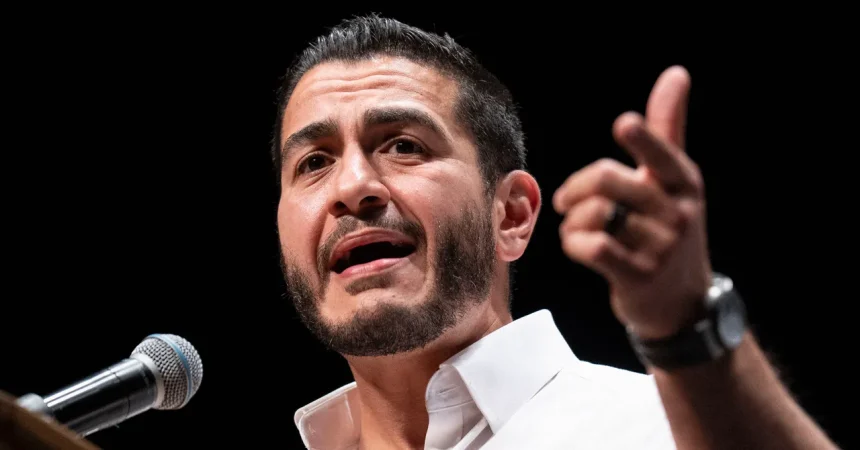
Michigan is currently serving as an unintended epicenter for two distinct, yet interconnected, public health crises that are rattling the nerves of Americans. In the span of just a few weeks, residents have grappled with some of the most dangerous air quality levels on the planet due to drifting Canadian wildfire smoke, while simultaneously navigating a frustrating spike in cyclosporiasis—a parasitic infection often linked to contaminated produce. For senatorial candidate Dr. Abdul El-Sayed, these aren’t just abstract policy issues; they are visceral, daily reminders of what happens when the infrastructure designed to protect public well-being is systematically dismantled. As a physician, researcher, and former Detroit health director, El-Sayed views these crises as an urgent wake-up call for voters to reconsider how government investment impacts their kitchen tables and their ability to breathe freely.
The conversation around food safety, in particular, has become a blunt-force argument for the necessity of government oversight. Discussing the recent outbreaks of “poop lettuce,” El-Sayed cuts through bureaucratic jargon to highlight the real-world consequences of downsizing the federal labs responsible for monitoring food cleanliness. He points to the recent defunding of these essential services—often driven by misguided efforts to cut government “inefficiency”—as the direct cause of our current predicament. When agencies that test for pathogens are stripped of their resources, the burden of safety shifts unfairly onto the consumer, who is left to “dodge” contaminated products or pay the price with days of debilitating illness. To El-Sayed, this isn’t just a regulatory failure; it’s a standard of living failure that we have been conditioned to accept as normal.
El-Sayed’s campaign for Michigan’s open Senate seat has gained significant momentum, bolstered by high-profile endorsements from progressive heavyweights like Bernie Sanders, Alexandria Ocasio-Cortez, and Elizabeth Warren. These figures aren’t just rallying behind his political platform; they are supporting his underlying thesis: that the erosion of public health is a symptom of a political system rigged by special interests and big-money lobbyists. For El-Sayed, the reason our food supply has become compromised is that massive corporations have successfully lobbied to replace rigorous, impartial regulation with self-policing. He challenges the logic of allowing companies to “regulate themselves” when they have proven unable to keep basic contaminants off the dinner plate, arguing that getting “money out of politics” is a prerequisite for a return to public safety.
The candidate’s personal experience with these crises adds a layer of raw authenticity to his platform. During a recent campaign stretch, El-Sayed himself became a victim of a suspected gastrointestinal illness, providing him a firsthand look at the misery of modern healthcare failures while balancing the demands of a high-pressure race. These experiences color his view of the current landscape; he doesn’t see them as mere statistics, but as interruptions to the lives of everyday working people. When he talks about staying off his bike to avoid the hazardous air quality caused by climate-driven wildfires, he isn’t just talking about a minor inconvenience—he’s illustrating the vanishing opportunity for people to engage in healthy living, a liberty that should be protected rather than sacrificed to industrial neglect.
If elected to the Senate, El-Sayed plans to turn the chamber into a venue for accountability, aiming to bring leaders from the EPA, the CDC, and the FDA to the witness stand to demand transparency. His objective is to perform a forensic examination of recent food supply failures and the bureaucratic decisions that led to the delay in reporting infection data. He harbors deep concerns that if our current public health infrastructure cannot handle the surge of a preventable parasitic infection, it is dangerously ill-equipped to confront a more lethal outbreak. In his view, the path to a healthier nation requires an administration that treats peer-reviewed science and public data as essential infrastructure, rather than as obstacles to be de-funded or ignored.
Ultimately, El-Sayed is challenging Americans to reject the “new normal” where we simply assume our environment will be toxic and our food will be tainted. He insists that this resignation is exactly what corporate interests want, as it relieves them of the duty to build a safer, more sustainable society. Through his background in medicine and public policy, he hopes to shift the narrative back toward the idea that government exists to fulfill basic roles: keeping our air breathable, our water drinkable, and our food safe. By connecting the dots between political spending and the health of the individual, El-Sayed is making the case that public health is the foundation upon which all other economic and social progress must be built.