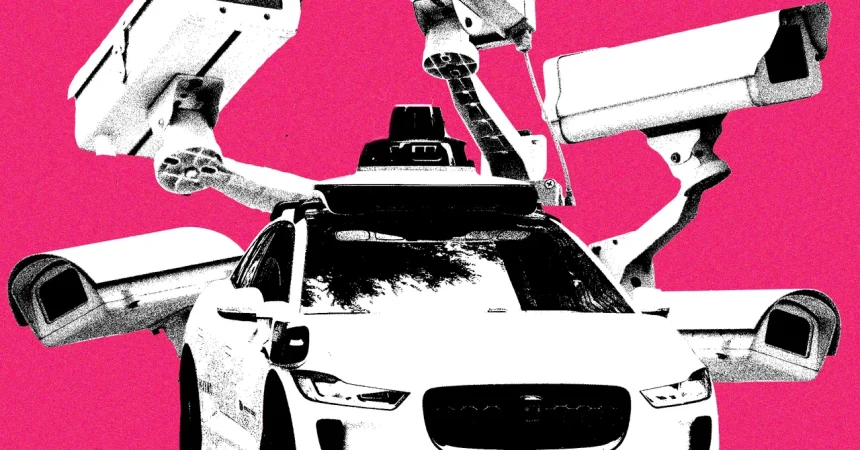
One afternoon this past summer, a self-driving Waymo pulled into an ordinary parking lot in San Mateo County, California, and simply stayed there, idling in the sun until the police arrived. It wasn’t a mechanical breakdown or a traffic violation. The local cops had received a 911 call from Waymo employees—actual human beings, sitting in front of screens somewhere far away—who had been watching the car’s passengers through cameras mounted inside the vehicle. What they saw must have been alarming: two teenagers appeared to be shooting a black handgun out the window, playing with it, drinking between shots, as if the car were some kind of rolling clubhouse. The police report painted a picture that could have ended very differently. But then came the twist, equal parts absurd and reassuring: the gun was harmless, a toy that fired soft, gel-filled Orbeez beads, the kind of thing kids soak in water and shoot at each other for fun. No bullets, no blood, no tragedy. And yet the incident stuck in people’s minds, not because of the toy gun, but because of what it revealed. The very car that was supposed to be giving people a private, driverless ride had quietly transformed into a mobile surveillance room, with eyes and ears that never blinked. It raised an uncomfortable question that most of us don’t think about when we climb into a robotaxi: Who is actually watching us, and why? For a few minutes on a warm California afternoon, a pair of teenagers learned the answer, and their story became a strange little parable about the hidden costs of convenience in the age of autonomous vehicles.
To understand why that parking lot incident matters, you have to understand the technology that makes self-driving cars see. The outsides of these vehicles are studded with cameras, bristling with sensors that scan the street, the pedestrians, the cyclists, the stray dogs, the sudden jaywalkers. Most of them also rely on radar and lidar, spinning and pulsing to build a three-dimensional map of the world as it unfolds in real time. All of that is well known, celebrated even, because it’s what makes the magic of driverless transportation possible. But far less appreciated are the cameras pointing inward, mounted inside the cabin, aimed at the passengers themselves. The companies that operate these fleets—Waymo, Zoox, Tesla, and others—say those interior cameras are essential to keeping riders safe and enforcing their rules. And they don’t just sit there passively. Earlier this year, Waymo revealed that it had used its cabin cameras to do exactly that. Some California passengers, many in their twenties or older, reported a strange experience: Waymo employees suddenly took over the vehicle’s intercom mid-ride, speaking directly to them, sometimes startling them, just to make sure they were old enough to ride alone. One 35-year-old told WIRED that he thought his backpack had tripped some kind of red flag. Imagine driving alone in what feels like a private pod, the future finally here, and then a stranger’s voice booms out of the ceiling, questioning whether you belong. It’s the kind of moment that makes you look around, suddenly aware that the quiet, empty space around you isn’t quite as empty as it seemed. The car may have no human driver, but it has plenty of human witnesses, just not ones you can see.
All of this feeds into a much larger conversation about privacy, and the way robotaxi companies handle the footage they collect from inside their cars. If you bother to read the privacy policies—and let’s be honest, most of us don’t—you’ll find language that sounds reassuringly mundane. Recordings captured inside vehicles may be used to check cleanliness between rides, to detect lost items, to verify that riders are following the rules. But then there’s a broader, more open-ended phrase that appears in many of these documents: the footage may also be used to improve the company’s products or services. That phrase, on its own, could mean almost anything. It could mean tweaking the software that controls the car’s heating and cooling. It could mean analyzing passenger behavior to train new algorithms. It could mean building profiles of individual riders, their habits, their emotions, their routines. Privacy experts point out that in the United States, there are few clear rules governing this sort of surveillance. Consumers often have no choice but to agree to lengthy “terms of service” documents printed in tiny, dense fonts before they can even open the ride-hailing app. No one reads those documents. Few people understand them. And yet, by clicking “I agree,” riders hand over enormous amounts of personal information, often without a clue about how it will be used, who it might be shared with, or how long it will be kept. It’s a persistent problem that long predates self-driving cars, but robotaxis make it more visceral because the surveillance is physically happening inside the space your body occupies. You are no longer just being tracked through your phone; you are being watched from within inches of your face, recorded even when you pick your nose, cry, argue, fall asleep, or simply stare out the window lost in thought.
Matthew Guariglia, a senior policy analyst at the Electronic Frontier Foundation, has spent a lot of time thinking about these questions. He puts it bluntly: “We are being essentially abandoned by our lawmakers when it comes to consumer privacy and what companies can do with information after they’ve collected it.” That’s a powerful statement, especially in a country that prides itself on innovation but has consistently failed to pass comprehensive federal privacy legislation. Companies like Waymo, Zoox, and Tesla, for their part, say that human staff only view interior camera footage when needed—when there’s an incident, a safety concern, a possible violation of the rules. They say recordings may be sent to law enforcement or regulators, and they point to legal processes like warrants and subpoenas. Waymo’s own support page notes that government agencies seeking data “are directed to follow valid legal processes in making such request.” That sounds responsible on paper, and perhaps it is in practice. But the people who study this stuff say that good intentions aren’t the same as good laws. These policies can change at any time. The footage that was collected to clean up spilled soda could later be used in an insurance dispute, a criminal investigation, a civil lawsuit, or something we can’t even imagine yet. The technology is evolving much faster than the rules that are supposed to govern it, and in that gap, trust is the only thing passengers have. Trust is a fragile thing, though, especially when you’re sitting in the back seat of a machine you don’t control, and you suddenly remember that the company running the car is also watching every move you make.
There’s something strange about the intimacy of being alone in a driverless car. No human driver means no face to look at in the rearview mirror, no one to make small talk with, no one to judge your choice of music or the way you eat your fries in the back seat. There is a feeling of privacy, of anonymity, that is both liberating and, as it turns out, illusory. That illusion is carefully engineered, perhaps even necessary, for the experience to feel comfortable. But the cameras are there, and they are not just sensors; they are witnesses. They can see the way you breathe, whether you’re nervous, whether you’re holding a phone or a weapon, whether you’re a teenager or a grown adult. They may even be able to recognize your face, compare it to databases, or track your emotional state using software that isn’t fully disclosed to the public. The implications extend far beyond a single ride. Every time you enter a robotaxi, you add another layer of data to the digital trail you already leave everywhere else. Over time, that trail becomes a map of your life: where you go, when you go there, who goes with you, how you behave along the way. It’s not hard to imagine a future where insurance companies, employers, law enforcement, or identity thieves find ways to access that information. It’s also not hard to imagine that the companies themselves might use it for purposes they never mentioned in that hastily-scrolled terms of service agreement. And unlike a human driver who might forget your face five minutes after you leave the car, a robotaxi remembers forever. The footage is stored, searchable, and reusable, in ways that we are only beginning to understand.
So what is a passenger supposed to do? For now, the honest answer is that there is no perfect answer. You can choose not to use robotaxis, but that feels like an empty victory, a refusal of a future that is already here. You can try to read every privacy policy, but they are written in a language that seems deliberately designed to obscure rather than clarify. The experts’ best advice feels almost comically simple, and yet it cuts to the heart of the issue. As Guariglia puts it: “Just because you’re alone in the car doesn’t mean you’re alone in the car. You should behave as if there’s a jumpy person in the front seat.” That’s not a bad way to live in the age of autonomous vehicles. The car may not have a driver, but it has memory. It has reason. It has a corporate owner with legal obligations, financial interests, and, perhaps, good intentions. The question is whether those good intentions are enough to protect you when you’re at your most vulnerable, exhausted after a long day, arguing with a loved one, or just being yourself in a space that feels private but isn’t. We deserve better laws, clearer rules, and more transparency from the companies building this technology. We deserve to know who is watching, when they are watching, and why. Until then, the best we can do is remember that even when the front seat is empty, the room isn’t.