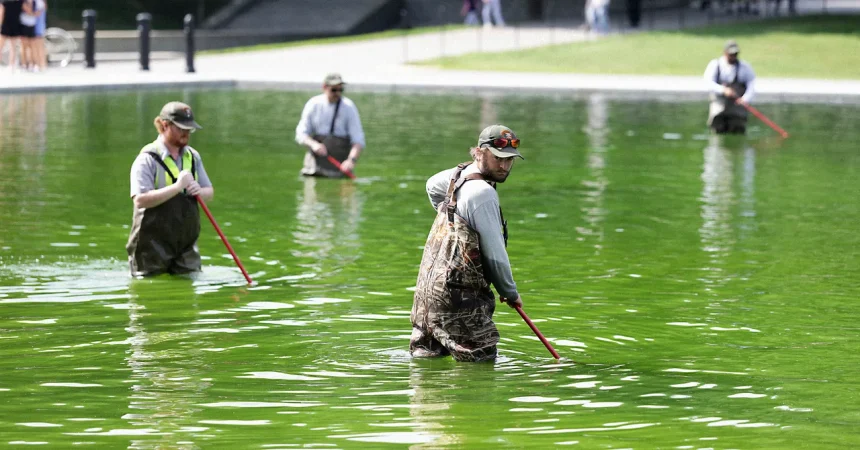
The Lincoln Memorial Reflecting Pool, a centerpiece of America’s capital, recently underwent a dramatic and costly transformation under the Trump administration. With an investment of over $14 million, the project was intended to revitalize the historic site in time for the nation’s 250th anniversary. Beyond fixing structural leaks, the renovation included a fresh coat of “American flag blue” paint, an aesthetic choice designed to ensure the water shimmered beautifully for visitors. However, the plan hit a major snag almost immediately after the grand reveal; within twenty-four hours, the vibrant blue hue was overtaken by an aggressive, unsightly algae bloom that turned the water a murky, swampy green. This unexpected turn of events has sparked a wave of public scrutiny, particularly regarding the awarding of a no-bid contract to a private construction company that—while experienced in maintaining the former president’s golf courses—had no prior history of working on federal infrastructure projects.
The Interior Department has scrambled to resolve the situation, with workers spotted pumping hydrogen peroxide into the basin earlier this week in a desperate bid to neutralize the growth. While officials have publicly pointed to “residual algae” lurking in dormant supply lines as the immediate culprit, the persistent nature of the bloom suggests that the root cause may be far more complex. The pool relies on water drawn from the adjacent Tidal Basin, which is historically susceptible to its own algae issues. While there is a mechanism to switch the water source to municipal drinking water when the basin becomes too contaminated, the government has been notably quiet about which source is currently feeding the revitalized pool. This lack of transparency has left observers wondering if the multi-million-dollar renovation successfully addressed the water quality issues or simply applied a expensive coat of paint over a systemic plumbing flaw.
Environmental experts suggest that the pool is struggling against a “perfect storm” of external factors, most notably the oppressive heat wave currently baking the Washington, D.C. area. Algae thrive in stagnant, warm water, and the Reflecting Pool—by design—does not feature the kind of vigorous flow that would naturally inhibit such organisms. According to scientists like Hans Paerl, a former professor at the University of North Carolina, high temperatures act as a catalyst for explosive growth. As global temperatures continue to climb, water bodies worldwide are finding it increasingly difficult to resist these blooms. The current situation in D.C. serves as a localized, high-visibility example of a much larger, global trend where changing climate conditions are making nature increasingly unpredictable for urban planners and maintenance crews.
The political optics of the situation are particularly fraught. President Trump had repeatedly championed the renovation, promising that his chosen, non-traditional contractor would complete the work faster and more affordably than standard government entities. Yet, the current struggle to maintain the pool’s integrity suggests that the project’s ambition may have outpaced its practical engineering. When an administration stakes its reputation on a project’s efficiency and aesthetic perfection, the sight of a neon-green pool—filled with chemical cleaners and the subject of national ridicule—becomes a challenging narrative to manage. The Interior Department is now betting that a combination of the hydrogen peroxide treatments and a “high-tech nanobubble ozone technology” will eventually prevail, but for now, the pool stands as a testament to the fact that even the most expensive human intervention can be humbled by the forces of nature.
Perhaps the most significant takeaway from this incident is the intersection of infrastructure, fiscal responsibility, and the environment. While the immediate focus is on defeating the algae, the saga highlights the necessity of long-term planning regarding climate shifts. As summers become hotter and more humid, the maintenance requirements for outdoor structures change. What was considered a standard water-management strategy a few decades ago may no longer be viable in a rapidly warming world. This ordeal raises legitimate questions about whether the federal government is prioritizing the right expertise when selecting contractors for sensitive projects. By bypassing traditional competitive bidding processes in favor of personal business connections, the administration opened itself up to intense criticism when the results failed to meet even the most basic standard of visual upkeep.
As the week closes, the humidity in Washington, D.C. shows no signs of breaking, which will likely keep the Interior Department’s maintenance teams on high alert. The ongoing battle for the pool’s clarity is more than just a struggle over water aesthetics; it is a tug-of-war between high-priced political promises and the raw reality of an evolving ecosystem. Whether the “nanobubble” technology works remains to be seen, but the public will be watching closely to see if the “American flag blue” can finally be restored. Ultimately, the Reflecting Pool’s green-hued crisis serves as a poignant reminder that nature does not always adhere to a government schedule and that the path to historical preservation is rarely as straight or simple as a well-intentioned political announcement suggests.