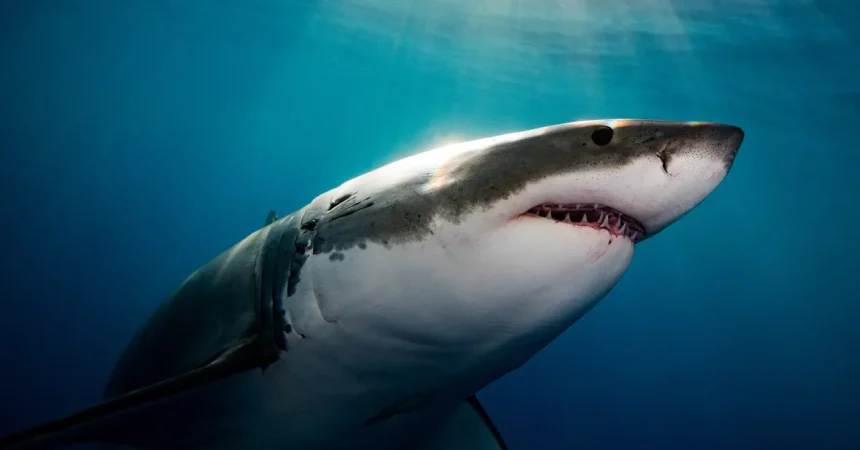
For 55 years, Greg Wilfert had been a lifeguard, which means he had spent more than half a century learning to read the ocean the way other people read newspapers. He knew the way the tide moved, the way the water changed color with the weather, and the way a quiet swim could turn dangerous in an instant. So when he went out for a routine swim off the coast of Scarborough, Maine, one August morning, he had every reason to expect a calm day. He was towing his rescue buoy, the bright piece of safety equipment lifeguards carry, when something grabbed it and yanked him hard beneath the surface. His first thought was mechanical and ordinary: he had somehow become tangled in a boat propeller. The force was too strong, too deliberate, and it was pulling on the buoy, not on him. When he came back up, gasping, he realized the truth. A great white shark had taken an interest in the buoy, perhaps curious, perhaps testing it with its mouth, and in that single moment, the ocean he had trusted for decades felt entirely different. Wilfert was not hurt, but the image of a veteran lifeguard being pulled underwater by a shark’s curiosity captures something important about the summer of 2023 along the coast of Maine. The sharks were there, they were close, and even people who had spent their whole lives in the water could no longer pretend otherwise.
It was not just one incident. It was a season, a parade, a great white bonanza along a state that had once seemed too far north or too cold for such encounters. Over a single two-day stretch in August, a dozen sightings were reported near Pine Point Beach in southern Maine. Beaches all over the state closed at one point or another after sharks were spotted in July and August, and the sightings kept coming as summer wound down. A great white was seen off Wells Beach over Labor Day weekend, and about thirty miles down the coast, a fisherman caught one on the same holiday. For beachgoers, the summer felt less like a normal vacation and more like a season of suspense. Lifeguards scanned the water with binoculars rather than just staring out at the horizon. Parents called their children closer to shore. Conversations at beachside cafes turned to sharks, almost as often as they turned to the weather. It would have been easier if there had been a single moment, one dramatic attack, to explain the sudden attention. Instead, the summer was defined by a slow, repetitive drumbeat of sightings: a dorsal fin here, a tagged shark there, a rescue buoy tugged from below. The effect was less like a horror movie and more like a strange, persistent awareness that humans were sharing the water with something ancient, powerful, and increasingly common. For the people of Maine, the question became unavoidable: why here, why now, and why so many?
The easiest explanation, the one that made it onto social media and into casual conversation, was climate change. The waters off the coast of Maine are among the fastest-warming on Earth, and the Atlantic Ocean has been experiencing a series of marine heat waves. Add El Niño, the climate phenomenon that pushes global temperatures even higher, and it seems natural to assume that rising ocean temperatures are dragging great whites northward, turning Maine into a new shark destination. But experts who study these animals are more careful. They point out that the relationship between climate change and great white sharks is far more complicated than a simple map of temperature lines. Great whites are not tropical fish that panic when the water dips below seventy degrees. They are highly migratory animals with the ability to regulate their own body temperature, which means they can tolerate a much wider range of ocean conditions than other shark species. That does not mean climate change is irrelevant. It means the story is bigger than rising temperatures alone. Scientists who have spent years tracking great whites along the East Coast see another force at work, one that has been building quietly for decades, and it has less to do with warmer water and more to do with the choices people made in the 1970s and 1990s.
To understand that force, you have to go back to 1975, the year Steven Spielberg released Jaws. The movie terrified a generation, but it also did something more subtle and more damaging: it turned great white sharks into monsters to be hunted. At the time, great whites were already in serious trouble in waters off both the east and west coasts of the United States. Overfishing, bycatch, and trophy hunting had pushed their numbers down to worrying levels. They were not seen as an ecological necessity or a creature deserving of protection; they were seen as a threat to be eliminated. In the 1990s, federal protections finally arrived, not just for great white sharks but also for gray seals, which are one of the sharks’ most important prey species. This was not a quick fix. Great white sharks grow slowly and mature late. Males take about twenty-six years to reach adulthood, while females can take up to thirty-three years. That means a shark born after protections were put in place might not have been ready to reproduce until the 2010s or even later. The timeline lines up almost perfectly with the sightings off Maine. According to Matthew Davis, a shark expert at Maine’s Department of Natural Resources, and Walter Golet, an associate professor at the University of Maine School of Marine Science who collaborates on shark research, there are simply more great whites off the coast now than there were in past decades. The conservation measures that seemed so controversial in the 1990s are now starting to pay dividends. Studies along the East Coast have found that protecting both sharks and seals has helped both populations grow. The great whites are not arriving in Maine because they are lost or confused. They are returning to a part of their range that had been empty for decades, and they are finding a coastline that now has plenty of seals to eat.
Scientists are able to see some of this recovery because of a technology called acoustic telemetry. Maine’s state shark monitoring system uses tags that are surgically placed on great whites, and each tag emits a unique electronic signature. Underwater listening stations along the coast pick up those signatures and log the movements of individual sharks, allowing researchers to track their journeys up and down the coastline. It is a clever system, but it is also incomplete. Maine’s program is less than a decade old, and as Davis points out, not every shark is tagged. In fact, only a small fraction of the great white population carries a tag, which means the acoustic record only captures a sliver of the full story. If a shark is untagged, it swims past the listening stations invisible, seen only by chance. That makes it difficult for scientists to say with absolute certainty whether this summer’s glut of sightings is a true population explosion or simply a visibility event, a summer when more people had phones, drones, and kayak cameras pointed at the water. But Davis and Golet both believe the increase is real. The combination of federal protections, a growing seal population, and a generation of great whites finally reaching maturity points in one direction. The sharks are back, and they are likely to keep coming. That is a conservation success story, but it does not feel like one to a parent standing on a beach in southern Maine, watching a dorsal fin slide through the water. It feels like a warning.
The question of what happens next depends on how people adapt to this new reality, and that is where climate science becomes important again. Some research suggests that extremely hot ocean temperatures could actually be harmful to great whites, forcing them to overheat, slow down, or move to colder waters in search of food. If the Gulf of Maine continues to warm at its current pace, the waters might eventually become less comfortable for them, at least in certain seasons. But James Sulikowski, the director of the Coastal Oregon Marine Experiment Station at Oregon State University, cautions against assuming that great whites are fragile. They are warm-blooded, or at least partly warm-blooded, in a way that allows them to control their body temperature and survive in a much larger range of ocean environments than most fish. They can handle cold water and warm water, deep water and shallow water, and they have done so for millions of years. What has changed is not the sharks’ capacity to survive; it is the human capacity to share space with them. The same waters that have grown crowded with seals, boats, surfers, and swimmers are now also home to a protected predator that was once hunted to the edge of disappearance. For decades, the ocean off the East Coast was a place where great whites were rare enough to be a legend. Now they are a fact of life, and no amount of beach closures or shark warnings will change that. What might change is the way people think about them. The summer of great white sightings off Maine was not an anomaly or a freak event. It was the visible result of a species rebounding, a reminder that conservation has consequences, and a challenge to find a way to live alongside an old predator in a warming, changing ocean. It is a strange thing to be grateful for, but perhaps the greatest lesson of the summer is that the oceans are still wild enough to surprise us, and still resilient enough to bring back the creatures we once nearly destroyed.