With the next midterm elections approaching, a growing number of Americans are preparing to do what citizens in a democracy are supposed to do: cast their ballots, trust the count, and accept the outcome. Polls suggest that Democrats are well positioned to win big in several key races, and that possibility has many people feeling hopeful and energized. But even before the results are announced, there are troubling signs that the fight will not end at the ballot box. The Trump administration has already signaled that it will mount legal challenges in certain races, raise questions about the validity of the results, and challenge the legitimacy of victories that do not go its way. That kind of election denial is worrying enough—but an even more radical strategy is being prepared by influential conservative thinkers. A post published by the Center for Renewing America, a right-wing think tank closely connected to the administration, argues that certain Democratic candidates should not be allowed to take their seats in Congress even if they win. The post suggests that members of what it calls a “Red-Green Alliance,” made up of “neo-Marxist progressives and anti-Western Muslims,” can and should be prevented from holding office. This is not a proposal to investigate voter fraud or demand a recount. It is an attempt to disqualify elected officials based on their political beliefs, their faith, and the company they keep. For ordinary voters, that is a frightening possibility. When you vote for someone, you expect them to represent you in Congress. If that representative is blocked from being seated, your voice has been erased, and your vote has been turned into nothing more than a suggestion.
The legal argument that the Center for Renewing America is making sounds, at first, like a technical question of constitutional interpretation. The Constitution says that each chamber of Congress shall be the judge of the elections, returns, and qualifications of its own members, and it also says that members must take an oath to support the Constitution. Benjamin Osborne, the legal fellow at the Center for Renewing America, used that language to argue that a candidate who has embraced the destruction of the constitutional order cannot truthfully swear to support it. In other words, if a politician belongs to a movement that supposedly wants to tear down American democracy, that politician should be barred from office before taking their seat. But this argument twists the Constitution in ways that legal scholars have rejected. The qualifications for Congress are defined narrowly and clearly: a member must have a certain age, a certain period of citizenship, and be an inhabitant of the state they represent. There is no requirement that a candidate pass a political loyalty test, and there is no provision allowing Congress to exclude someone because their beliefs are considered radical or un-American. The First Amendment protects a person’s right to hold unpopular political views. It protects socialists, progressives, Muslims, and every other group that has ever been demonized by those in power. Throughout American history, even members who were deeply critical of the government have been seated, not excluded, precisely because the Constitution protects speech over the fears of the majority. If this legal theory were accepted, it would mean that one party could simply decide that its opponents are too dangerous to govern, refuse to seat them, and then claim the Constitution is on its side. That is not constitutional law; it is a calculated inversion of democratic norms.
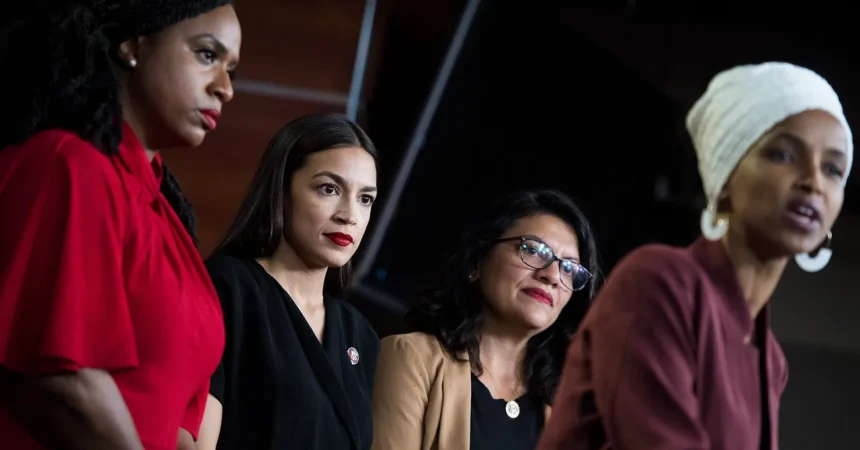
Perhaps the most human way to understand the danger of this idea is to look at the actual people being targeted. The Center for Renewing America has named the “Squad,” a group of four progressive women of color who were elected to Congress in 2018, as part of the so-called Red-Green Alliance. These women—Alexandria Ocasio-Cortez, Rashida Tlaib, Ayanna Pressley, and Ilhan Omar—are not abstract threats to the republic. They are elected representatives with real constituents. A once-bartender from the Bronx who fought for working families; a Palestinian-American woman from Detroit who grew up in a family of immigrants; a Black woman from Chicago who spent years advocating for survivors of violence; and a Somali refugee who fled a brutal civil war and now sits in the halls of American government. Their stories are not the story of a movement trying to destroy the Constitution. They are the story of America, with all its complexity and promise. The Center for Renewing America has also named Zohran Mamdani, a New York City mayoral candidate, and Abdul El-Sayed, a Michigan Senate candidate. Mamdani is the son of immigrants and a state legislator from Queens who has focused on housing, transit, and tenant rights. El-Sayed is an epidemiologist and former city health official who has spent his career working on public health and social justice. None of these people have called themselves Marxists, even if some, including Ocasio-Cortez and Mamdani, identify as democratic socialists. Democratic socialism is a political tradition that has existed in American life for more than a century, and it is entirely legal to support it. But the label “Red-Green Alliance” is not a factual description. It is a dehumanizing slogan designed to make Muslim Americans and progressive Americans look like foreign invaders plotting against the nation. The people behind this label are not protecting the Constitution. They are trying to exclude certain Americans from participating in their own government.
To understand why this strategy is being taken seriously, it helps to know who is behind the Center for Renewing America. The organization was founded by Russell Vought, one of the main architects of Project 2025 and the current director of the Office of Management and Budget. Vought is not a fringe figure hiding in the shadows; he is one of the most powerful people in the federal government, with direct influence over the president’s agenda and the federal budget. He has made no secret of his hostility toward Islam. When he was nominated for his first administration role, he faced widespread criticism for comments he had made suggesting that Muslims have a “deficient theology” and “do not know God.” Those comments were not simply theological opinions. They are part of a worldview that treats Muslim Americans as outsiders who cannot be trusted in public life. Vought has described himself and his allies as “radical constitutionalists,” but that phrase does not mean what most people would assume. In practice, it has meant something closer to the opposite: a willingness to break through constitutional limits in order to expand the power of the executive branch. The Center for Renewing America may present itself as a think tank publishing intellectual legal scholarship, but it is really a political weapon. Its purpose is to provide a veneer of legitimacy for actions that would otherwise be recognized as an attack on democracy. When an organization with this kind of power publishes an essay suggesting that Muslim and progressive legislators can be prevented from taking office, it is not merely an abstract debate happening in a law library. It is a warning about what might come next.
That warning is especially credible because Vought has already demonstrated a willingness to ignore the boundaries that are supposed to separate the branches of government. One of the most important powers of Congress is the power of the purse—the authority to allocate federal funds and decide how taxpayer dollars are spent. The Constitution gives that power to Congress, not to the president or his appointees. But Vought has repeatedly refused to disburse money that Congress has approved. Last year, he froze $5 billion in foreign aid funding, and earlier this year, he clawed back more than $800 million in funds that had already been authorized. Senator Susan Collins, a Republican from Maine, has said that these actions may violate the Impoundment Control Act, a law that limits the ability of the executive branch to withhold spending. This is not just a bureaucratic detail. When funds are frozen or delayed, real programs suffer. Farmers, healthcare providers, disaster recovery efforts, and international aid programs that were counting on that money are left in limbo. Vought’s defenders might frame his behavior as a bold stand against wasteful government spending, but the deeper issue is structural. He is treating Congress as an obstacle rather than a partner, and he is treating the law as a suggestion rather than a binding rule. That same attitude lies at the heart of the Center for Renewing America’s argument about seating elected members of Congress. If the executive branch can simply ignore Congress’s power to fund the government, then it is only a small step to imagine that one branch can also decide which elected officials are allowed to take office. This is not radical constitutionalism. It is a quiet erosion of the entire system of checks and balances.
Richard Pildes, a professor at New York University’s School of Law, described the think tank’s argument as “another attempt to contort and twist basic norms that have never been used this way for their own partisan purposes.” That careful academic language captures something that should concern every ordinary American. The norms of democracy are not abstract inventions. They are the shoulders of the entire political system. If one party is allowed to decide that its opponents are too extreme to serve, then elections no longer matter. The ballot becomes a meaningless ritual, and the will of voters can be overturned by a handful of powerful people who claim to know better. This is what has happened in autocratic countries around the world, and it can happen here if enough people look away. The best response is not to panic, but to be vigilant. We need to recognize these theories for what they are: efforts to dehumanize political opponents and turn democratic elections into a façade. We need to insist that candidates who win elections are seated, regardless of their religion, their race, or their political ideology. We need to remember that the Constitution protects the rights of the most unpopular people in society precisely because the powerful never needed protection. And we need to support leaders and institutions that are willing to defend the rules of the game, even when those rules produce results they dislike. The approaching midterms will test more than poll predictions and party strength. They will test whether Americans still believe that voters have the final word. That belief is the foundation of everything else. If we lose it, we lose more than an election. We lose the idea that ordinary people have a voice in their own government—and we lose the shared trust that makes democracy possible.