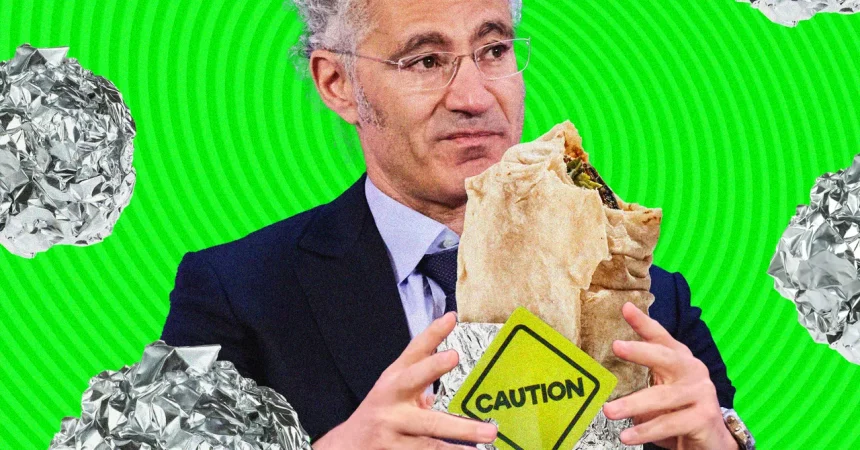
1. A Surprising Partnership in the Fast-Food World
It’s easy to imagine Chipotle as a company obsessed with what’s inside its burritos: organic cilantro, responsibly raised chicken, and guacamole made fresh every morning. But behind those stainless steel countertops, the chain is quietly investing in something far less visible than salsa: data. Chipotle has teamed up with Palantir, the intelligence-adjacent software company best known for its work with the military and spy agencies, to build a “food safety risk platform” designed to help prevent outbreaks before they ever reach a customer’s plate. According to screenshots reviewed by WIRED, the platform operates on Palantir’s flagship Foundry software and appears to pull together all kinds of information from individual Chipotle stores—health department inspection scores, past pest incidents, and even reports of employee illness—then boils it all down into a single, easy-to-understand food safety score. That score essentially tells the company how risky a particular location is, and presumably prompts action when a number slips into dangerous territory. Chipotle spokesperson Erin Wolford confirmed the initiative but wouldn’t comment on how long it’s been in the works or how widely it’s been rolled out. Palantir, for its part, didn’t respond to WIRED’s request for comment, which leaves a little mystery around the details. Still, the fact that a major fast-food chain is using Palantir’s powerful data-crunching tools to look after the health of its customers is a compelling sign of how much the restaurant industry has changed. It also raises a question: Can a company best known for surveillance help us eat safely, or are we just trading one kind of risk for another?
2. Inside the Food Safety Risk Platform
The concept behind the platform is simple, but the execution is anything but. Instead of relying on random inspections or waiting for a customer to report a bad meal, Chipotle’s system appears to act like a radar that constantly scans for warning signs. A store might have a mediocre health department score one month, then a rodent sighting the next, then two employees call in sick with stomach problems all in the same week. Individually, those red flags might not seem like a big deal. But when you layer them together in a single dashboard, they create a clearer picture of a location heading toward trouble. That’s where Palantir’s Foundry comes in. Foundry is designed to weave together messy, disconnected datasets—spreadsheets, government records, internal logs, even free-text notes from managers—and make them searchable and usable. In this case, it seems to generate a “food safety score” for each Chipotle store, essentially ranking locations by their risk level. A low score might trigger an immediate visit from a regional manager, extra food safety training, or even a temporary closure for deep cleaning. The underlying logic is the same kind of predictive modeling that Palantir uses for military intelligence and counterterrorism, but turned toward a much more mundane target: preventing a bad batch of cilantro from making hundreds of people sick. For Chipotle, which has spent more than a decade trying to live down a series of high-profile foodborne illness outbreaks, this kind of high-tech vigilance is probably a welcome defense. But it also raises privacy and algorithm concerns. How accurate are these scores? What happens if a store owner argues that the data is wrong? And does a computer-based risk score actually make food safer, or does it just catch the problems that are already easy to spot?
3. A Particularly Ugly Year for Foodborne Illness
The timing of this technology is notable, because 2025 has been a rough year for food safety across the United States. According to the Food and Drug Administration, there have been more than 12,800 illnesses tied to foodborne outbreaks so far this year—an alarming number that includes everything from salmonella to cyclospora. A massive cyclospora outbreak connected to iceberg lettuce was responsible for a huge share of those cases, and it prompted recalls that rippled through grocery stores and restaurants nationwide. Chipotle, fortunately, wasn’t caught in that particular storm. The chain says it doesn’t serve iceberg lettuce, so it wasn’t directly affected by the recall. Even so, the company has had its own brushes with contamination. In July, Chipotle proactively stopped serving jalapeños from a specific supplier who was linked to a salmonella outbreak that eventually sickened more than 430 people in multiple states. That move was probably cautious, but it also shows how quickly a single ingredient can turn into a national crisis. For a restaurant built on the promise of fresh food, there’s a certain irony: the more ingredients you cut in-house and the more “real” your food is, the more opportunities there are for something to go wrong. The average fast-food burger patty may come frozen and pre-cooked, but a bowl full of fresh lettuce, tomatoes, and corn is teeming with natural, living things—and some of them can be dangerous. In that sense, a predictive tool that tracks pest incidents and employee sickness isn’t just a clever innovation; it’s practically a survival necessity. And it may explain why a company like Chipotle, which was once burned by repeated E. coli and norovirus outbreaks, is willing to partner with one of the most controversial data companies in the world.
4. Palantir’s Quiet Rise in Corporate America
Palantir’s partnership with Chipotle isn’t an isolated experiment. The company, founded in 2003 by Peter Thiel and a group of Stanford friends, has become a surprising heavyweight in corporate data analytics. While most people still associate Palantir with government surveillance, its commercial arm has been growing at an explosive pace. Over the last few years, Palantir has signed contracts with major food companies like Tyson, the poultry and beef giant, and General Mills, the cereal behemoth that owns brands like Cheerios and Häagen-Dazs. It even works with the independent purchasing co-op for Wendy’s, helping the fast-food chain manage its supply chain. Companies use Foundry to track inventory, automate ordering and delivery, and get early warnings about potential ingredient shortages before they turn into menu disasters. At Wendy’s, for example, Palantir’s software can spot a coming shortage of a particular item and suggest alternatives or alert managers to stock up before the crisis hits. This is a different kind of business than the one that made Palantir famous, but it’s just as lucrative. In August, the company reported that US commercial revenue reached $764 million in the most recent quarter, a jaw-dropping 149 percent increase compared to the same period last year. Today, commercial work accounts for nearly half of Palantir’s US business. That growth has turned Palantir into something more than a defense contractor—it’s a data infrastructure company for the grocery aisle, the loading dock, and the restaurant kitchen. The same tools that help the Pentagon track insurgents can help a national burrito chain decide which produce supplier to trust. It’s a little strange to think about, but also a little encouraging: the same algorithmic logic that identifies threats on a battlefield can be used to flag a suspicious batch of shredded cheese before it reaches a tortilla.
5. The Immigration Cloud Over Palantir and Chipotle
Still, Palantir’s history with government agencies is hard to ignore, especially when you consider who works in the restaurants that use its software. Chipotle, like most fast-food chains, employs a huge number of immigrants. Roughly a fifth of the restaurant workforce in the United States is foreign-born, and many of those workers are undocumented. Palantir has long done work with Immigration and Customs Enforcement and the Department of Homeland Security. Last year, ICE awarded Palantir a $30 million contract to build a surveillance platform that gave the agency visibility into people who were self-deporting—a line of work that can only be described as directly tied to immigration enforcement. That connection creates an awkward tension for a company like Chipotle, which has its own complicated history with immigration. Back in 2010 and 2011, following an ICE audit, Chipotle fired hundreds of workers who were ineligible to work in the United States. The move was painful for the company’s reputation and devastating for the employees involved. More recently, Chipotle’s current CEO, Scott Boatwright, acknowledged that the Trump administration’s immigration crackdown would likely affect his employees, whether directly or psychologically. He told NBC News that it was a moment for the company to connect with its people, to check in and ask: “Hey, how are you doing, how are you feeling, is there anything we can do to help or support?” Those are kind words, but they land awkwardly next to a data partnership with a company that helps ICE track people. It’s one thing to say you care about your immigrant workforce; it’s another to hand your operational data to a firm that builds surveillance tools for the same government carrying out mass deportations. For many observers, that contradiction feels uncomfortable—and it’s exactly the kind of moral complexity that Palantir tends to attract.
6. The Price of Prevention and the Future of Food Safety
So what should we make of all this? On one hand, you could argue that a fast-food chain can never have too many tools when it comes to protecting its customers from foodborne illness. The Centers for Disease Control and Prevention estimates that millions of Americans get sick from food every year, and thousands die. Any system that helps catch a contamination problem early is a public health win. In that sense, Palantir’s food safety platform is a good thing—a high-tech shield built from data, designed to keep harmful pathogens out of our lunch. But on the other hand, the partnership is a reminder that artificial intelligence, predictive analytics, and massive data collection are no longer confined to government agencies or border patrol. They are becoming part of the ordinary infrastructure of everyday life. When you order a burrito bowl, you might not be thinking about the algorithms that decide whether the store is safe. But they’re there, watching pest-control reports and employee sick days and health-inspection scores, quietly deciding whether someone should be retrained or visited by a supervisor. That can be genuinely helpful, but it also introduces a new kind of fragility. What if the algorithm makes a mistake? What if it punishes a store for reasons that are unfair? What if employees start hiding their illnesses because they’re afraid of what the score might do to their jobs? There are no easy answers. But one thing is certain: the future of food safety is no longer just about washing hands and keeping refrigerators cold. It’s also about who controls the data, what they do with it, and whether the same technology that protects us can also be used to harm the people who make our food. Chipotle is betting that Palantir can help prevent the next outbreak. Only time will tell if that bet is worth the cost.