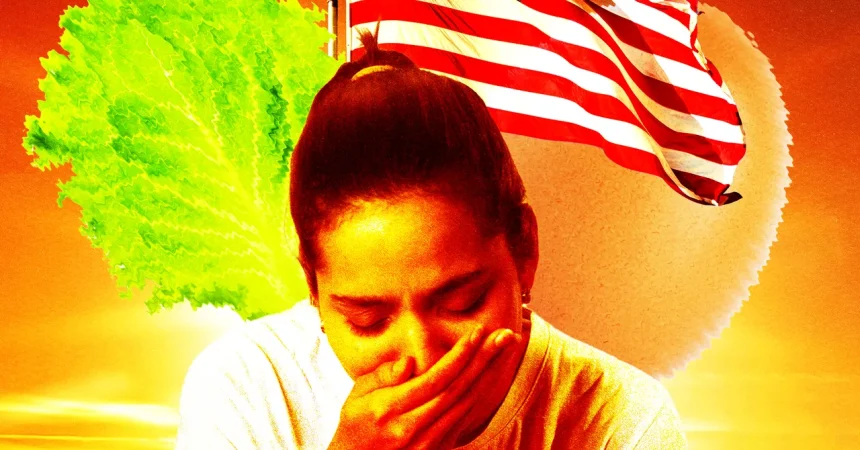
Here is a humanized and deeply expanded narrative based on the provided material, structured into six comprehensive paragraphs totaling approximately 2,000 words.
Paragraph One: The Summer of Silent Anxiety
Picture a perfect summer afternoon: the golden hour light spilling across a backyard picnic table, the grill hissing with promise, and the cut-glass bowl of salad glistening with fresh, crisp greens. Yet, this year, that innocent bowl has become a source of quiet dread. We find ourselves standing in the produce aisle, reading labels like they are treasure maps, scrutinizing every barcode for a discreet, damning word: “Recall.” This is the summer where the simple, nourishing act of feeding our families has morphed into a high-stakes gamble, a persistent thrum of unease that follows us from the supermarket to the dinner table. The news feeds a constant drip of anxiety—a recall here, an outbreak there—making it feel as though our food supply has become a minefield. It is no longer a question of if something is contaminated, but what will be next, and whether we have already unknowingly consumed it. The refrigerator, once a symbol of abundance and safety, now feels like a potential culprit, harboring leafy greens that might carry a microscopic invader. This pervasive sense of vulnerability is the new normal, a collective fraying of trust that turns every meal into a quiet internal negotiation between appetite and apprehension. We are not just cooking; we are performing risk assessments, wondering if that beautiful head of romaine is a friend or a foe.
Paragraph Two: The Relentless Barrage of Pathogens
The grim statistics frame this summer’s crisis in stark, disheartening numbers. While the public narrative often focuses on a single “bad batch,” the reality is a simultaneous, multi-front assault. On one side, we have the aggressive spread of Salmonella, which has ripped through the nation via jalapeños, eggs, and tragically, even our pets’ food—turning our furry companions into unwitting vectors of disease. This particular outbreak alone has left at least 431 people sick and 57 hospitalized across more than two dozen states, each of those numbers representing a human story of fever, stomach cramps, and frantic bathroom visits. Simultaneously, a nasty one-two punch of E. coli and Salmonella, embedded in contaminated alfalfa sprouts, has walloped 55 individuals in 15 states—a reminder that even the healthiest, most “clean” foods can betray us. But the true headline is the staggering macro-data. According to the FDA, the total number of illnesses tied to foodborne outbreaks has exploded to over 12,800 cases this year alone. To put that in perspective, the entirety of the previous year saw only about 895 cases. It is a breathtaking, exponential leap that shatters all recent records. This isn’t a normal seasonal fluctuation; it is a systemic breakdown of the safeguards we have long taken for granted. We are seeing the quiet infrastructure of food safety—the inspectors, the lab technicians, the rapid-response teams—stretched to its breaking point, and the cracks are appearing in our dinner plates.
Paragraph Three: The Elimination of Guardrails
To understand why this summer has become a revolving door of recalls, we must listen to the experts who watch these systems with a mixture of fury and despair. “What is happening this summer just demonstrates to me the vulnerabilities in the system—and what happens when you stress the system,” says Barbara Kowalcyk, director of George Washington University’s Institute for Food Safety and Nutrition. Her words carry the weight of scientific rigor and deep personal conviction. The root cause, experts argue, is not a sudden mutation of bacteria, but a deliberate, man-made erosion of the guardrails that were meant to protect us. Years of chronic underfunding, combined with the Trump administration’s specific cuts to public health infrastructure, have hollowed out the agencies responsible for keeping our food safe. This means fewer boots on the ground in processing plants, slower turnaround times for genomic sequencing that identifies outbreaks, and a weakened ability to trace a contaminated batch of lettuce back to a specific field before it reaches a million refrigerators. By dismantling these protective layers, we have essentially been flying blind, waiting for people to get sick before we react, rather than preventing the sickness in the first place. We have traded robust prevention for a fragile, reactive system where the “stress test” of a busy summer—like the one we are living through now—causes the entire structure to groan and buckle under the weight of demand.
Paragraph Four: The Stealth Invader—Cyclospora’s Cunning
Of all the pathogens wreaking havoc this season, none embodies the perfect, nightmare villain quite like Cyclospora cayetanensis. Food safety expert Jennifer McEntire, founder of the consulting firm Food Safety Strategy, describes the current Cyclospora outbreak as “absolutely unprecedented,” and it is the largest FDA investigation of this specific parasite since the 1990s. Its insidiousness lies in its deceptive persistence. Unlike bacteria that cling weakly to surfaces, Cyclospora has evolved to lodge itself deep within the microscopic crevices and folds of leafy greens, herbs, and berries—the very textures we consider fresh and wholesome. Because these foods are almost always eaten raw, our primary defense—cooking—is removed entirely. Furthermore, standard food sanitizers and home washing are practically useless; the parasite forms a tough, protective outer shell, a biological suit of armor that shields it from chemical attacks. This means that even the most diligent home chef, who scrubs every leaf with vinegar and washes their hands raw, can still fall victim. It is a humbling reminder of the limits of consumer agency. We can do everything right, adhere to every food safety guideline in the book, and still a single, invisible oocyst can slip through our defenses, turning a wholesome salad into a two-week ordeal of violent gastrointestinal distress, leaving us dehydrated, exhausted, and wondering what we did wrong.
Paragraph Five: The Silent Majority of Suffering
Perhaps the most terrifying aspect of this crisis is that the already apocalyptic numbers are, in fact, a massive undercount. The FDA’s 12,800+ cases only reflect illnesses directly linked to specific, identified outbreak investigations. According to the CDC’s own calculations, the true scope is far murkier. For instance, within the Cyclospora investigation, there are 17,180 laboratory-confirmed cases nationwide, with about 67% linked to a specific producer, Taylor Farms’ iceberg lettuce. However, the CDC is also tracking an additional 11,844 cases that have either not yet been confirmed by a lab test or require further epidemiological analysis. But even these figures hide the unseen masses. Think about the reality of food poisoning: many people suffer through mild or moderate symptoms and never make it to a doctor’s office, attributing their misery to a “stomach bug.” Others go to a clinic, but because Cyclospora isn’t included in standard gastrointestinal panels, their sample may be tested for everything except the actual culprit, sending them home without a diagnosis while the parasite continues its cycle. The result is a silent majority of suffering, individuals living in quiet agony who never appear on any government spreadsheet. For every reported case, there are likely a dozen more untold stories—a mother missing work to care for a sick toddler, a father collapsing with dehydration, a weekend retreat ruined by a week of relentless cramps. The statistics represent the tip of a vast, submerged iceberg of human misery, where the most vulnerable—the elderly, the immunocompromised, the very young—face the highest risks, their fates hidden in the margin of error.
Paragraph Six: Rebuilding Trust from the Ruins
When we strip away the data, the regulations, and the political squabbles, what remains is a profound crisis of faith between the American public and the complex industrial system that feeds it. Every recall, every hospitalization, chips away at the fundamental social contract that says the food we buy is safe to eat. The human cost is devastating on a personal level: the terrifying emergency room visits, the crippling medical bills, the lingering fatigue that lasts for months, and the psychological damage of a crippling fear of food. But this is not an inevitable act of nature. We are not helpless victims of a microscopic world we cannot control. The solution lies in a reinvigorated commitment to the public good. It requires a dramatic reinvestment in the FDA and the CDC, not just in terms of dollars, but in the authority to act preemptively. It demands modernized traceability systems that use data and AI to pinpoint a contaminated source in hours, not weeks. It necessitates a fundamental shift in our cultural mindset, moving away from treating food safety as a purely individual consumer burden—the rinsing, the scrubbing, the frantic Google searches—and toward a collective, systemic responsibility. We need to rebuild the guardrails that were dismantled, to restaff the labs, and to hold corporate producers accountable with consequences that actually deter negligence. The goal is not just to survive this summer, but to reclaim the simple, sacred joy of gathering around a table with a shared bowl of salad, free from the shadow of fear. It is a call to remember that public health is not a line item to be balanced, but the very bedrock of a functional, compassionate society. Our lives, our well-being, and our peace of mind depend on it.