For nearly a century, our understanding of the cosmos has rested on a fundamental—and comforting—assumption known as the Cosmological Principle. It suggests that if you zoom out far enough, the universe becomes “smooth.” Imagine looking at a piece of fabric; up close, you see individual threads and knots, but from across the room, it appears to be a solid, uniform sheet. Scientists have long believed that the universe works the same way, with galaxies and clusters smoothing out into a featureless, balanced background on the absolute largest scales. This assumption is the bedrock upon which our most sophisticated mathematical models of the Big Bang and dark energy are built. However, recent evidence suggests this foundation might be wobble-prone, as a new study indicates that the universe may retain complex, organized structures far beyond the point where they were expected to vanish.
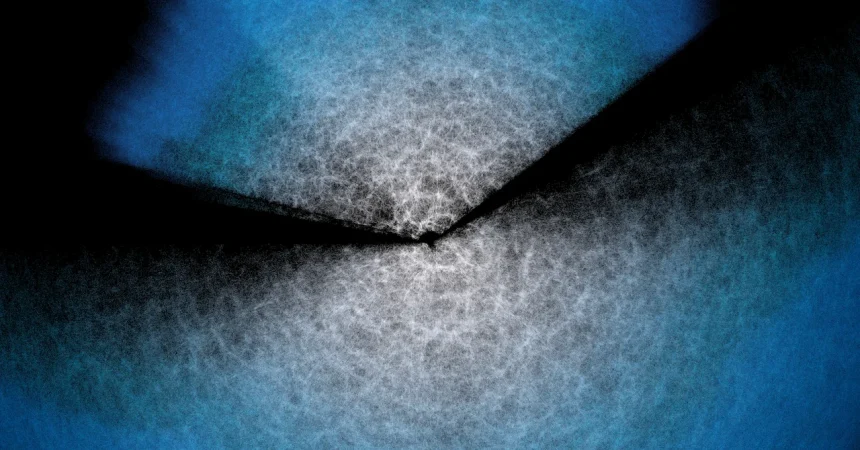
Leading this inquiry is Francesco Sylos Labini, a research director at the Enrico Fermi Research Center, whose team utilized data from the Dark Energy Spectroscopic Instrument to map the positions of millions of galaxies. The results defy the traditional expectation of cosmic “blurring.” Instead of seeing the chaotic web of galaxy filaments and voids fade into a uniform grey as their field of view expanded, the researchers found that these cosmic networks remain vividly interconnected over billions of light-years. It is as if, no matter how far back we step, the fabric of space refuses to resolve into a solid, indistinct color. Instead, the universe presents a persistent, intricate texture that refuses to dissolve, challenging the idea that cosmic uniformity is an inevitable destination of scale.
To humanize this discovery, it helps to move away from complex formulas and visualize the universe as a vast, shifting map. The standard cosmological model tells us that if you keep expanding your perspective, the “noise” of individual stars and galaxies should eventually cancel itself out, leaving behind a perfectly balanced, symmetrical picture. Yet, Sylos and his colleague Marco Galoppo discovered that the “map” never truly reaches that state of bland consistency. The cosmic web—the massive, bridge-like structures connecting galaxy clusters—doesn’t just exist locally; it seems to exert an organizational influence that spans scales previously thought to be devoid of such structure. The universe, it appears, is not a smooth, featureless photograph when viewed from a distance, but rather a persistent, self-organizing pattern that keeps its structure intact regardless of how wide we cast our gaze.
It is important to clarify that this discovery does not imply the universe is lopsided or that it possesses a single, mystical “cosmic arrow” pointing in one direction. The researchers are careful to emphasize that the universe does not have a “preferred axis” or a lopsided bias toward one side of space. The finding is much more nuanced: they have identified a form of “coherent organization” that survives across distances that should, theoretically, be chaotic or uniform. This isn’t about space leaning in one direction; it is about the structural integrity of the cosmos being far more resilient than we ever anticipated. The universe isn’t biased; it’s just remarkably and stubbornly structured.
The implications of this research are significant, primarily because they force us to question the tools we use to understand our origins. For over two decades, Sylos has challenged the scientific community to prove the assumption of homogeneity—the idea that the universe behaves the same in every direction. By repeatedly testing this, his team has exposed a rift between our mathematical ideals and the observable reality. If the universe does not become statistically uniform, then the simple, elegant models we use to explain how it began and where it is going may be incomplete. We may be trying to describe a sprawling, intricate tapestry using a language that only knows how to describe plain white canvas.
Ultimately, this study invites a sense of wonder about our place in a universe that refuses to be simplified. Whether this “wobble” in our standard model leads to a total paradigm shift or simply a revision of our current physics remains to be seen. What is clear, however, is that the cosmos is not the settled, predictable, and uniform expanse we once envisioned. It is a place of enduring complexity, where galaxy-spanning filaments and interconnected structures persist, suggesting that even on the largest scales, the universe remains a creative, connected, and deeply patterned entity. We are just now beginning to see that the further we look, the more the cosmos surprises us with its hidden, unshakable order.