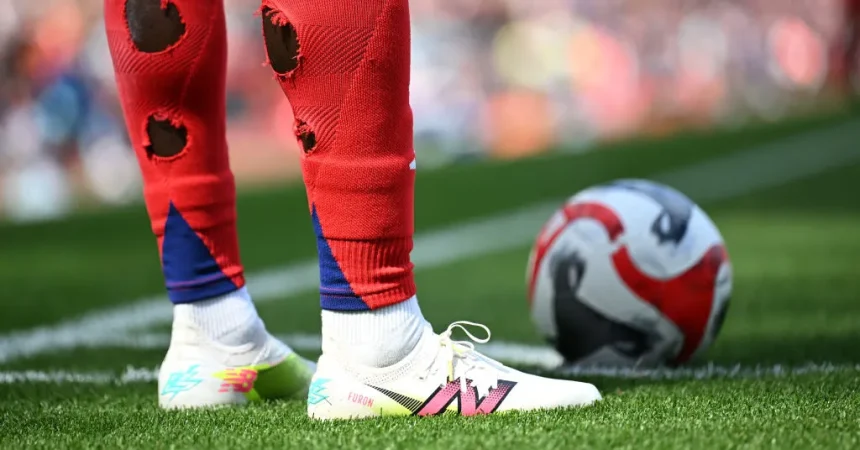
If you’ve been glued to the television screen during this year’s World Cup, you might have noticed a curious recurring fashion statement: many of the world’s elite players are taking the pitch with jagged, unsightly holes cut into the calves of their socks. It looks like a wardrobe malfunction at first glance, but in the high-stakes world of professional soccer, nothing is accidental. While social media is currently ablaze with wild theories suggesting these shredded socks provide some secret aerodynamic or performance-enhancing edge, the truth is far more grounded in human instinct. This trend is nothing new; it has quietly surfaced at the Olympics and various European Championships for years, yet despite the ongoing debate, scientists are still coming up empty-handed when looking for actual physiological data that proves these holes help an athlete run faster or play harder.
To understand why players are suddenly turning their expensive gear into Swiss cheese, we first have to look at how modern soccer socks are designed. Engineers spend years crafting these garments to be feats of technical precision. They are meant to be form-fitting, acting as a supportive exoskeleton that stabilizes the ankle, supports the arch, and wicks away sweat to keep the foot firmly planted in the cleat. Constructed from high-tech blends of nylon, polyester, and spandex, these socks are designed to provide constant, uniform compression. For the average person, this is a helpful feature, but for a professional athlete whose calves are constantly firing and expanding, this “supportive” pressure can start to feel more like a tourniquet.
The complaints from players often center on a nagging, pins-and-needles sensation. When a world-class athlete is sprinting or carving through a defense, the muscles in the calf aren’t static—they physically thicken and expand with every contraction. Throughout the ninety minutes of a match, this happens thousands of times. For players with particularly muscular builds or high sensitivities, the sock’s synthetic fabric essentially acts as a restrictive wall. As the muscle swells during a sprint, the sock pushes back. Over time, that constant restriction can cause blood flow concerns or simple, distracting discomfort—a tingling, numb feeling that can break a player’s concentration at the exact moment they need all their cognitive faculties directed toward the game.
This is where the practice of “letting the muscle breathe” becomes a ritualistic coping mechanism. Players have convinced themselves—often through trial and error—that cutting those slits allows their calf muscles the room they need to expand without the constant battle against the fabric. They believe this relieves tension and wards off the dreaded onset of cramps. Sports medicine experts, however, remain skeptical. They point out that proper compression is actually designed to reduce inflammation after intense exercise, not hinder it. There is currently no rigorous research to back up the players’ claims. Yet, in the shadow of science, the practice thrives, fueled by the player’s personal narrative that if something feels better, it must be better.
In professional sports, the line between the physical and the psychological is incredibly thin. While there is no data to suggest that a pair of perforated socks improves speed or stamina, there is a mountain of evidence regarding the power of “perceived comfort.” High-performance sports are as much about mental readiness as they are about muscle fiber. If a player feels restricted, they are distracted; if they feel restricted, they lack confidence. By cutting those holes, the player is essentially “hacking” their own comfort levels. Even if their actual speed remains identical, the feeling of freedom can make them play with more aggression and fewer doubts. It turns a piece of equipment into a personalized tool, tailored to the specific anatomical idiosyncrasies of that individual athlete.
Ultimately, we are likely to keep seeing these holey socks on the pitch for years to come. Because the rules of the game allow players to modify their equipment as long as their shin guards stay protected, there is no barrier to stopping the trend. It has become a fascinating, modern-day sports ritual—a silent pact between the player and their gear. While the “performance advantage” may be largely imaginary, the comfort is very real. And in a game of razor-thin margins where every fraction of confidence counts, a player’s personal belief in their equipment is often the only validation required. For now, the holes remain, serving as a reminder that even in the most data-driven sport on Earth, the human experience—and our desire to feel comfortable—will always have the final say.