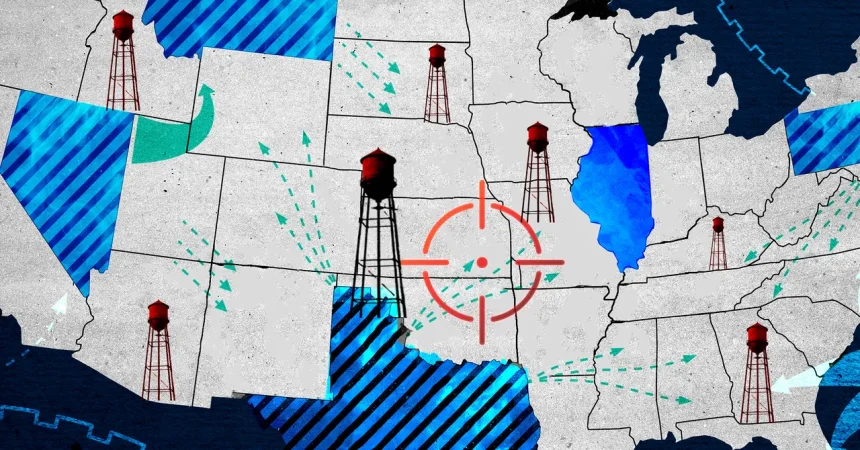
As the second day of the simulation unfolds, the atmosphere in the room shifts from academic concern to visceral dread. Corman, the facilitator, reveals that the initial digital breaches have metastasized into physical chaos; water mains are bursting across the nation, and the lifeblood of modern society—hospitals, refrigerated food supplies, and data centers—is rapidly drying up. What began as a manageable IT crisis has evolved into a full-scale systems collapse, stripping away the comfort of the participants’ corporate abstractions. The reality of a man-made drought is no longer a theoretical exercise but a claustrophobic cage, forcing everyone to confront the fragility of the infrastructure that underpins our daily existence.
The pressure intensifies when Corman introduces a new, sobering layer of complexity: a video message from a fictional high-ranking military official. This is the first time the specter of a geopolitical adversary, China, is explicitly mentioned, shifting the context from a mere cyber-nuisance to a potential prelude to war. The official’s plea—focused on protecting military mobility—signals that the nation’s survival is now tethered to the insurance companies’ ability to manage critical resources. Suddenly, the participants are no longer just business executives managing risk portfolios; they have become the accidental triage nurses of a failing superpower, tasked with deciding which vital organs of the country live and which are allowed to wither.
With the stakes redefined, Corman presents an impossible assignment: the teams must now establish a hierarchy of water distribution. The previous strategies—simply serving the largest clients or operating on a first-come, first-served basis—suddenly feel dangerously naive, even immoral. The participants are forced to weigh the sanctity of human life against the cold, hard logic of national security and economic stability. They must choose between keeping a hospital running to save the dying, maintaining the grid for military mobilization in response to a potential Taiwan conflict, or ensuring the survival of the logistics chains that prevent mass starvation. The room is thick with the weight of these choices, as the veneer of professional detachment begins to crack under the pressure of such profound moral jeopardy.
To their credit, the participants initially default to their humanity. Every breakout group settles on the same noble answer: the priority must be to save human lives. It is a protective, reflexive response, a collective attempt to maintain moral high ground in a scenario designed to erode it. However, the lack of depth in their resolution becomes apparent as the minutes tick by. While it is easy to declare that “people come first,” none of these executives has a concrete plan for the agonizing, granular decisions that would inevitably follow that assertion. They have chosen a guiding light, but they have yet to reckon with the darkness of the implementation.
The facade of consensus is shattered by a single, dissenting voice that forces everyone to face the uncomfortable truth of the corporate world. This participant points out that in the real, high-stakes environment of a national emergency, prioritizing human life might not be compatible with the legal and political realities of their positions. When government officials from the Treasury are demanding financial stabilization, or when military commands are prioritizing “dual-use” infrastructure for national defense, the “human life” mandate becomes an incredibly difficult pitch to sell to shareholders and regulators. This intervention exposes a terrifying conflict of interest: during a catastrophe, the mandate to protect humanity may be directly at odds with the legal and geopolitical machinery that dictates how the world is actually run.
As Corman brings the simulation to an abrupt close, the screen displays a final, haunting slide: a matrix of mounting financial losses and human casualties. He clarifies that these aren’t just scores to be tallied, but qualitative markers of a society in the process of unraveling. The exercise succeeds not by providing solutions, but by stripping away the illusion that anyone—whether in the boardroom or the situation room—is truly prepared for an event of this magnitude. In the end, the most important lesson learned is the most sobering one: in a collapse of this scale, there are no winners. The goal of the game isn’t to win; it is to realize just how quickly the bedrock of our civilization can turn to dust under the pressure of war and technical failure.