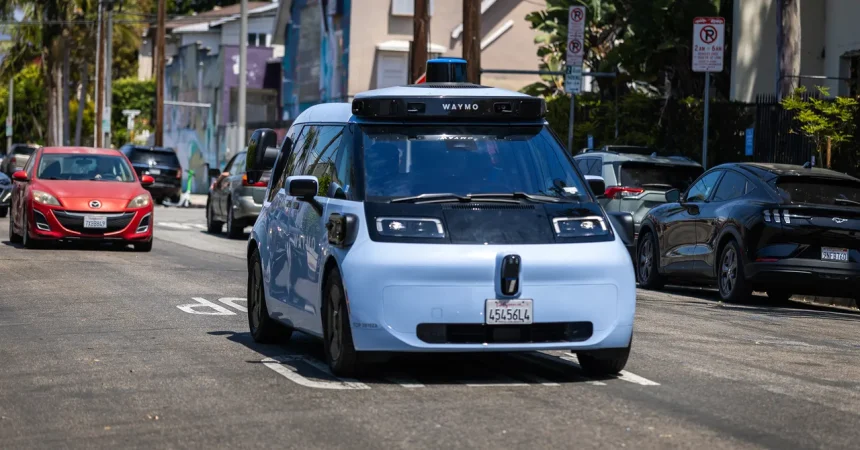
For nearly two decades, California has served as the unofficial laboratory for the future of transportation. Thanks to a unique blend of perpetual sunshine, a deep-seated love for technological innovation, and a highly skilled workforce, the state has become a magnet for robotaxi companies eager to prove that self-driving cars can safely navigate our complex, bustling world. Among these, Alphabet’s subsidiary, Waymo, has surged ahead to become the clear leader in the U.S. driverless ride-hail market. However, the company’s ambitious growth plans have recently hit a significant, government-mandated speed bump, forcing a moment of reflection and recalibration for the tech giant as it seeks to scale its operations across the Golden State.
The current bottleneck stems from a delayed decision by the California Public Utilities Commission (CPUC), the regulatory agency tasked with overseeing passenger transport. Because of this administrative pause, Waymo has been unable to legally expand its footprint into the vast territories it has targeted in both Northern and Southern California. While regulators deliberate, the company remains in a period of restricted growth, unable to roll out its newest piece of hardware—the “Ojai,” a sleek, pale blue electric vehicle manufactured in China—as a revenue-generating tool. For the average passenger, this delay has created a bizarre, short-term perk: because the Commission has not yet signed off on these specific vehicles for fare-based transport, rides in the Ojai units are currently completely free of charge.
This “free ride” period is expected to last at least through late September, provided that Waymo continues to offer them as part of its driverless fleet. It is important to note that this gracious, if unintentional, discount only applies to the new Ojai vehicles; Waymo continues to charge standard fares for its established fleet of Jaguar I-Pace robotaxis. The situation highlights a distinct difference between California and other states, which have often allowed tech companies to launch testing programs and public services with minimal friction. California, by contrast, maintains a rigorous, multi-layered oversight process. Any company wanting to operate autonomous vehicles must secure dual approval: a permit from the Department of Motor Vehicles to test the technology, and a separate, more strenuous authorization from the CPUC to carry paying passengers.
Waymo’s expansion request, submitted back in January, is nothing if not ambitious. The company is seeking permission to blanket a massive portion of the state with its services. In the north, they hope to connect a corridor stretching from the remote Sea Ranch and Sacramento down through the dense urban hubs of Berkeley, Oakland, and San Jose. In the south, the vision is even broader: extending the current Los Angeles service into the sprawl of Thousand Oaks and Santa Clarita, reaching all the way down to the Tijuana border past San Diego. It is a bold vision of a seamless, autonomous network, but one that has encountered much more resistance than the company may have initially anticipated.
The approval process has become unexpectedly messy, marked by a series of pointed inquiries from the CPUC that signal a protective, rather than permissive, stance. In May, the agency pressed Waymo for clearer answers regarding its emergency response protocols, specifically citing a chaotic incident during a power outage in San Francisco last December that saw dozens of Waymo vehicles stall and gridlock traffic. Furthermore, regulators have demanded rigorous assurances that the company has implemented foolproof safeguards to prevent unaccompanied minors from using the service, which is a clear violation of state law. These questions follow a formal complaint filed by a labor union representing traditional ride-hail drivers, highlighting the friction between new-age automation and the established labor force that keeps the state moving.
As of now, a new deadline has been set: the CPUC’s Consumer Protection and Enforcement Division and Waymo have agreed to extend the review period through September 25. A spokesperson for the agency confirmed that while the review is ongoing, no elements of Waymo’s request have been authorized, leaving the company in a state of suspended animation. For the tech-savvy public, this serves as a reminder that even the most revolutionary technologies remain subject to the slow, deliberate pace of democratic governance. Until that later date in September, the conversation remains centered not just on the software and sensors driving these cars, but on how these machines fit into a society that demands safety, accountability, and fair treatment for all its citizens.