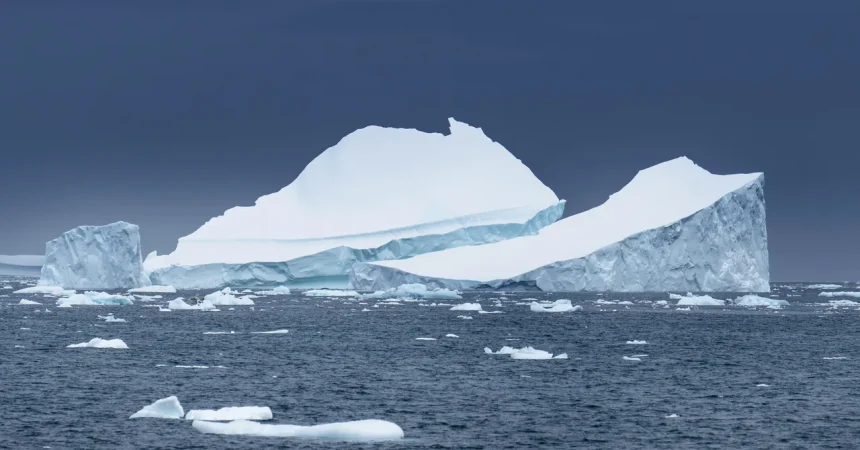
The vast, frozen wilderness of Antarctica, once perceived as a bastion of permanent stillness, is undergoing a transformation that has left the scientific community profoundly unsettled. In what should be the peak period of winter ice expansion, satellite imagery has revealed a chilling anomaly: an area of the Bellingshausen Sea roughly equivalent to the size of France is entirely devoid of ice. Even in the depths of June, when the continent’s icy mantle should be relentlessly advancing, this massive expanse of ocean remains stubbornly liquid. Specialists like Dr. Will Hobbs, whose career has been dedicated to studying these frozen reaches, describe the situation with a raw, visceral frustration, using the word “depressing” to capture the shock of witnessing nature deviate so sharply from its historical rhythm.
This is not merely a localized curiosity; it is a signal of a climate system struggling to maintain its equilibrium. Scientists are increasingly concerned that the absence of this protective ice layer is creating a feedback loop of warming. Without the reflective surface of the sea ice to bounce solar radiation back into the atmosphere, the open ocean absorbs more heat, which in turn prevents further ice from forming. This phenomenon likely contributed to a staggering, record-breaking temperature spike on the Antarctic Peninsula, where the mercury climbed to 15.4 degrees Celsius—nearly 22 degrees above the typical winter expectation. Such extremes in an environment defined by its bitter, sub-zero stability are deeply alarming indicators that the regional climate is becoming erratic and potentially hostile.
The ecological stakes for the creatures that call this harsh frontier home are impossibly high. Beneath the winter ice, the ecosystem operates on a delicate, invisible clockwork. Krill, the foundational species of the entire Southern Ocean food web, rely on the underside of this ice as a shelter from predators and a grazing ground for algae. As the ice vanishes, the nursery for these tiny crustaceans is evicted, threatening the very bottom of the food chain. For the iconic emperor penguin, the consequences are already manifesting in tragedy. These birds require stable, long-lasting ice to raise their chicks; when it fails to appear, or breaks apart prematurely due to unseasonable warmth, the survival rate for entire colonies plummets, as evidenced by recent devastating losses that have pushed the species toward the brink of endangered status.
Furthermore, the vulnerability of the continent extends far beyond local wildlife and threatens to impact the entire globe through the acceleration of sea-level rise. The Bellingshausen Sea acts as a front-line guardian for some of Antarctica’s most notorious glaciers, specifically Pine Island and Thwaites. These massive bodies of ice are already known for their instability, and their seaward edges are typically bolstered by floating ice shelves shielded by a buffer of winter sea ice. When that protective barrier disappears, the wave energy of the open ocean can buffet these ice shelves directly, encouraging them to fracture and collapse. Should these massive glaciers begin to crumble at a faster rate, the cumulative effect on global sea levels could be profound, turning a regional Antarctic crisis into a worldwide coastal challenge.
The frequency of these events suggests that we have entered a new, precarious era for the polar regions. Dr. Hobbs and his colleagues note that this is the third time in just four years that sea ice levels in this sector have reached such historic lows, leading some to wonder if the region has passed an irreversible tipping point. The loss of consistency in the Antarctic winter is not just a scientific data point; it represents the unraveling of a biological and physical structure that has defined the Southern Hemisphere for millennia. As the old records for temperature and ice density are routinely shattered, the scientific consensus is shifting from observing a gradual change to witnessing a rapid, systemic breakdown of the polar environment.
Ultimately, the plight of the Antarctic serves as a sobering reminder of the interconnectedness of our planet’s climate. What happens thousands of miles away in a desolate, frozen sea is not isolated from the rest of the world; it is linked to the heat waves on our continents, the health of our oceans, and the safety of our coastlines. As we look toward the future, the empty, water-filled expanse of the Bellingshausen Sea stands as a silent testimony to the urgency of climate instability. Protecting these remote places is no longer just a mission for scientists or conservationists—it is a necessary endeavor for understanding and preserving the delicate balance of the entire global ecosystem before the ice that sustains us all reaches a point of no return.