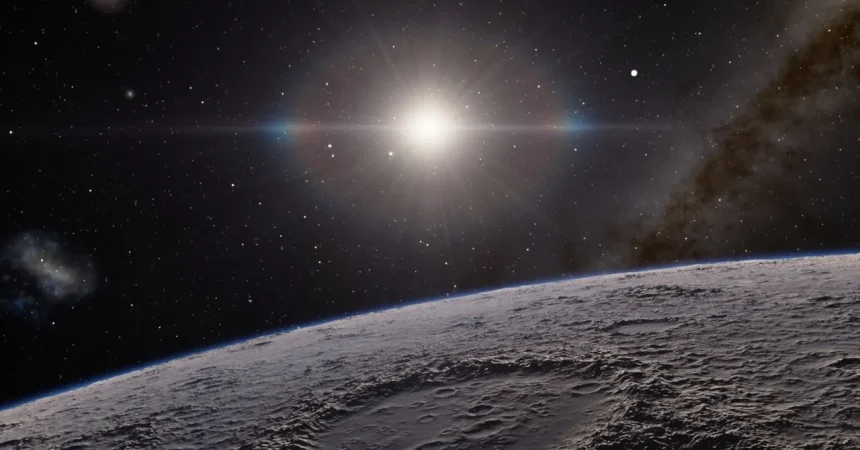
On a quiet Wednesday, a piece of space history unfolded in a place where we rarely get to watch human-made objects meet their end. A SpaceX Falcon 9 upper stage, a hulking relic of a 2025 mission, finally reached the conclusion of its long, aimless journey through the stars by slamming into the lunar surface. For astronomers around the world, this was meant to be a high-stakes, front-row seat to a celestial event. Despite having precise calculations on exactly when and where the 5,400-mph collision would occur, the moment itself remained frustratingly elusive. Even with high-powered telescopes pointed toward the moon, no one actually managed to capture a direct image or a video of the impact flash on the lit side of the crater, leaving us with a strange silence where we expected a spectacle.
While the visual proof might be missing, the scientific evidence of the crash is far from non-existent. Researchers working with the European Southern Observatory’s Very Large Telescope in Chile identified a telltale signature in the minutes following the predicted impact: a faint, ethereal stream of sodium and lithium. Scientists are confident this was the “smoking gun” of the collision. They believe the sodium was kicked up from the lunar crust itself, while the lithium likely served as the final, metallic echo of the rocket’s own hardware. It is a humble, chemical way to confirm such a violent event, but in the vast, dark theater of space, it is exactly the kind of forensic clue that allows scientists to confirm that our discarded technology has officially left its mark on our closest neighbor.
The aftermath of this event is still being processed by the global scientific community. NASA, which had promised to monitor the situation, has yet to publish their own findings, and institutions everywhere are currently busy scrubbing through terabytes of data to see what might have been missed in the initial excitement. We already know the rough physical toll the impact took: calculations suggest the rocket carved out a crater roughly 60 feet wide and 12 feet deep, sending a plume of lunar dust and rock lofting into the airless sky. We won’t have to wait too long to see the scars, however. Both NASA’s Lunar Reconnaissance Orbiter and South Korea’s lunar craft are scheduled to pass over the impact site soon, and they will likely bring us the high-resolution photographs that have so far eluded ground-based observers.
The difficulty in filming this event serves as a gentle reminder of just how challenging space observation truly is. Even with professional-grade, earthbound telescopes, the tricky lighting conditions and the sheer distance of the impact site made capturing the moment nearly impossible. This reality stands in sharp, ironic contrast to the internet, where a wave of hoax videos and fabricated imagery has already begun to circulate on social media, claiming to show the “real” impact. It is a recurring modern tragedy where truth struggles to keep pace with the instant gratification of viral content. While professional astronomers struggle with the complexities of orbital mechanics and light, digital opportunists have already “solved” the mystery with pixels that were never actually there.
Looking at the broader picture, this event is part of a growing trend in our space-faring era. This particular rocket stage didn’t hit the moon on purpose; after its mission was finished, it was left in an unstable orbit. Over the course of more than a year, the complex gravitational tug-of-war between the Earth, the sun, and the moon slowly tugged it off course until its path finally intersected with the lunar surface. It isn’t even the first time this has happened—a Chinese rocket struck the moon in 2022—which signals that our “orbital junkyard” is beginning to impact our celestial neighbors in ways we haven’t fully accounted for yet. It is a quiet, metallic reminder that everything we send into orbit eventually has to go somewhere.
As we look toward the future, this incident serves as a quiet call to action. With human lunar missions and commercial space activity ramping up significantly, the moon is becoming an increasingly crowded destination. This unexpected crash highlights the growing necessity for more rigorous safety protocols and space traffic management. We are no longer just looking at the moon as a distant, pristine rock; it is becoming a workspace, a laboratory, and, unfortunately, a potential site for our leftover debris. As we continue to push the boundaries of what we can achieve in the stars, we must also get better at cleaning up after ourselves, ensuring that the legacy we leave on the moon is one of careful exploration rather than forgotten, crashing scrap metal.