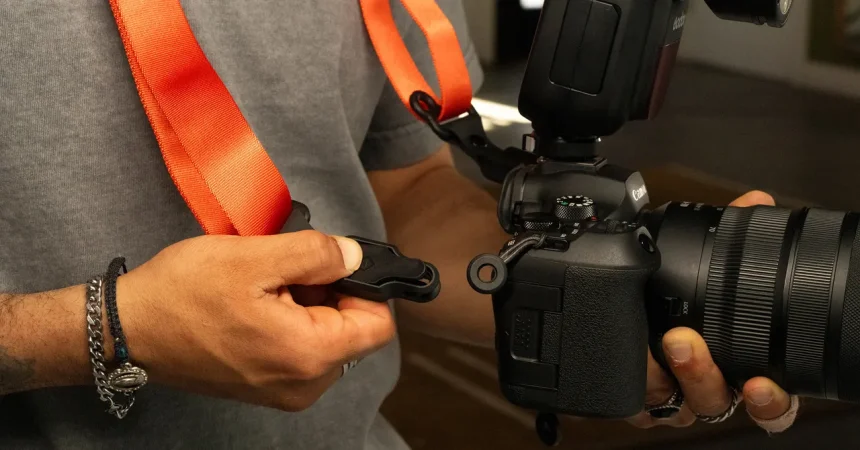
If you’ve ever unboxed a brand-new camera, you know the ritual. You peel away the plastic, admire the body, maybe click the lens into place, and then you get to the strap. And almost without fail, that strap is a disappointment. It’s thin, flimsy, and plastered with the manufacturer’s logo, the kind of thing that feels less like a piece of gear and more like a promotional handout. It’s the sort of strap you tolerate because you have to, not because you want to. But the real frustration shows up in practice. You’re out in the field, trying to attach your camera to a tripod or a gimbal, and that cheap strap is now a floppy, whipping hazard. It dangles, it swings, it smacks you in the face at the worst possible moment. You end up awkwardly trying to tuck it out of the way, or you just give up and let it flail around, hoping it doesn’t scratch the camera or ruin your shot. It’s a small thing, but it’s the kind of small thing that can make a beautiful day of shooting feel just a little more annoying. That’s why someone needed to rethink the camera strap in the first place.
More than a decade ago, Peak Design did exactly that. They looked at the humble camera strap and said, there has to be something better than this. Their solution was the Anchor Links system, a set of small, sturdy circular nubs that you leave attached to the eyelets of your camera. Instead of wrestling with a strap every time you want to remove it, you can simply detach the strap from those anchors in a second. Need to throw the camera on a tripod? Pop the strap off. Want to switch between a neck strap, a wrist strap, or a shoulder strap? Swap them out without getting your fingers tangled in fabric and buckles. It was one of those ideas that seems obvious in hindsight, but at the time, it was a revelation. The quick-connect mechanism changed the game, and it didn’t take long for it to become the de facto industry standard. Competitors took notice, and soon enough, copycat systems started popping up everywhere, each one trying to mimic that satisfying click-and-release feel. Peak Design had essentially invented a new category, and for years, their system was the one everyone else was measured against. But now, a new player has come along, and they’ve found a way to push that idea even further—using magnets.
That player is Wandrd, a company best known for its camera bags and everyday carry gear. They’ve been watching the strap space for a long time, and this week, they launched their own take on the quick-release camera strap. It’s called the Magnetic Camera Strap system, and it does something no other strap has done before. Instead of relying purely on mechanical locks and tension, it uses magnets to help guide the strap into place. “We’re photographers ourselves, so we’re constantly ideating, tinkering, thinking of ways that things can be better,” Ryan Cope, Wandrd’s cofounder, told WIRED. “A camera strap like this has been at the back of our minds for a while.” That patient, deliberate approach shows in the design. The system looks familiar at first glance—there are circular anchors that attach to your camera, just like Peak Design’s. But Wandrd calls theirs Torus Links, and they’ve added a twist that changes the whole experience. The anchors are donut-shaped, with a hole in the center, and that hole is the key to how the magnetic connection works.
Here’s how it all comes together in practice. The Torus Links are the round, donut-shaped pieces you attach to your camera’s eyelets. They’re rated to carry up to 198 pounds, which means unless you’re doing something seriously unusual with your camera, they’re not going to fail on you. The strap itself ends in a mechanism Wandrd calls the CoreLock, and this is where the magnetic magic happens. When you bring the strap near the Torus Link, embedded magnets inside the CoreLock start to pull the two pieces together. You don’t have to align everything perfectly, you don’t have to fumble around and press little buttons while holding a heavy camera with one hand. The magnets do the guiding, and then the CoreLock pinches into the hole at the center of the Torus Link, locking the camera securely in place. It’s a satisfying, almost effortless connection, the kind of thing that makes you wonder why nobody thought of it sooner. But what’s really clever is that Wandrd didn’t just make a magnetic strap for the sake of magnets. They made a magnetic strap that’s actually more secure than the alternatives because you can’t just pull it off. It’s not like a MagSafe accessory on your phone, where a quick tug yanks it free. To detach the strap from the Torus Link, you have to use the dual-pinch mechanism on the CoreLock, deliberately squeezing the top and bottom of the lock before the strap comes away. That means the magnets are a convenience, not a compromise. You get the ease of a guided connection, but you also get the peace of mind that your camera isn’t going to accidentally detach and crash to the ground.
Wandrd also borrowed one of the smartest safety features from Peak Design’s playbook, but they made it their own. The cords on the Torus Links are covered in black fabric, and over time, all cords wear down eventually. The question is how you’re supposed to know when that’s happening before it’s too late. Wandrd’s answer is a visual warning system built right into the cord. As the fabric starts to wear away, you’ll first see yellow underneath, a subtle but clear signal that it’s time to start thinking about replacements. If the wear gets to the point where you see red, that’s the stop sign. That means the cord is compromised, and you should stop using the link immediately. It’s a small detail, but it’s the kind of detail that photographers actually need. Gear gets abused. It gets tossed into bags, scraped against rocks, pulled in all directions. Having a built-in warning system takes the guesswork out of maintenance and helps you avoid a catastrophic failure at the worst possible moment. And to back it up, Wandrd offers a two-year warranty, so if anything goes wrong in that window, you’re covered. It’s not just about making a strap that works well when it’s brand new; it’s about making a strap that stays reliable over the long haul, and that’s exactly the kind of thinking photographers appreciate.
Does a magnetic camera strap make your photos better? No, not directly. It won’t give you better light or a sharper lens. But what it does do is remove a small, constant source of friction from your workflow, and that can make all the difference when you’re in the field. The best gear is the kind you don’t have to think about, the kind that just works the way you want it to, so you can focus on the actual shooting. That’s what Wandrd is aiming for here. They’ve taken an idea that Peak Design made famous, added their own magnetic twist, and created a system that feels both familiar and fresh. For photographers who have been using the same basic strap setup for years, it’s a compelling reason to try something new. And for anyone who’s ever been annoyed by a cheap camera strap, it’s a sign that the industry is still listening, still tinkering, still trying to solve the little problems that make a big difference. The camera strap might not be the most glamorous piece of gear in your bag, but when it works right, you barely notice it. When it doesn’t, you notice it every single time. With the new Magnetic Camera Strap system, Wandrd is betting that a little bit of magnetic help can make the whole experience feel smoother, more secure, and just a little bit more enjoyable. And honestly, after all these years of dealing with flimsy straps and annoying dangling fabric, that sounds like a pretty great upgrade.