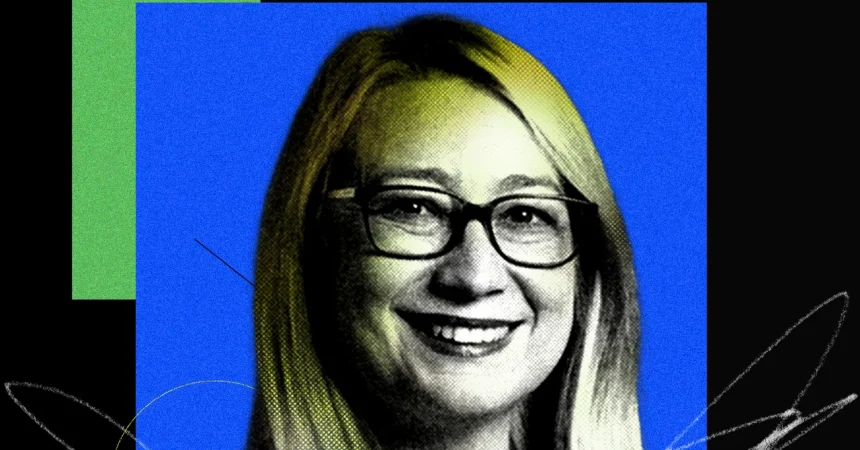
There are moments in life when the abstract suddenly becomes unbearably concrete. Jess Asato has spent her political career trying to make the online world safer, especially for women and girls. As a Labour MP and a longtime campaigner for survivors of violence and abuse, she had read the emails, listened to the testimonies, and helped shape the Online Safety Act that was supposed to force platforms to take responsibility. She knew the statistics by heart: the proportion of women who have experienced online abuse, the number of deepfake images doubling each year, the way a single fake image could rewrite a person’s future. She knew the stories too, the ones recounted in quiet corners of committee rooms, through tears, by mothers and daughters and colleagues who had been told to laugh it off or just stay offline. She had met women whose careers were ended, whose relationships were poisoned, whose mental health collapsed after a stranger pressed “generate.” She thought she understood. But understanding is not the same as living through it. That truth arrived on a day she cannot fully reconstruct, in the form of a message from an ally, then another, then a flood. Someone had used Grok, the artificial intelligence chatbot built into X, to produce explicit, fabricated images of her face and body. The images were false. They also could not be unseen. In the space of a few minutes, the campaigner became the victim; the public figure became a haunted private woman; the safe boundary between political work and personal life collapsed into pixels. For years she had been the person who said, “We believe you” to strangers. Now she was the stranger, trying to believe herself.
The Grok deepfake scandal had escaped the laboratory before anyone could build a fence. Grok, Elon Musk’s chatbot, was marketed as a rebellious alternative, a machine that said what it thought and drew what it was told. It was supposed to be a satirist, a provocateur, a jester in the court of AI. But the joke was on everyone who had to be the punchline. The image generator had no meaningful safeguards, despite repeated warnings from civil society groups. It could be instructed to make a realistic photograph of a woman in any state of undress, and the fact that the woman was real and had not consented was treated as a minor inconvenience, a bug to be fixed later. The scandal was not a leak or a hack; it was a feature of the system. Users exchanged prompts, shared tips, and bragged about producing images of famous people. Jess Asato’s name eventually came up. She had been involved in high-profile campaigns against online misogyny, which made her enemies; she had a public and easily scraped image archive; and she was a woman, which in the dark corners of the internet remains enough. When she finally saw one of the images, she felt the floor fall away. It was not a caricature or a blurry parody. It was her face, clear and recognizable, superimposed on a naked body in a pose that made her stomach turn. There was no attacker in the room, no emergency, no wound. But her body suffered its own private emergency anyway, the kind that makes your heart race and your hands go numb. She remembered thinking: this is how good people are destroyed.
The first image did not end the story; it began a slow leak of poison. In the days that followed, Asato discovered more images in different places, on different accounts, generated by different people who had somehow found the same name. She began to check whether people could see her differently. She looked at photographs of herself with suspicion, wondering if the face she sent in a work email might somehow be mined for another sick fantasy. She felt the strange, irrational need to apologize, as though she had done something wrong, though she had only been the subject of a crime. This is the anatomy of online abuse: it compresses the immense pressure of a crowd into a single, unsupported spine. Every notification became a potential ambush. Every meeting with a constituent carried the secret fear that someone had seen the images and thought they were real. She thought about the girls she had defended on the campaign trail, the ones who said they would never leave their bedrooms, and for the first time she felt their isolation not as a statistic but as a physical weight. She thought about her family, too, and the shame of having to explain something that she had not done. How do you tell a person you love that someone has made a pornographic version of you without your permission? How do you say that your face now lives in rooms you will never enter? The images are not her. But they wear her eyes, her smile, her jawline. They are ghosts in a machine, and they are impossible to exorcise.
This is not a story about one politician. Deepfake image abuse has become one of the fastest-growing forms of violence against women in the digital age, an assembly line of humiliation that runs twenty-four hours a day. Around the world, politicians, journalists, actors, and ordinary schoolgirls have been targeted. In South Korea, classrooms became laboratories of sexual exploitation with deeply fake images of classmates. In Britain, a creator of AI-generated abuse was jailed after manufacturing hundreds of images of real people, mostly women, and the case barely made front-page news. Even the most famous woman in the world, Taylor Swift, was attacked by AI-generated explicit images that reached millions before they were removed. The technology has outrun the law, and the platforms have chosen to treat the problem as a public-relations issue rather than an emergency. For Asato, there is an extra layer of cruel irony. She had supported the Online Safety Act, a landmark piece of British legislation designed to hold platforms accountable for illegal content. But the Act was written before the latest generation of AI tools, and its provisions have not been fully implemented. The law is like a lock built for a door that no longer exists. When she reported the images to the platform, she encountered what so many victims describe: a labyrinth of automated forms, mystery-meat prioritization, and silence. The platform seemed to treat her as a glitch rather than a human being. She asked for the images to be removed; some went down, then resurfaced. She asked for information about the accounts; there was no answer. She asked for someone to take responsibility; the company preferred to talk about freedom of expression. It was a painful education in everything she had been trying to change, and it taught her that the architecture of the internet is not neutral. It is a system of choices, and the choices have been made to maximise engagement, not safety.
The temptation for any victim is to withdraw, to go quiet, to hope the world forgets. Jess Asato did not choose that path. After the initial shock, after the sleepless nights and the urge to disappear into a sea of deleted accounts, she made a decision to turn her own violation into a platform. She was not going to let the person who typed her name win. She spoke to colleagues, many of whom admitted they had experienced similar threats but had kept silent out of shame. She contacted survivors, psychologists, regulators, and other parliamentarians. She demanded that the government of the United Kingdom classify deepfake pornography as a serious criminal offence, not a nuisance or a bit of “online mischief.” She called on X and the companies selling AI image generators to install meaningful safeguards, to verify the identity of users, to prevent public figures from being manufactured into explicit content without their consent. She knew that she could not single-handedly change the culture that produced the image. But she could refuse to be evicted from public life. She could use the very thing her abuser wanted to take away, her voice, to speak even louder. There is something profoundly human in her response. She did not turn her pain into a manifesto; she turned it into a question for the people in power. Are you going to keep telling women this is just the price of being online? Or will you finally begin to build a world where the camera cannot become a weapon? She also allowed herself to be angry, because anger is the fuel that keeps survivors moving. Anger at the people who manufactured the images, at the platform that profited from them, at the culture that would tell her to just ignore it and move on. That anger did not make her hard; it made her clear.
In the end, Jess Asato’s story is not a tragedy. It is a warning, and a measure of how far we still have to go. The deepfake images will never be completely erased. They are out there, buried in the strange archives of the internet, waiting to resurface on someone else’s hard drive. But so is her voice. She continues to walk into Parliament, to speak in debates, to carry the stories of the survivors she has met alongside her own. She has discovered that the horror of online abuse is not only the image; it is the feeling of being isolated, of being turned into an object in a world that asks you to prove your reality. And she has learned that the only way to fight objectification is to remain stubbornly, messily, and publicly alive. Her battle is not yet won. The technology is still developing; new tools are appearing; millions of women are still vulnerable to the same crime. But she has given them a witness. She has shown that a face is not a resource, a name is not a prompt, and a woman’s body is not a public park for the imagination of strangers. If the platforms will not listen, she will make them hear. If the law is not ready, she will help it grow. And if anyone thought that a little bit of fake porn could silence her, they were wrong. Jess Asato is still here, still fighting, and still refusing to let the algorithm have the last word.