Picture this: you’re standing at the kitchen sink, filling a glass with tap water. It’s clear, it’s cold, and it’s safe enough, but maybe there’s a faint whiff of chlorine or a slightly flat, metallic taste. So you reach for a pitcher with a carbon filter, the kind that’s become a fixture in so many American kitchens. That little filter does something real—it can make your water taste and smell noticeably better by trapping some of the things that make tap water unappealing. But here’s the thing: when compared to a reverse osmosis system, also known as RO, a carbon filter is a pretty modest upgrade. RO systems use a semipermeable membrane to push water through at a microscopic level, removing an enormous range of contaminants that a simple carbon pitcher simply can’t touch. That doesn’t mean carbon is useless, though. RO can’t capture everything, and carbon filters remain genuinely helpful for grabbing certain volatile organic compounds through adsorption. That’s why most serious RO systems actually include a carbon filtration stage built right in—they’re not rivals, they’re partners in the quest for cleaner, better-tasting water.
Now, if you’ve ever looked at under-sink water filtration systems, you might have been confused by the variety. There are two main kinds of reverse osmosis systems on the market today, and the difference matters more than you might think. The older style, called tanked systems, filters water slowly but steadily, without needing electricity. The purified water is stored in a rather large holding tank tucked away under your sink, ready to be drawn on whenever you open the tap. That sounds convenient, but the tank takes up a lot of cabinet space, and water can sit in it for a while before you use it. The newer option, tankless systems, process water on demand, which means you get fresh, purified water whenever you want it. The tradeoff is that these systems require electricity to keep the water flowing quickly and efficiently through the membrane. And because they’re more complex, they tend to be considerably more expensive. There’s no perfect answer for everyone; it all depends on your kitchen layout, your budget, and how much filtered water you actually go through. But the choice between tanked and tankless is an important one, and it’s worth understanding before you spend your money.
Before you start shopping, it’s natural to wonder: how worried should I actually be about what’s in my water? The honest answer, according to people who work in water treatment for a living, is that most of us don’t need to lose sleep over it. John Voll, an industrial water treatment veteran who now runs a site that tracks water and air quality for hundreds of municipalities, puts it plainly: “US tap water is safe for most people most of the time. The problems are local, not universal.” That’s a reassuring sentence, but it’s also a call to action. The only way to know whether your water has a local problem is to look at your own water supplier’s most recent quality report. The Safe Drinking Water Act requires community water systems to publish an annual report on the water they deliver, and those reports must be out by July 1 every year. They’re not exactly beach reading—they’re dense, bureaucratic documents packed with numbers and legal thresholds. But Voll says you really only need to keep your eye on three key pollutant metrics: lead, nitrate or arsenic, and PFAS, the so-called forever chemicals found in nonstick cookware, waterproof jackets, and countless other everyday products. Lead and nitrate or arsenic are serious health concerns, but they’re fairly rare in modern municipal supplies. PFAS, on the other hand, are turning up all over the country, and they’re a much bigger deal than most people realize. According to Voll, 98 of the 200 largest US cities have at least one PFAS compound detected in their water supply. That’s a striking statistic. And if you want to remove PFAS, reverse osmosis is one of the few household filtration methods that can actually do it. Carbon filters generally can’t. So the takeaway is simple: don’t assume your water is full of dangerous chemicals, but also don’t assume it’s perfectly clean. Read the report first, then decide.
Of course, deciding to install a reverse osmosis system isn’t just about what it can remove; it’s also about what you’re willing to put up with. And there are some real drawbacks to consider. The first is water waste. The technology behind reverse osmosis has historically been inefficient, requiring a lot of tap water to create a relatively small amount of purified water. In the old days, the ratio could be as bad as four gallons of tap water for every one gallon of clean water, with the rest sent down the drain. That’s a lot of waste, and it’s not great for your water bill or the environment. The good news is that newer systems have gotten much better. Modern RO units can produce up to three gallons of clean water for every four gallons of tap water, or a roughly 3-to-1 pure-to-drain ratio. That’s a huge improvement, but it means you’re still sending some water down the drain every time you fill a glass. The second big drawback is cost, and not just the upfront price. RO systems can require up to six different filter cartridges, each with a different job, and they all need to be replaced every year or two depending on how much water you use. This is the classic printer ink problem: the machine is affordable, but the consumables keep adding up. Plan to spend anywhere from $50 to $200 a year on replacement cartridges, and be sure to check the price of replacements before you commit to a particular system. There’s also the mineral question. Reverse osmosis membranes are so good at filtering that they remove things you might actually want to keep. Calcium, magnesium, and potassium are all too big to pass through the membrane, which means your purified water may be nearly mineral-free. That’s fine for taste, but some people prefer water with a little mineral content. RO systems also remove fluoride, which many municipalities add to drinking water to prevent tooth decay. Dentists are not fans of this. If you want those minerals back, you can buy a system with a remineralization cartridge, but that’s yet another replaceable part and yet another ongoing expense.
Then there’s the installation, which is where things can get a little intimidating. Unless you already have a dedicated faucet and a hole drilled in your countertop, installing an under-sink RO system is going to involve some home modification. Most systems come with their own faucet, so you need to prepare to have a new hole drilled into your countertop if you don’t have one available. And because there’s plumbing involved, you need to think carefully about whether you’re comfortable doing it yourself. I’ll be honest: I’m not a fan of DIY projects that involve water, even when they seem simple. A small leak under the sink, unnoticed for a few days, can cause serious damage to cabinets, flooring, and walls. So I always bring in a plumber for installations like this. I’d rather pay for professional peace of mind than risk a slow drip behind a closed cabinet. That said, the physical setup isn’t nearly as complicated as it sounds. The under-sink RO filter is separate from your existing plumbing, and most systems use three color-coded lengths of tubing to connect to the water supply, the drain, and the new faucet. One tube connects to your incoming water supply through a small adapter valve, another clips into your wastewater drainpipe with a fitting that’s included in the box, and a third carries the purified water up to the faucet. If you were replacing an existing system, you could probably manage these connections on your own. But for a first-time installation, especially if your plumbing is old or cramped, having a professional there is worth every penny. In my case, the plumber had an aged unit removed and a new one installed in less than an hour. It was painless, once I handed over the check.
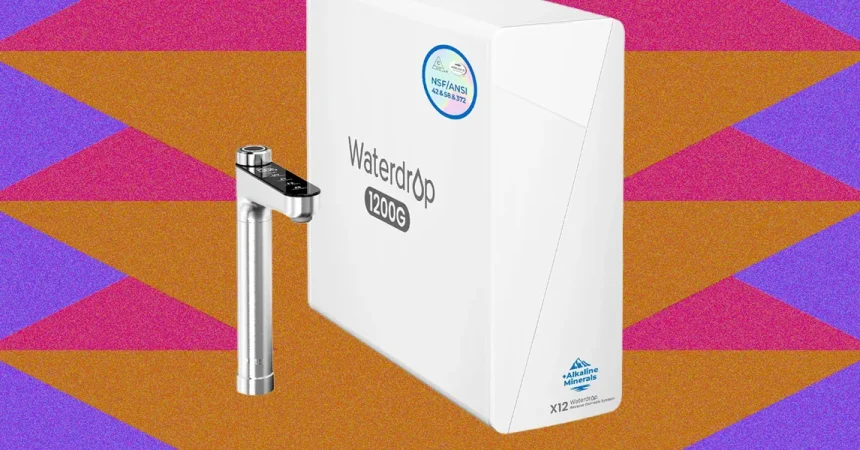
So, after all this, do you actually need an under-sink reverse osmosis system? The honest answer is: probably not, unless your water report shows a problem or your water tastes bad enough to bother you. For me, it was about taste. I looked up my city’s annual water report, and there was nothing hazardous in it—no lead, no arsenic, no concerning levels of PFAS. But the report also mentioned that my water supplier uses chloramine as a disinfectant, and drinking that treated water straight from the tap has a slight but noticeable, off-putting taste. That taste is made worse by the extreme hardness of the water where I live. The region is basically limestone bedrock, so the water picks up a lot of calcium carbonate, which can add a slightly bitter flavor to everything from coffee to ice cubes. I didn’t need an RO system to be healthy; I wanted one because I wanted my water to taste better. The fact that it removes lingering contaminants along the way is just a bonus. I tested the Waterdrop X12, a tankless under-sink reverse osmosis system, and it made a real difference. The water comes out crisp and clean, with no odd aftertaste, and it’s nice to know that I’m drinking something that’s had a serious workout before it reaches my glass. If you’re considering an RO system, my advice is to start with your water report. If there’s a real problem, then by all means, invest in a good system—it’s worth it. If your water is safe but you just don’t love the taste, RO can absolutely fix that too. And if your water is already clean and tastes great, maybe stick with a simple carbon pitcher or save your money. There’s no one-size-fits-all answer, but the good news is that you don’t have to guess. The information is out there, and a little research can tell you exactly what you need. Clean, good-tasting water is one of those quiet daily pleasures that’s easy to take for granted, but once you have it, you’ll wonder how you ever lived without it.