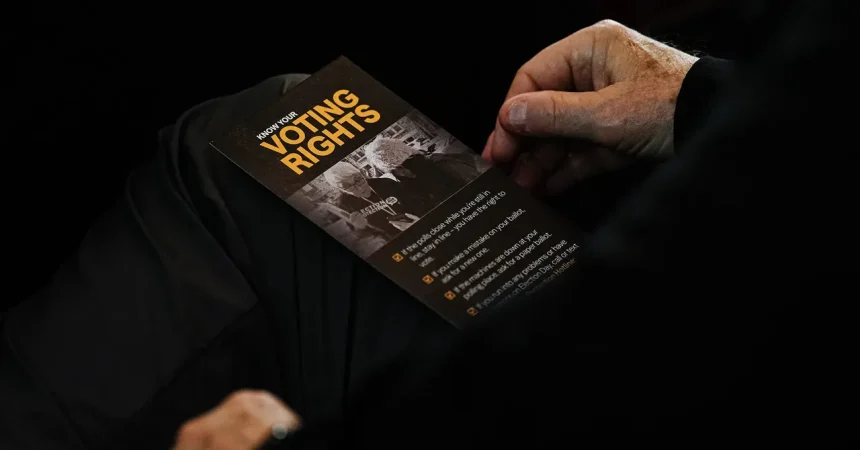
In the gray November chill of central Columbus, Ohio, the Franklin County Board of Elections building at 1700 Morse Street stands as a quiet symbol of civic life. Inside, neighbors cast their ballots for the midterm elections. Outside, the street is alive with the rhythms of a vibrant Somali American community — halal markets, family-owned shops, mothers pushing strollers, elders walking slowly with canes. But beneath that ordinary bustle is a deep and lingering unease. This same neighborhood was the target of Operation Buckeye, a coordinated Immigration and Customs Enforcement campaign last December that federal officials said was aimed at “the worst of the worst criminal illegal aliens.” The operation, meant to reassure the public, instead left behind something far more complicated: a modest number of arrests, months of sustained harassment, and a persistent dread that federal agents might reappear at any moment, especially now, during the high-stakes days of early voting. For many residents, the election building is not just a place to vote; it is a place they must pass through with their hearts in their throats, hoping that the familiar black SUVs and dark uniforms do not materialize on the sidewalk ahead.
Liliana Rivera Baiman knows that fear intimately. An organizer with 614 ICE Watch and the Ohio Good Neighbor Network, she has spent the weeks leading up to Election Day watching the neighborhood around Morse Street with careful, practiced eyes. “Here in central Ohio, our early voting location is located in a neighborhood that’s been the hardest hit by ICE, and it’s an immigrant community neighborhood,” she said. “So we knew that that neighborhood was at risk and that people were going to be going to vote there, and a lot of the community there, like our Somali community that can vote, our Latino community, they walk to the location.” The message from the Trump administration had been loud and threatening: immigrant communities could be targeted during the midterms, and no one knew exactly what that would look like. So Baiman and her fellow organizers decided they would not wait to find out. They began training volunteers to serve as watchful eyes and protectors of the democratic process — not to confront agents, but to observe, document, and report. The goal was not to escalate tension, but to make sure that anyone who wanted to vote could do so without the shadow of immigration enforcement hanging over their shoulder. It was, Baiman said, about teaching people to see what was really happening, to recognize the insignia on an ICE vest, the model of an unmarked vehicle, the way agents move in pairs through crowded streets.
The volunteer effort in Columbus is both deeply local and part of a much larger national movement. On any given day, dozens of people patrol near early voting sites in the city, and on Election Day that number is expected to swell to roughly 250. These volunteers receive training on how to identify immigration agents, how to record interactions on their phones, and how to share information quickly and safely through encrypted apps like Signal and WhatsApp, where dozens of groups coordinate in real time. Baiman described the training process in practical, grounded terms: “We teach people that they have to observe the behavior. We show them what to look out for, what does ICE look like, this is the type of uniform that agents wear, these are the types of vehicles that they drive. We show them examples so that they can get familiar with what they might see.” For the volunteers, many of whom are retired teachers, college students, faith leaders, and lifelong residents of immigrant neighborhoods, the work is both simple and profound. They are not lawyers; they are witnesses. They are not there to police the police; they are there to make sure that the act of casting a ballot is not swallowed up by fear. One volunteer, when asked why she had chosen to stand for hours in the cold outside a polling place, thought for a moment and then said simply: “Because my neighbors deserve to be seen as voters, not as targets.” That sentiment, unremarkable and yet radical, echoes across the country in the countless efforts now unfolding around early voting sites and Election Day precincts.
From Arizona to California, from Georgia to Ohio, similar groups have been building what one organizer called “a human safety net for democracy.” WIRED spoke to a dozen people involved in this work, and their descriptions form a picture of coordinated, hyperlocal resistance to an environment of threat. Massive national organizations like the American Civil Liberties Union, Common Cause, and Indivisible have been running training sessions that teach ordinary citizens how to observe polling places, understand voter rights, and respond to intimidation. But local groups — Living United for Change in Arizona, NorCal Resist, and countless others — have taken those lessons and adapted them to the specific fears of their communities. In some places, volunteers are stationed at bus stops and intersections near polling centers, carrying clipboards and water bottles, wearing bright vests that say “Election Observer” or simply “I’m Here to Help.” In others, they have set up phone trees and rapid-response chains so that if someone spots a federal agent, the word spreads within minutes. They have practiced worst-case scenarios: What if ICE enters a polling place? What if someone is stopped on the way in? What if a family is sitting in a car in the parking lot, waiting for their turn, and an unmarked vehicle pulls up beside them? These are not theoretical questions; they are the stuff of daily life for people who have seen agents sweep through their neighborhoods before. The training sessions are not just about legal knowledge, though that matters deeply — they are about building a shared sense of agency, of turning helplessness into preparedness.
All of this is happening in the face of an official statement from the Department of Homeland Security, which has repeatedly said that ICE has no plans to deploy agents to polling locations on Election Day. “ICE is not planning operations targeting polling locations,” a DHS spokesperson told WIRED, adding a crucial caveat: “ICE conducts intelligence-driven targeted enforcement, and if an active public safety threat endangered a polling location, they may be arrested as a result of that targeted enforcement action.” For immigrant communities, that caveat is precisely what makes the threat so difficult to dismiss. The line between “targeted enforcement” and “you happened to be there” is thin and easily blurred. A parent who is dropping off a child at a babysitter’s house and then walking to vote could be seen as collateral damage in an unrelated operation — or even the subject of a mistaken identity. The law is clear that U.S. citizens and lawful permanent residents have the right to vote without being questioned about their immigration status, and that polling places are generally off-limits to certain kinds of law enforcement activity. But people who have lived through raids, who have heard stories of neighbors vanished in the night, or who have themselves been detained in the past do not always trust the fine print of legal protections. They know that a badge and a uniform carry an authority that can override paperwork, and that the fear of being questioned is often enough to keep someone away from the ballot box entirely. That is why the volunteer observers are not just documenting ICE sightings; they are also helping voters understand that they have rights, that they can ask for a lawyer, that they do not have to open their doors, that their presence at a polling place is a protected act.
In the end, what is unfolding in the neighborhoods around 1700 Morse Street and in similar communities across the country is not simply about one election or one federal policy. It is about the meaning of belonging, the promise of representation, and the willingness of ordinary people to stand alongside their neighbors in moments of fear. For every volunteer who wakes up before dawn to stand outside a polling place, there is a voter who sees that familiar bright vest and takes a breath. For every message sent through a Signal group warning that a suspicious vehicle has been spotted, there is a family that decides to walk together to the polling station, holding hands. The organizers know that they cannot erase the trauma of raids like Operation Buckeye, nor can they fully shield anyone from the arbitrary power of immigration enforcement. But they can make something visible: a community that refuses to be terrorized into silence. They can show, in the most basic and human of ways, that the right to vote belongs to everyone who lives in this country, regardless of the color of their skin, the sound of their name, or the length of their journey. And as Election Day approaches, the people of these neighborhoods are not asking for pity. They are asking to be seen — not as threats, but as citizens, as neighbors, as part of the American story. In that simple act of showing up, of watching over the vote, they are rewriting that story from the ground up. The line outside the election building stretches down the block, and the volunteers have coffee and hand warmers to share. The morning is cold, but the community is warm. The vote is waiting. And so are they.