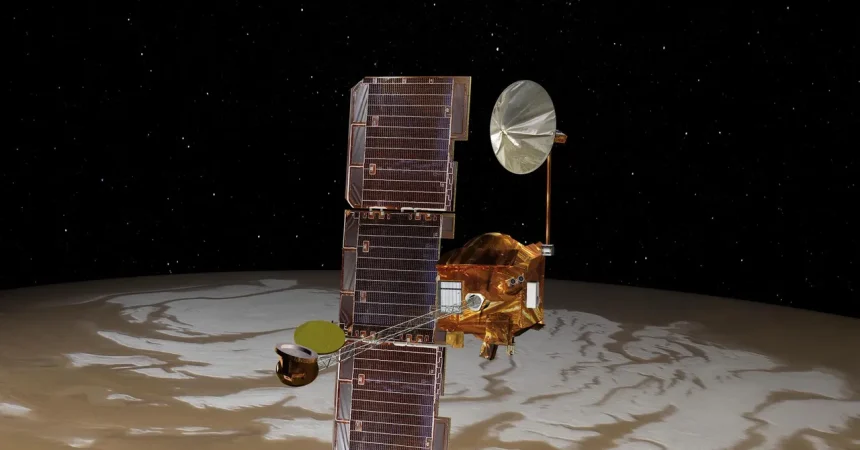
In the long, lonely silence of deep space, some machines become more than machines—they become pioneers, veterans, and quiet legends. NASA’s Mars Odyssey spacecraft, for instance, has reached an almost amusing milestone: it has been operating for so long that, if it were a person, it could rent a car without any young-driver fees. It arrived at the Red Planet on October 24, 2001, a moment that now feels like a lifetime ago. Back then, many of the engineers who sent it on its way probably assumed they would celebrate its mission for a few years and then move on to the next project. Instead, Odyssey kept going. Along with its younger sibling, the Mars Reconnaissance Orbiter, or MRO—now twenty years old itself—these two orbiters have survived far beyond anyone’s most optimistic dreams. The scientists and engineers who watched their launches never could have imagined that these spacecraft would still be circling Mars today, sending back data, snapping images, and acting as the steady, reliable voices for every rover on the ground. They have become the wise old grandparents of Mars exploration, still sharp, still curious, still willing to share everything they have learned with a younger generation that often takes them for granted.
Having such an unbroken, decades-long record of observations from above the Martian surface has done nothing less than rewrite the story of water on Mars—both the water that existed long ago and the water that still exists in frozen, hidden pockets today. It is easy to think of Mars as a dry, dusty ball of reddish rock, but Odyssey’s instruments have mapped vast reserves of subsurface ice, revealing a planet that is far more interesting and dynamic than a simple dead world. MRO, meanwhile, has watched gullies, slopes, and dust patterns shift over time, catching Mars in the act of changing season after season. Those images give scientists something they never had before: a time-lapse view of another planet’s surface in astonishing detail. Together, the two orbiters have helped transform Mars from a static picture into a living, breathing world in the imagination of the public and the understanding of researchers. Briony Horgan, a planetary scientist at Purdue University who is not involved with either mission, put it plainly: both Odyssey and MRO are some of the most productive spacecraft ever built. They are not just useful; they are critical to NASA’s entire Mars research program. Without them, scientists would be flying blind, missing the kind of long-term perspective that only dedicated, patient orbiters can provide.
Keeping these aging orbiters alive, however, has not been easy. Space is a brutally harsh environment, and simply surviving for decades takes a combination of skill, stubbornness, and no small amount of good luck. One of the greatest dangers is the constant barrage of high-energy particles streaming through the solar system. These particles can slam into delicate electronics, corrupt memory, damage instruments, and, in the worst cases, end a mission entirely. Engineers on Earth would love to keep constant watch over their spacecraft, the way they do with satellites orbiting close to home. But Mars is far away, and bandwidth is limited. According to Rob Lillis, a planetary and space physicist at the University of California, Berkeley, who has worked on several newer Mars orbiters, science spacecraft at Mars might only check in with Earth once or twice a week. That means there is no round-the-clock support, no immediate human hand to fix a problem when something goes wrong millions of miles away. A Mars spacecraft has to be able to manage by itself. It must detect glitches, protect itself from dangerous events, and even enter safe modes without waiting for a rescue team to call. The fact that Odyssey and MRO have done this for so long is a testament to brilliant engineering and constant creative problem-solving, often under pressure and with limited information.
One of the most important jobs these two orbiters do is far behind the glamorous science they perform: they connect humans on Earth to every NASA rover on Mars. The rovers cannot communicate directly with Earth in any practical way, so they rely on the orbiters to relay their messages home. Without Odyssey and MRO, the rovers would be isolated, and the entire Mars exploration program would grind to a halt. Every picture taken by a rover, every soil sample analyzed, every weather report, every status update flows through these veteran spacecraft. They are the invisible bridge across millions of miles of emptiness, carrying the voices of robots like Curiosity and Perseverance back to the people who built them. It is a deeply human role, almost like a parent who stays up late to make sure the children get home safely, and it has made the orbiters indispensable. Yet even as scientists celebrate their achievements, a troubling question lingers: will Odyssey and MRO be the last of their kind, at least for the Red Planet? The future of Mars exploration is uncertain, and there is no guarantee that NASA will build another orbiter with the same combination of endurance, instruments, and relay capabilities. Budgets are tight, priorities shift, and the focus has turned to other destinations and new challenges. Some researchers wonder if the era of the great Mars orbiters is coming to an end.
There is something almost bittersweet in the idea that the very spacecraft that have taught us so much might soon have no successors. Odyssey’s observations of ice, for example, helped show that Mars is not barren but layered with water frozen just beneath the surface—a crucial discovery for future human missions, which will need water for drinking, growing food, and making fuel. MRO’s ability to see surface features change over time turned Mars into a planet of moving sand, shifting ice, and seasonal activity, rather than a static relic. Horgan called these missions critical, and Lillis emphasized their ability to operate independently in a hostile environment. Together, they represent a kind of golden age of Mars exploration, one that may not come again for a long time. But perhaps their greatest legacy is not just the data they have sent home, but the example they have set. They show that with enough patience, enough creativity, and enough stubbornness, machines built by human hands can outlast even the engineers who designed them. They prove that exploration is not always about the newest, shiniest object; sometimes it is about the old workhorse that just refuses to quit. Odyssey can rent a car now, but more importantly, it has earned the right to be called a true pioneer of another world.
As we look up at the Red Planet and think about what comes next, it is worth pausing to appreciate what these two remarkable spacecraft have given us. They arrived when the internet was still young, when cellphones were still novelty items, when the Space Station was barely under construction. They have watched the world change below them on Mars and the world change below them on Earth. They have survived solar storms, computer glitches, aging instruments, and the quiet anxiety of engineers counting the days. They have persisted through every challenge, not because they were built to last forever, but because good engineering and a little luck can take a machine a very long way. And so, while scientists wonder whether another orbiter like them will ever fly to Mars, they can also take comfort in the fact that these two are still here, still working, still whispering secrets about the Red Planet back to the eager human race. Eventually, all good missions must end. But for now, Odyssey and MRO remain shining examples of what happens when determination meets discovery. They are not just machines orbiting Mars. They are the enduring memories of every launch-day dream, every late-night troubleshooting session, every small success and hard-won victory. They are proof that sometimes the greatest journeys are measured not in speed, but in persistence. And for that, they deserve more than a rented car—they deserve our awe.