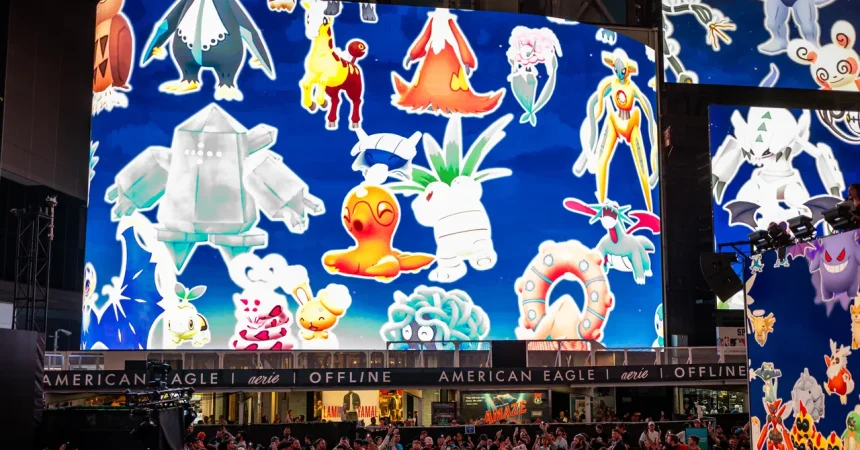
The recent spectacle in New York City wasn’t just a gaming event; it was a testament to how far technology and community building have come since the frantic, glitchy summer of 2016. To manage the immense intensity of Times Square, organizers invited 2,000 hand-picked “Pokémon Go” trainers to participate in a curated, high-energy experience. By keeping the event invitation-only through a network of community ambassadors, the team avoided the chaos that usually accompanies such massive public gatherings. For the players, the allure was shrouded in mystery: they knew something thematic was brewing, but the true scope of the night—a blend of live music and coordinated digital warfare—remained a secret until the moment the city’s iconic billboards flickered to life.
As the sun dipped below the Manhattan skyline, a signal went out to the gathered trainers: it was time to converge. What followed was a masterclass in modern event design. The EDM duo Loud Luxury provided the soundtrack, turning the public square into an electrifying party, before the real show began. On the towering screens surrounding the square, Mega Mewtwo Y made a dramatic entrance, signaling a massive, unified raid. Thousands of players stood shoulder-to-shoulder, their devices illuminated in the night, working in perfect synchronization to take down the legendary Pokémon. It was a fleeting, magnificent moment where the digital and physical worlds collided, turning the busiest intersection on Earth into a colossal gaming arena.
The beauty of this event, however, wasn’t just for those lucky enough to stand in the heart of New York. Recognizing that local presence is only half the battle, the developers ensured this experience was shared globally. Every trainer, regardless of where they were in the world, was invited to participate in a special “Global Fest.” While the rest of the world might have lacked the towering Times Square screens, they were granted the same access to the Mega Mewtwo Y raids. This inclusivity is central to the game’s philosophy; it transforms Pokémon Go from a local fad into a massive, borderless social network that connects millions, proving that the magic of the game thrives best when everyone is invited to the table.
Looking at the raw numbers, the scale of this phenomenon remains staggering. With over 800 million players over the last decade and a staggering one trillion Pokémon captured, the game has evolved into a cultural cornerstone. Even now, in 2025, it commands a billion dollars in revenue annually with 100 million active players who continue to incorporate the game into their daily routines. On average, trainers spend 45 minutes a day roaming their neighborhoods, collectively logging over 62 billion miles since the game’s inception. These aren’t just statistics; they represent a global movement of people finding reasons to step outside, explore their local geography, and engage with the world in a way few other digital platforms have ever successfully encouraged.
A major key to this sustained longevity is the shift toward community-led growth. Kim Adams, the VP of Game Development, points out that the company has leaned heavily into the people who care most about the game: its players. By vetting and empowering over 3,000 community ambassadors worldwide, they have created a grassroots support structure that keeps local groups active and engaged. With nearly a million tickets sold for live events in 2024 alone, the data proves that this community-first approach is working, with daily playtime and real-world exploration metrics trending upward. It is a striking turnaround from a company that once struggled to keep its servers from buckling under the excitement of its own massive player base.
That growth hasn’t come without its own set of growing pains, though. Longtime players like Howie Ragunton remember the infamous growing pains of the 2017 Chicago event—a cautionary tale of what happens when infrastructure fails to keep pace with ambition. Back then, cell networks crashed and servers stood paralyzed, leaving thousands of trainers disappointed. But as Ragunton notes, the company has learned, adapted, and hardened its infrastructure to handle the load of modern massive-scale raids. Seeing the game evolve from that early, rocky infancy into the seamless, tech-heavy production seen in Times Square proves that while Pokémon Go started as a trend, it has matured into a sophisticated, global institution that knows exactly how to keep its community walking, raiding, and playing together.