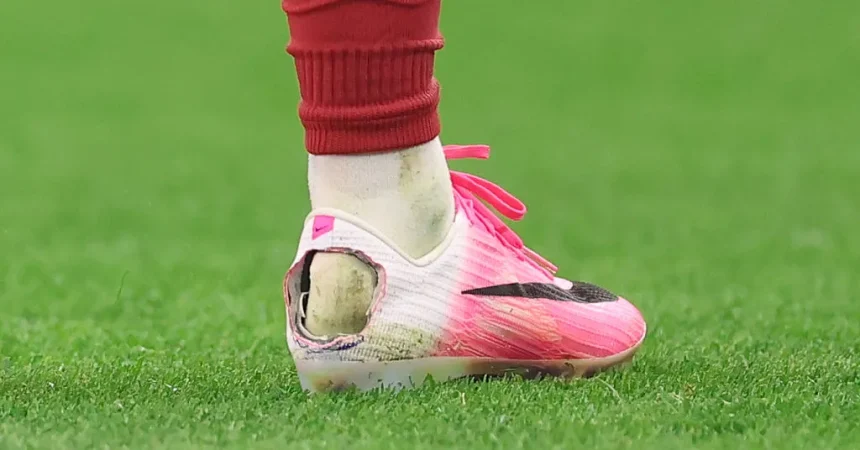
During the intensity of this year’s World Cup, a seemingly bizarre visual trend captivated fans and commentators alike: Portuguese forward Pedro Neto took to the pitch wearing cleats that had been deliberately hacked away at the heel. At first glance, it looked like a wardrobe malfunction or a bizarre fashion choice, but it was anything but an error. This intentional modification was a calculated move, designed to relieve agonizing pressure on a notoriously sensitive part of the foot. It served as a stark reminder that even at the highest levels of global sport, the world’s elite athletes are often battling silent, physical discomforts that the casual viewer usually never sees.
While images of Neto’s mangled-looking footwear went viral on social media, the practice itself is a long-standing “open secret” within professional soccer. For years, players have been surgically modifying their footwear to reduce the friction between rigid, high-performance materials and their sensitive heels. In a sport where cleats are engineered to fit like second skin and every explosive sprint or lateral juke demands absolute biomechanical precision, even a minor source of irritation can be catastrophic. If a player is distracted by a nagging rub or a sharp pinch in their heel, their focus shifts, their movement becomes guarded, and their performance inevitably suffers.
The origins of this persistent discomfort are as varied as the players themselves. For some, it may be a simple case of recurring blisters or raw skin caused by hours of repetitive training. For others, the pain stems from deeper internal issues, such as inflammation of the Achilles tendon or chronic structural peculiarities where a player might simply have a naturally larger or more prominent heel bone. In the relentless, high-impact world of professional soccer, these vulnerabilities often become roadblocks, forcing players to find creative – and sometimes drastic – solutions to keep their careers on track without compromising their speed or technique.
One of the most frequently discussed medical explanations for this specific type of pain is Haglund’s syndrome, often referred to by athletes as “pump bump.” According to the American Academy of Orthopaedic Surgeons, this condition involves a bony enlargement on the back of the heel bone that grinds against the Achilles tendon, causing persistent swelling and throbbing. While the term suggests a structural deformity, it manifests as a debilitating syndrome that makes the simple act of pulling on a pair of tightly laced sports shoes an excruciating experience. For these athletes, the condition isn’t just an inconvenience; it is a clinical challenge that dictates how they approach their professional footwear.
Treatment for such conditions generally starts with trying to make the shoe more hospitable, usually by opting for softer materials or utilizing protective heel pads. However, the constraints of professional soccer present a unique dilemma: players are bound by strict team and tournament regulations regarding their gear, yet their feet are being crushed by the very equipment mandated for the field. Consequently, modifying the physical structure of the cleat—by hacking away the rigid heel counter—serves as a necessary, if unconventional, “loophole.” It mirrors the way players have long cut holes in their socks to relieve pressure on their calves; it is an act of functional rebellion born out of necessity rather than preference.
Ultimately, the focus on Pedro Neto’s Nike Mercurial Vapor 16 Elites during the Portugal-Spain match highlights a broader truth about modern sports: there is no such thing as a “perfect” universal fit. While the boots provided to superstars are technically the same models available to the general public, they are rarely worn “off the shelf.” They are sculpted, stretched, and often physically altered to accommodate the unique biology of the player inside them. By cutting the back of his cleats, Neto wasn’t disrespecting the gear—he was reclaiming his autonomy, proving that even in the most technologically advanced game on Earth, the human element still demands the final say on how it moves.