The quest to create truly functional humanoid robots has reached a fascinating turning point. For years, we have marveled at viral videos of machines dancing, performing backflips, or gracefully navigating obstacle courses. While these feats are impressive displays of engineering, they remain largely performative. To be useful in our daily lives—or to serve as reliable workers in our industries—these robots must transition from impressive gymnasts to proficient laborers. Becoming “truly human” in a functional sense doesn’t mean having a realistic face or smooth skin; it means possessing the ability to handle the mundane, messy, and repetitive drudgery of the workplace that we often take for granted.
Enter Flexion Robotics, a Swiss startup composed of former Nvidia researchers who believe they have unlocked the secret to practical autonomy. Rather than focusing on a single, highly choreographed trick, the team is working to solve the “chore problem.” Their approach centers on teaching robots basic, transferable mechanics—like how to grip a handle, navigate a flight of stairs, or balance while holding a box. By treating these as individual building blocks of movement, Flexion is moving away from the “one-trick pony” model of past robotics, aiming instead to create a general-purpose helper that can adapt to the unpredictable chaos of a real-world office or warehouse floor.
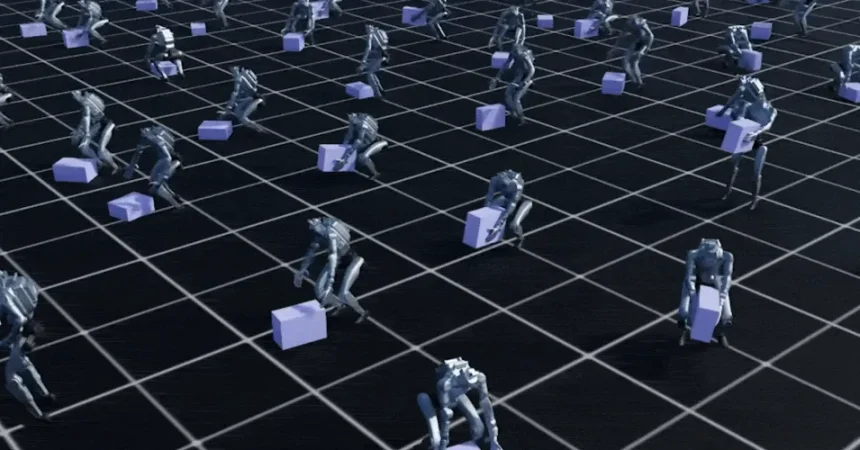
The standard industry approach to training robots has historically relied on teleoperation, where a human operator controls the robot’s every move from behind the scenes. While this produces polished demo videos, it is inherently fragile. A robot that folds a shirt perfectly in a sterile lab often fails spectacularly the moment it is placed in an unfamiliar room with different lighting or floor textures. Flexion’s method flips this script by utilizing advanced simulation. They train their agents within a virtual environment, allowing the robot to fail millions of times—learning from its mistakes—without the risk of breaking expensive hardware. This simulation process, combined with minimal human guidance, creates a foundation of “muscle memory” that functions far more reliably when the robot finally hits the floor.
The true magic of the Flexion system lies in its hierarchical AI structure, which essentially functions like a human brain delegating tasks to its limbs. First, a master AI model interprets a user’s verbal command—such as retrieving a package from a lobby and stocking it in a breakroom drawer—and breaks it down into a sequence of logical steps. This model acts as a project manager, determining which learned skills it needs to chain together to complete the mission. To guide this process, the system digests vast libraries of video footage showing humans performing these same tasks. It then correlates those observed movements with the simulated skills it has already mastered, translating a video of a person handing someone a package into a set of physical coordinates for its own motors and grippers.
At the core of this innovation is the concept of reinforcement learning, a technique where the machine treats every attempt at a task as a data point to improve. According to Nikita Rudin, the company’s CEO and a veteran of Nvidia’s robotics division, this “secret ingredient” is woven into every layer of the software. From the master model deciding the high-level strategy to the low-level controllers keeping the robot upright while it walks, trial and error is the teacher. This makes the robot remarkably resilient; if it fumbles a box or misjudges a step in simulation, it eventually finds the perfect path to success. By the time the robot is deployed in the physical world, it is effectively a seasoned veteran, having already “experienced” countless variations of the task at hand.
Ultimately, Flexion’s vision represents a shift toward a future where robots are integrated into the fabric of our workspaces as reliable, autonomous assistants. While the idea of a humanoid robot acting as a personal office courier might feel like science fiction, the technology is rapidly arriving at our doorstep. By mastering the art of the mundane—the simple, repetitive, yet physically demanding chores that fill our workdays—these machines are finally moving toward the true purpose of their existence. The goal isn’t just to make a robot that looks like us, but one that can effectively stand beside us, easing the burden of our daily labor and proving that real intelligence is often found in the ability to handle the small stuff.