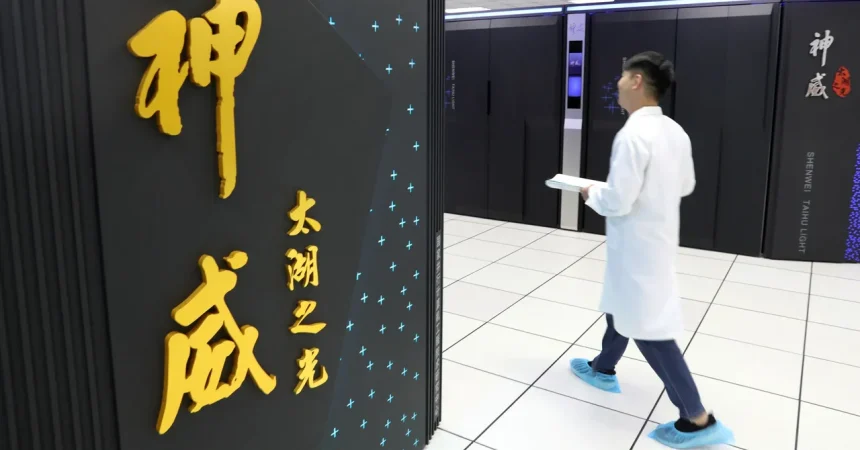
The landscape of global technology has shifted dramatically with the recent revelation that China’s “LineShine” supercomputer has officially claimed the title of the world’s fastest machine. Located at the National Supercomputing Center in Shenzhen, this massive system has dethroned the American-built “El Capitan,” which had held the number-one spot since 2024. This change in the TOP500 ranking—the definitive list of the world’s most powerful computing systems—marks a symbolic and technical turning point. After nearly a decade of watching U.S.-led innovation dominate the top of the leaderboard, China has successfully reasserted its presence in the high-stakes world of elite computing, proving that its domestic capabilities have reached a level of maturity that the international community can no longer overlook.
The technical specifications of LineShine are, by any measure, staggering. It achieves a processing power of 2,198 exaflops, meaning it can execute over two quintillion operations per second, effectively outperforming the outgoing U.S. champion by a significant margin of more than 20 percent. Perhaps most impressive is that it accomplishes this sheer velocity while consuming roughly 42.2 megawatts of power. However, it isn’t just the speed that has caught the attention of computer scientists globally; it is the unique design philosophy behind the machine. Unlike contemporary supercomputers, which rely heavily on specialized Graphics Processing Units (GPUs) to handle massive parallel processing tasks, LineShine is built entirely on Central Processing Units (CPUs). This is an unconventional approach for modern supercomputing, as CPUs are typically found in common laptops and phones rather than the sprawling racks of massive data centers.
This accomplishment is more than just a win for performance benchmarks; it is a profound testament to Chinese self-reliance. Every inch of LineShine’s architecture—from the software to the hardware—is homegrown. The system is powered by approximately 45,000 “LX2” processors, each boasting 304 cores operating at 1.55 GHz. These chips are integrated into the LingKun platform and held together by a high-speed networking system known as LingQi, which was specifically engineered to reduce lag and optimize data transfer speeds. By running on the China-developed Kylin OS, a Linux-based operating system, the entire project serves as a practical demonstration that the country has successfully bypassed the need for Western-made foundational software and architecture to solve the world’s most complex scientific problems.
The timing of this breakthrough is far from accidental, arriving in the thick of a broader, geopolitical struggle for technological hegemony. For years, the United States has enforced a rigorous program of export controls, tariffs, and restrictions on the flow of high-end semiconductor technology, advanced AI components, and specialized software to China. These policies, spanning both the Trump and Biden administrations, were explicitly designed to throttle the pace of China’s technological ascent. By blocking access to the most advanced hardware, Washington aimed to keep domestic Chinese firms from reaching the same high-performance capabilities as their American counterparts. LineShine, however, stands as a direct rebuttal to the idea that these supply chain barricades will effectively stop China’s progress.
Rather than being slowed down by these restrictions, China has instead intensified its internal focus, pouring investment into indigenous innovation. Because the country was denied easy access to the cutting-edge GPUs that power Western AI development, its engineers were forced to innovate around the bottleneck, resulting in the CPU-focused architecture seen in LineShine. This shift illustrates a “necessity is the mother of invention” scenario on a national scale. Beijing is using this achievement to signal to the world—and particularly to the United States—that the Chinese technology sector is not only capable of surviving under intense external pressure but is actually using that pressure to catalyze a new phase of independent industrial development.
Ultimately, the emergence of LineShine changes the nature of the conversation surrounding global computing. We are no longer living in a world where there is one clear, unified path to building high-performance systems. Instead, we are seeing the rise of a bifurcated environment where China is forging its own ecosystem of processors, networks, and operating systems that operate independently of U.S. control. While the U.S. remains a formidable force in the supercomputing arena, the dominance of LineShine serves as a clear warning that the gap in computing power is not widening in favor of the West. It is a bold, undeniably powerful message that in the race for future dominance in AI and scientific computing, the rules and the players are shifting as quickly as the data these machines process.