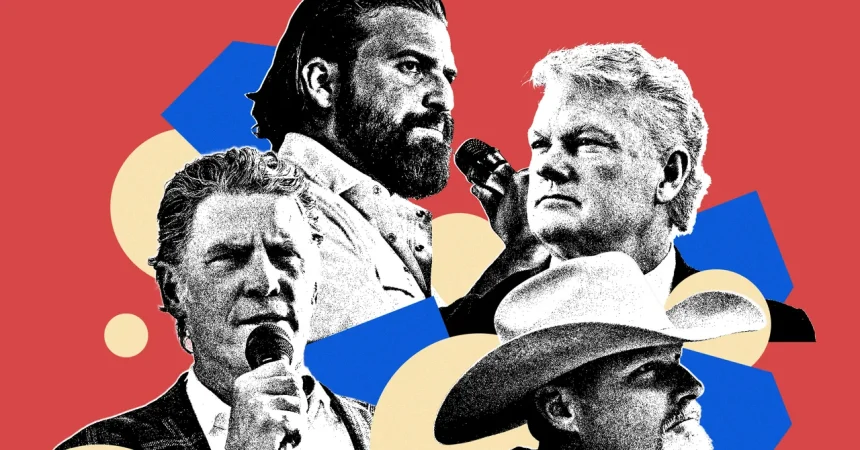
Five weeks from now, Americans will walk into polling places and make choices that will shape their communities, their states, and their country. Yet if you only listened to the television ads, you might not realize that in much of the United States, extremism itself is on the ballot. A WIRED review of candidates running for statewide and federal positions, paired with exclusive data on state-level races, has found hundreds of Republican candidates who openly express virulently hateful ideologies, share racist content on their own social media feeds, have close ties to white supremacist and antisemitic figures, and are members of far-right groups online. These are not isolated cases. They are not being disciplined by the party. President Donald Trump and his administration have openly embraced, endorsed, and defended many of them, sending a clear signal to primary voters and donors that radical behavior is not a stray accident but a winning formula. For the average voter, this can feel overwhelming. It can be hard to know what is true and what is exaggerated. But the evidence is not buried in secret files. It is visible to anyone who knows where to look. Some of these candidates are running in safely Republican seats, which means that if their primaries were won, they are almost certainly going to be elected in November. Others are in swing districts that could go either way. But whatever the outcome in individual races, the presence of so many extreme candidates changes what it means to be a Republican and, more importantly, what it means to hold power in America. The question is whether enough people will look before November, or whether the normalization of hatred will simply become another step in the long, slow slide of American democracy.
The most disturbing part of the data is how local it is. Data collected by the Institute for Research and Education on Human Rights and shared exclusively with WIRED shows that more than 500 candidates running for state legislative seats in November are members of far-right Facebook groups that promote militias, gun rights, and Christian nationalism. Let that sink in for a moment. These are people who could be elected to the state House or state Senate, the very bodies that decide what your children learn in school, whether voting is easy or difficult, how police departments are funded, what health care is available in your community, and whether your local election results are certified without interference. A Facebook group might seem harmless at first, like a place where people post memes about the Second Amendment or share prayers for the nation. But many of these groups function as recruitment centers and grievance chambers where conspiracy theories are treated as fact, where democratic institutions are openly mocked, and where political opponents are described in the language of enemies in a war. When more than 500 candidates are members of these spaces, it is not a coincidence. It is a network. And that network is powered by a worldview that sees pluralistic democracy as a weakness to be exploited rather than a system to be protected. The people in these groups are not anonymous trolls hiding behind fake names. They are your neighbors, your local lawyers, your small business owners, your former city council members. They have learned that the fastest way to win the loyalty of the far-right base is to prove that they are willing to tear down the norms that previous generations of politicians considered sacred. If they win, they will not simply be legislators. They will be foot soldiers of a movement that believes the old rules no longer apply.
The primary season offered a preview of what this movement has become, and it was not entirely welcoming to every extremist. Groyper James Fishback and antisemitic influencer Dan Bilzarian, for example, did not make it through Republican primaries. But their losses should not be mistaken for a return to decency. Many candidates with similarly radical views survived their primaries and are now on general election ballots, and a number of them are expected to win. This is not a bug in the system; it is the system recognizing that the acceptable range of political behavior has shifted. According to Luke Baumgartner, a former research fellow at George Washington University’s Program on Extremism, these candidates are “taking a page out of the Trump administration’s playbook.” He argues that the executive branch has handed them “a permission slip to say and do what would have been unthinkable during the George W. Bush, McCain, or [Mitt] Romney eras of the GOP.” Think about what that means in human terms. In the not-so-distant past, a candidate caught sharing a racist image or consorting with white nationalists would have been committing political suicide. Their own party would have abandoned them, their donors would have walked away, and their campaign would have collapsed. Today, those same actions are almost a form of proof, a way to signal to the base that you are not part of the old guard. The primaries did not serve as a sluice gate to filter out the worst people. They served as a stress test, and many of the most extreme candidates passed. The old gatekeepers are still there, but they no longer have the authority to stop anyone. The norms that once guarded American democracy are not bending. They are being demolished on purpose.
The consequences of this political realignment are not theoretical. Researchers at the University of Maryland found that terrorism and targeted violence incidents rose by 19 percent in 2025 compared with 2024. The U.S. Capitol Police reported that threat assessment cases against members of Congress increased for the third year in a row, with a 58 percent jump from the previous year. The U.S. Marshals Service documented threats against almost 400 judges, a roughly 5 percent increase from the year before. These are not abstract statistics. Behind every number is a person who cannot walk into a crowded grocery store without scanning the room for suspicious behavior, who has added a security system to their home, who has thought about whether their children’s school is too exposed, who has changed their routine because someone on the internet decided they were the enemy. When politicians with extremist ties are given a platform, the people who listen to them understand the assignment. A conspiracy theory that begins in a Facebook group does not stay there. It moves into a candidate’s speech, then into a cable news segment, then into the mind of someone who decides that the only way to save the country is to act. The line between violent language and violent action has never been thinner. Every election cycle that passes without consequences makes that line thinner still. And the threats are not just aimed at famous politicians. They are aimed at local officials, election administrators, school board members, and judges—ordinary people who are doing their jobs and suddenly find themselves at the center of a nightmare.
To see how all of this comes together in a single contest, look at the race for Texas Railroad Commissioner. The title sounds like a relic from the 19th century, but the office is one of the most powerful positions in Texas because it regulates the oil and gas industry that drives the state’s economy. The Republican candidate, Bo French, is so extreme that Karl Rove—the architect of one of the most successful conservative political machines in modern American history—has publicly said he would vote for a Democrat rather than support what he called a “bigot.” Rove is not a progressive. He is a lifelong Republican strategist who spent decades pushing the party to the right. When a man like that says he would rather vote across the aisle than for the GOP nominee, something fundamental has changed. French is one of five candidates in races that WIRED is watching closely, and his campaign embodies the choice that voters face across the country. In another era, a candidate with this kind of reputation would have been abandoned by his own party. He would have been shunned at fundraisers, ignored by leadership, and, if necessary, primaried by a more moderate alternative. Here, he is the nominee. The party establishment can hold its nose, but it does not have to hold the line. This is what happens when a political party stops asking whether a candidate is qualified or decent and starts asking only whether they are loyal to the cause. The Texas Railroad Commission may sound obscure, but the decisions made by that office affect the air you breathe, the price you pay at the pump, and the future of the planet. When someone that extreme is in charge of those decisions, the stakes are impossible to overstate.
So what does all of this mean for you? In the next five weeks, the country is not simply choosing between left and right. It is choosing whether extremism will be treated as a normal part of governing. The candidates are not hiding. Their social media timelines are public. Their affiliations with extremists are documented. Their own words have been preserved in screenshots and videos. The permission slip came from the top, but the signatures on the ballot are their own. This is where the human choice comes in. Democracy is not a machine that runs forever by itself. It requires voters to pay attention, to ask hard questions, to look past party labels and campaign slogans and actually examine who these people are and what they believe. It requires ordinary people to resist the temptation to say, “My party, right or wrong.” It requires believing that the republic is worth protecting. The researchers who gathered this data did not do it to scare you; they did it to warn you. The candidates are not hoping you will read their old posts or trace their online networks. They are hoping you will stay busy, stay cynical, stay comfortable. They are hoping you will decide that politics is too ugly to engage with. If you do, they will be elected anyway. In five weeks, the voting booths will open. The ballots will tell the truth about who we are as a country, but only if we show up ready to hear it.