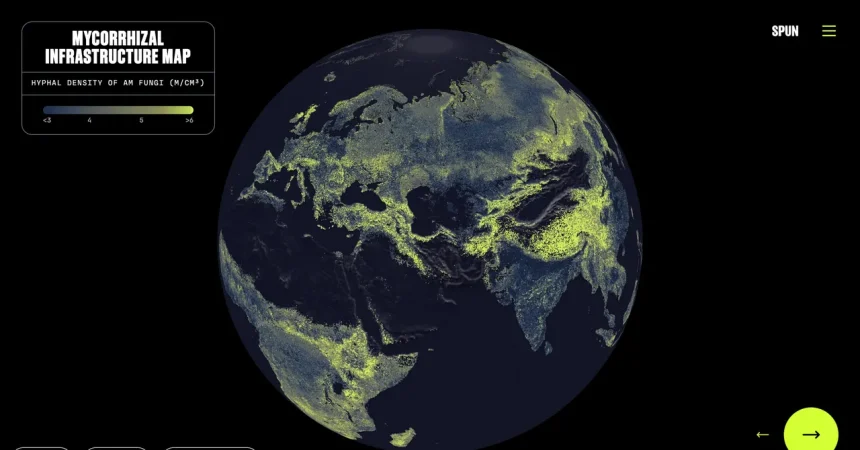
Beneath the soil you walk upon every day lies a hidden, pulsating infrastructure of life that rivals any man-made engineering feat in its complexity and sheer scale. For the first time, researchers have unveiled a global map of the mycorrhizal network—a breathtaking underground web of fungal filaments that functions as the planet’s silent support system. These microscopic threads, known as hyphae, reach out to connect the root systems of some 70 percent of all plant species on Earth. It is a symbiotic partnership written in the language of biology: the fungi provide the plants with essential water and nutrients mined from the soil, and in return, the plants feed the fungi the carbon they produce through photosynthesis. This ancient bargain is not merely a botanical curiosity; it is the fundamental mechanism that allows terrestrial life to thrive.
The numbers behind this discovery are staggering, challenging our very perception of what exists in the dirt under our boots. By synthesizing data from over 300 studies and 16,000 soil samples, an international team utilized machine learning and high-resolution imaging to estimate that this network spans an incomprehensible 110 quadrillion kilometers. To put that into perspective, if you were to lay this thread end-to-end, it would stretch nearly a billion times the distance between the Earth and the sun. This “wood wide web” isn’t just long; it is incredibly dense. A single teaspoon of healthy soil can contain up to 10 meters of fungal filament, creating a concentrated, life-giving architecture that works tirelessly, 24 hours a day, to sustain the world’s ecosystems.
Beyond its physical reach, the network is a massive player in the global climate game. The researchers estimate the total biomass of these fungi contains roughly 300 megatons of carbon—a weight equivalent to four to six times the total mass of every human being alive on Earth today. More importantly, this network acts as a carbon pump, transporting roughly 4 billion metric tons of carbon dioxide—about 11 percent of all annual human-caused emissions—directly into the soil. By sequestering this carbon, the fungi don’t just feed plants; they actively help regulate our atmosphere. In many ways, they act as the planet’s circulatory system, moving resources through the earth and stabilizing the environment in a way that remains largely invisible to our eyes.
However, the rapid transformation of our landscape is placing this silent giant under significant strain. The study found a sobering disparity: the density of these vital fungal networks in agricultural soil is roughly half that of natural, undisturbed ecosystems. This is a critical issue because of where these fungi live. Grasslands, which house an estimated 40 percent of the world’s arbuscular mycorrhizal biomass, are currently being converted to agricultural land at four times the rate of forests. As we plow, till, and chemically treat these soils, we are essentially breaking the circulatory system of the planet. When these networks are fragmented or destroyed, the soil’s capacity to recycle nutrients and lock away heat-trapping carbon diminishes, creating a negative feedback loop that harms our own food security.
The pioneers of this field, such as coauthor Merlin Sheldrake, view this mapping project as more than just an academic exercise; they see it as a call to re-evaluate our relationship with the natural world. For hundreds of millions of years, these fungi have been the primary architects of terrestrial life, yet we have only just begun to understand the logistics of their underground “highways.” By acknowledging that we share our planet with such an immense, functional, and necessary living network, we open the door to new strategies—not just for conservation, but for active restoration. Understanding how these systems function allows us to move from simply exploiting the land to potentially working in tandem with the fungi to improve soil health and combat climate change.
Ultimately, this study reminds us that we are not just walking on inert dirt, but on a living, breathing, and deeply interconnected layer of biological intelligence. The challenges we face—from warming temperatures to the need for sustainable farming—are immense, but they are not entirely beyond our control. By looking beneath our feet, we have gained a new perspective on a world that has been quietly protecting the biosphere since long before humans arrived. The next, and perhaps most vital, step is to translate this knowledge into policy and practice. If we can learn to protect and foster these vast subterranean networks, we may find that one of our greatest allies in the race to secure our future has been right beneath us all along, waiting for us to notice.