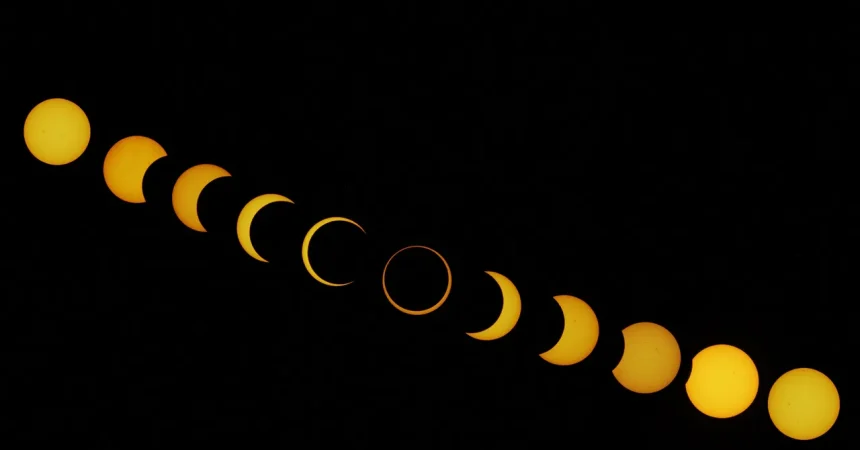
The year 2026 is poised to be a quiet one for the cosmos, featuring only four eclipses in total, but it is saving its best performances for the final act of the summer. As we navigate the calendar, August emerges as a celestial jackpot, offering two distinct opportunities to witness the universe in motion. With two eclipses having already passed earlier in the year, the events occurring on August 12 and August 27–28 represent our final chances to experience these awe-inspiring phenomena before the year closes. Whether you are a seasoned stargazer or simply someone who appreciates the rare beauty of the night sky, these late-summer spectacles promise to be the highlight of the astronomical year.
The main event kicks off on August 12 with a total solar eclipse—an event that truly stands in a league of its own. This dramatic display happens when the moon perfectly aligns between the Earth and the sun, casting a fleeting shadow across our planet. While the reach of this shadow is broad, touching parts of the Arctic, Alaska, Canada, Iceland, and even segments of the eastern United States, the true spectacle is reserved for a select few. For most, this will appear as a partial eclipse, but for those lucky enough to be in the precise path of totality, the world will briefly turn to dusk in the middle of the day.
For the most fortunate observers, the path of totality cuts through the stark, beautiful landscapes of eastern Greenland and the western edge of Iceland. However, the crown jewel of this eclipse is undoubtedly Spain. It has been over a century since the Iberian Peninsula experienced a total solar eclipse, making this a once-in-a-lifetime moment for the region. As the sun dips low toward the horizon in the late afternoon, the stage is set for a truly cinematic experience. In Spain, the event will culminate around 8:30 p.m. Central European Time, with the sun’s light being fully obscured for about two minutes. It is a profound reminder of our place in the solar system, though, as always, one must remember that viewing the sun directly—even during an eclipse—requires proper safety gear to protect your eyes.
Following the solar drama of mid-August, the sky shifts its focus to the moon on the night of August 27 and into the early morning of August 28. Unlike the solar eclipse, which requires you to be in a very specific geographic “path,” this partial lunar eclipse is a more democratic affair. A lunar eclipse occurs when the Earth maneuvers between the sun and the moon, casting its shadow across the lunar surface. Because of the way light interacts with Earth’s atmosphere, the moon often takes on a haunting, deep reddish hue, transforming the familiar white orb into a rusty, glowing disc that feels like something out of a classic science fiction film.
This specific event is exceptionally generous in its coverage, visible to a vast portion of the Western Hemisphere. Residents across the Americas—from the vast expanses of Canada and the United States down through Mexico, Central America, the Caribbean, and South America—will have a front-row seat. While the term “partial” might sound underwhelming, it is anything but; up to 96 percent of the moon’s face will be swallowed by Earth’s shadow. This creates a striking visual, leaving a sliver of the moon bright while the rest of the sphere fades into darkness. It is an ideal event for those who prefer to observe the heavens from the comfort of their own backyard, as it requires no special equipment—just a clear sky and a bit of patience.
As we look toward the end of August 2026, it is worth pausing to appreciate the timing of these events. There is a distinct, rhythmic beauty to the way the sun and moon choreograph their movements, and having two such distinct experiences so close together is a rare treat for any skywatcher. Whether you find yourself waiting for the sun to vanish over the coast of Spain or watching the moon slowly darken while sitting on your porch in North America, these moments serve as a bridge between our daily lives and the vast, silent machinery of the universe. Mark your calendars, prepare your vantage points, and take a moment to look up; the sky is putting on a show that you won’t want to miss.