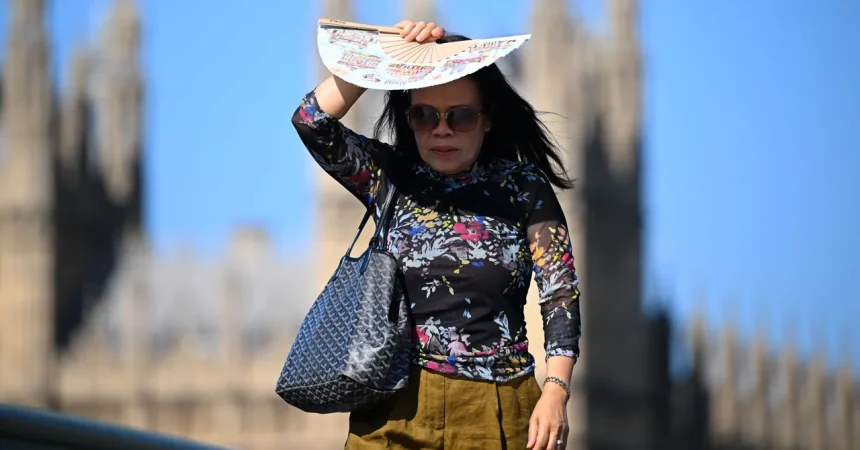
The summer heat we are currently enduring is no longer just a trend in the weather report; it has evolved into a persistent, global crisis that feels increasingly inescapable. Across the Northern Hemisphere, residents from the coastal towns of Europe to the sprawling deserts of the American West are finding themselves trapped under a suffocating blanket of record-breaking temperatures. This isn’t just “hot weather” in the traditional sense; it is a dangerous, systemic shift that is putting life, infrastructure, and the natural world under unprecedented strain. As we watch maps turn a menacing shade of red, it is becoming clear that we are living through a period of atmospheric volatility that challenges the very habitability of some of our most familiar regions.
In Europe, the situation has become harrowing, with leaders like French President Emmanuel Macron describing the combination of blistering heat and raging wildfires as the most difficult challenge the nation has faced since the Second World War. From the scorched landscapes of Spain to the traditionally temperate hills of Germany, the sheer scale of the disruption is jarring. Communities are struggling to cope as heat records are shattered one after another, turning the summer season into a genuine emergency. It is a sobering reminder that there is no longer a “safe” zone; the heat is moving across borders, finding vulnerabilities in even the most prepared societies and forcing us to question how we adapt when the weather turns truly hostile.
Across the Atlantic, the American West is bracing for its own terrifying ordeal. In places like Phoenix, where the heat is a known adversary, the current conditions are crossing into the realm of the impossible. The concern isn’t just the daytime high, which promises to climb toward a staggering 115 degrees; it is the fact that, at night, the temperature may refuse to dip below 100 degrees. When the mercury stays that high overnight, it denies the human body and our structures the chance to cool down, stripping away the natural reprieve that usually makes life in the desert possible. Further north, cities like Salt Lake City and parts of Montana are seeing temperatures that would be considered extreme even for the heart of the tropics, creating a perfect environment for wildfires to ignite and accelerate with terrifying speed.
To understand why this is happening, we have to look at the invisible forces governing our skies, specifically the phenomenon known as “heat domes.” Scientists explain that these areas of high pressure behave like a physical lid, locking in heat and sunshine while preventing the movement of cooler air. The culprit behind these stagnant domes often lies in the jet stream—the high-altitude wind currents that act as the steering wheel for our weather. When this current becomes “wavy” and sluggish, it stops circulating the air efficiently, allowing tropical heat from the south to push deep into Northern territories and stay there for days, or even weeks, on end.
However, these atmospheric mechanics are being pushed to their breaking point by a more ominous global factor: the warming of our oceans. Experts describe the situation as the Earth “running a fever.” Because our oceans are responsible for absorbing nearly 90 percent of the excess heat trapped by our carbon emissions, they have become massive reservoirs of energy that eventually bleed back into the atmosphere. This “feverish” water is a direct consequence of decades of fossil fuel reliance, and it is now fueling everything from intense hurricanes off the Mexican coast—which then pulse surges of heat into the atmosphere—to the scorching air masses currently suffocating Japan and South Korea.
Ultimately, we are witnessing the consequences of a climate that has been systematically altered by human activity. Research confirms that recent heatwaves, which have already claimed over a thousand lives in Europe alone, would have been physically impossible without the extra layer of insulation provided by man-made carbon pollution. This is the new reality we inhabit: a world where complex weather patterns like El Niño and the jet stream are no longer operating within their normal bounds, but are instead amplified by a warming planet. The challenge ahead lies in recognizing that our summer, once a time for rest and recreation, has become a frontline in the fight for our future, requiring us to confront the reality of a warming world with both scientific urgency and collective resolve.