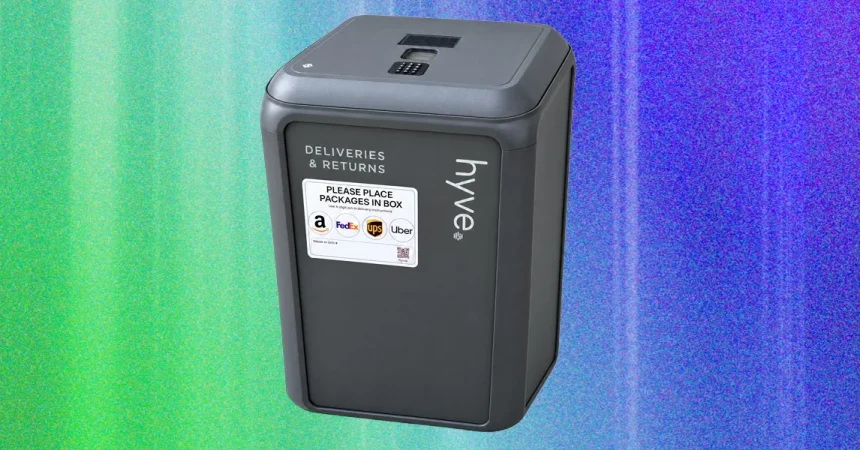
If you have ever lived in a house where cardboard boxes accumulate on the front porch like an invasive species, you know the particular low-level dread that comes with every delivery notification. I had watched one too many videos of porch pirates wandering up driveways, glancing around, and calmly walking off with my latest online order, and I had finally decided to do something about it. That something was the Hyve, a sleek, boxy parcel locker designed to sit near your front door and receive packages securely, with a hinged lid that delivery drivers can open, deposit a package into, and close, leaving the contents safely tucked away until you retrieve them. I was skeptical at first, because technology like this often promises the moon and delivers a pile of manuals and compatibility issues. But I was also desperate, so I set it up, synced the app, and waited. The next day, I encountered the FedEx driver in person, and that was only because he rang the bell, a rarity in the age of “leave it at the door” signatures. I opened the door still in my bathrobe, hair askew, and asked if he had noticed the delivery instructions on my FedEx account. He looked puzzled and confessed that he “thought he heard something” when pulling up to my house. It turned out that FedEx’s handheld driver devices can speak delivery instructions out loud, in addition to showing a garbled, half-printed version of the text on screen, but the volume on his device was turned down. There I was, standing on my doorstep in a robe, trying to explain the box, waving my phone at him, and ultimately demonstrating the Hyve myself by opening the lid and closing it again. He nodded slowly and then gave me a genuine grin. He had simply never been told that this box existed, and now he was on board. It was a small victory, but it felt like progress.
The following day, I was thrilled to get a push notification from the Hyve app that FedEx had successfully left a box for me inside. There was a little digital ding, a moment of golden triumph, and I practically ran outside to see for myself. The driver even rang the bell again, only to show me his success with a smile, like a kid who had just learned a magic trick and wanted to prove it worked. I opened the hatch, peered inside, and there was my package, safe, dry, and invisible from the street. I tell you, opening that hatch and seeing my package inside was like Christmas morning for both of us. For a moment, I felt as though I had cracked the code of modern life, a small rebellion against the chaos of porch theft and missed deliveries. But the universe, of course, has a sense of humor. The third day, a fresh FedEx delivery appeared on the porch again, sitting out in the open as if the Hyve did not exist. My heart sank. I checked the app, and nothing had been registered. The driver had moved to another route. My carefully built alliance with one helpful individual had evaporated overnight, replaced by a stranger who had no idea what this strange plastic monolith by the door was supposed to be. I was about to give up on the whole shebang, to haul the thing into the garage and accept my fate as a person who would forever be chasing delivery trucks and calling customer service. I had learned the first truth about parcel lockers: they are only as good as the goodwill of every driver who approaches your house, and goodwill is a fragile currency.
But then, something clicked. I cannot tell you exactly why, whether word spread among the local delivery drivers, whether the serial number in the delivery instructions finally got entered into the right databases, or whether the universe simply decided to reward my persistence, but all of a sudden, FedEx, UPS, and Amazon all started using the Hyve locker, and regularly. At first, it was a trickle. Then it was a flood. I soon became accustomed to getting notifications multiple times a day that the box had received a delivery, with my estimation of its usage rate climbing to something like 75 percent. No longer was my doorstep darkened with cardboard. No longer did I flinch every time I heard the crunch of a truck’s tires on the driveway. Instead, the Hyve became a kind of quiet, hardworking companion, sitting there like a dutiful mailroom clerk, absorbing the endless stream of packages that my online shopping habit generated. Trips to empty the Hyve became an undertaking necessary several times a day, and I found myself developing a new routine, a little excursion to the front door with my keys, popping open the hatch, pulling out crumpled brown boxes and padded envelopes, breaking them down for recycling, and carrying the spoils inside. It was strangely satisfying, a tangible connection to the invisible economy that delivered everything from dog food to books to oddly shaped bundles of socks directly to my home. I even began to look forward to those notifications, the little buzz in my pocket that meant something had arrived safely, ready for me to retrieve at my convenience.
The success, of course, brought a new problem. On some days, the usage level revealed quite an entirely new challenge: a single UPS delivery of a few boxes could fill the locker completely, leaving no room for anything else that arrived later in the afternoon. I discovered this the hard way when I received a notification that a package was inside, went out to retrieve it, and found the compartment stuffed to the brim with three medium-sized boxes from an online retailer, wedged in so tightly that I had to tug and pull and even tilt the whole thing to get everything out. That left the locker empty, but it also meant that if another delivery came later that day, I had to run out and clear it again, or the driver would have no choice but to leave the package on the porch. My hopes of leaving for a week and not having to worry about packages were dashed, gently but definitively. The bin simply didn’t have the capacity for more than a day or two at most, given the relentless pace of deliveries at my house. I was no longer protecting myself from porch pirates; I was simply managing a very small, very fast-filling warehouse. Early on in my testing, I spoke to the company about the usage issues I was experiencing, and its CEO freely admitted that this is, in no uncertain terms, a problem for many homeowners. The Hyve is designed for the average house, but the average house in the age of two-day shipping is apparently a very busy loading dock. She assured me that the company was aware of the limitations and was working on solutions, but for the time being, the box was what it was: a small, secure, but decidedly finite receptacle.
To combat the problem of drivers ignoring the box entirely, Hyve provides an adhesive sign that you can place on the outside, a simple, no-nonsense instruction that tells carriers to use the lockbox for deliveries. It is likely quite helpful at improving usage rates, and I have to admit that the sign probably did more work than my personal conversations with individual drivers. But it is not a panacea, and it is not particularly attractive. It looks like a parking lot notice, a little plastic placard that interrupts the clean lines of the box with a blocky message. I appreciated the pragmatism, but I did not love the aesthetic. Then, over a Zoom call, the CEO showed me another innovation that she said was having even better results. The idea was so simple, so delightfully human, that I had to laugh. Attach a placard that reads “Snack Stop” to the top of the lockbox, and stock a collection of treats inside, chips, crackers, meat sticks, little packages of cookies, anything that a hungry delivery driver might appreciate during a long day of hauling heavy boxes from truck to doorstep. The theory was that drivers would open the lid to grab a snack, see the empty interior, and be reminded that this is a place where packages are meant to go. It was a bribe, yes, but a friendly one, a small gesture of goodwill that could turn a rushed, overworked driver into a loyal collaborator. What delivery driver could possibly say no to a free Slim Jim? I pictured a weather-beaten UPS worker peeling back the lid, discovering a stash of snacks, and thinking, “Hey, this house gets it.” It was the kind of trick that made me smile, and it also made me realize that the problem of package delivery is not simply a logistical one. It is a human one, and it requires human solutions.
In the end, the Hyve taught me something I hadn’t expected: that package security is not just about locks, apps, and notifications. It is about building a tiny, unspoken relationship with the people who bring your stuff. You can install the best technology in the world, but if the driver doesn’t know how to use it, or doesn’t care, or is simply too rushed to read the instructions, it is just another expensive object sitting in your yard. The snapshot was imperfect, the capacity was limited, and the sign was far from pretty. But there were moments, real moments, when the system worked beautifully, when a notification would arrive and I would step outside to find a package tucked safely inside, warm and dry and invisible to anyone passing by. Those moments made me feel less like a lonely consumer and more like a neighbor, part of a strange, sprawling network of people who depend on each other to do the right thing. I still occasionally find a box on the porch, and I still occasionally curse the limitations of the Hyve when it fills up too quickly. But I also stock the “Snack Stop” drawer with granola bars and jerky, and I like to think that the drivers appreciate it. The next time you order something, remember that the person behind the wheel is not a robot. Give them a reason to care, even a tiny one, and the world starts to feel a little less chaotic. For me, that reason was a plastic box, a bag of chips, and the quiet joy of opening a hatch to find something waiting for me inside.