The tension in San Francisco’s Mission District throughout the mid-2010s was not merely a debate over zoning ordinances or architectural aesthetics; it was a profound, deeply personal struggle for the city’s identity. When Supervisor David Campos stepped into the vacancy left by Chris Daly to lead the anti-gentrification crusade, he tapped into a well of genuine community anxiety. By 2015, the rhetoric had reached a fever pitch, culminating in his bold, controversial call for a moratorium on all new housing construction in the neighborhood. To Campos and his base of community organizations, this was a defensive posture—a desperate attempt to hit the “pause” button before the neighborhood they loved was irreparably transformed into something unrecognizable for, and unaffordable to, its long-term residents.
However, the housing debate quickly hit a wall of practical and political friction. Scott Wiener, representing the more centrist wing of San Francisco’s Board of Supervisors, spearheaded the opposition to the moratorium. Wiener and his allies argued that shutting down production would only exacerbate the supply-side nightmare already driving prices into the stratosphere. While the Board ultimately rejected the moratorium, the political fallout had a chilling effect on the local landscape. Activist energy successfully derailed projects like the infamous, 10-story development dubbed “the Monster in the Mission.” Even today, years later, that site remains a ghost of a project—a testament to how effectively community mobilization can freeze development, even if advocates for more housing view that success as a disastrous failure of policy.
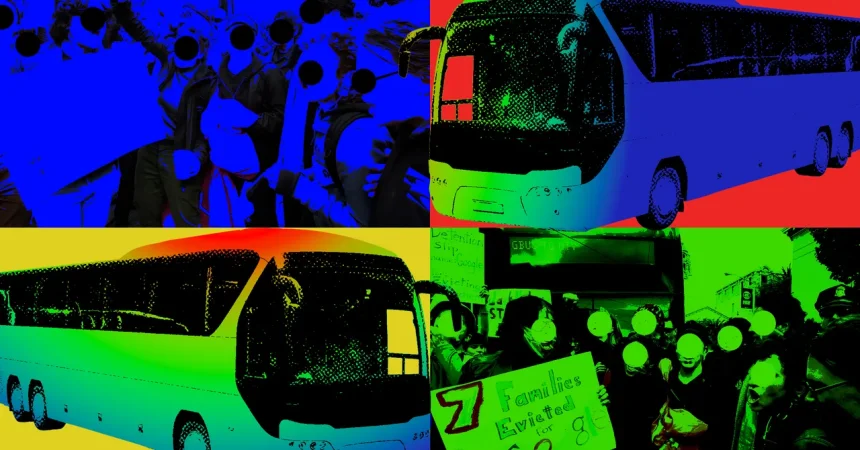
Beyond the dry statistics of rent prices and density, the psychological divide in the city was best crystallized by a singular, persistent target: the tech shuttle buses. Known affectionately by some and derisively as the “fucking Google buses” by others, these vehicles became physical manifestations of perceived inequality. These shuttle stops, where high-salaried tech workers queued up for their commute to the suburbs, became the front lines of a class war. They were seen as symbols of a “tech takeover,” a visual shorthand for an economy that seemed to be operating in, but not for, the city of San Francisco. The protest against these buses was theatrical and loud, capturing the frustrations of residents who felt that the soul of their city was being systematically displaced by a transient workforce.
The origins of this flashpoint, surprisingly, were rooted in a very mundane, human desire for convenience. Cari Spivack, the Google employee who unwittingly launched this political firestorm, was not trying to provoke a social revolution; she was simply a frustrated commuter. As a product manager in the early, magical days of Google, Spivack found her white-knuckle commute from Bernal Heights to Mountain View to be a daily drain on her quality of life. The existing public transit options, specifically the aging and unreliable Caltrain line, were insufficient for the workforce of a company that prided itself on solving impossible problems. Spivack noticed a pattern of inefficiency and applied the standard Google ethos: if there is a problem, build a solution.
Spivack’s journey into corporate history is a snapshot of an idealistic era. With no formal engineering background but plenty of the “Googley” spirit—a cultural mandate for creativity and autonomy—she leveraged the company’s internal openness. In a time when you could still pitch a life-changing infrastructure project to a co-founder like Larry Page while waiting in a cafeteria line, Spivack did just that. She saw a problem—too many cars, not enough time, and a negative environmental impact—and proposed a fleet of private buses. What she imagined as a practical perk to help her and her colleagues reclaim their time became, in the eyes of the city, the ultimate signifier of a widening divide between the neighborhood residents and the new tech hegemony.
Ultimately, this story serves as a lens through which we can view the broader struggle of urban life in the twenty-first century. It highlights the clash between the Silicon Valley mindset—which views the world as a series of frictions to be smoothed out through innovation—and the traditional values of community, stability, and neighborhood continuity. While Spivack was solving a problem for Google, she was simultaneously creating a new, highly visible friction for the city of San Francisco. The saga of the Google buses reminds us that our urban neighborhoods are not just market-driven zones of land and steel, but delicate ecosystems. When those systems are disrupted, the backlash is rarely about just one thing; it is about who owns the space, and who defines the future of the place we call home.