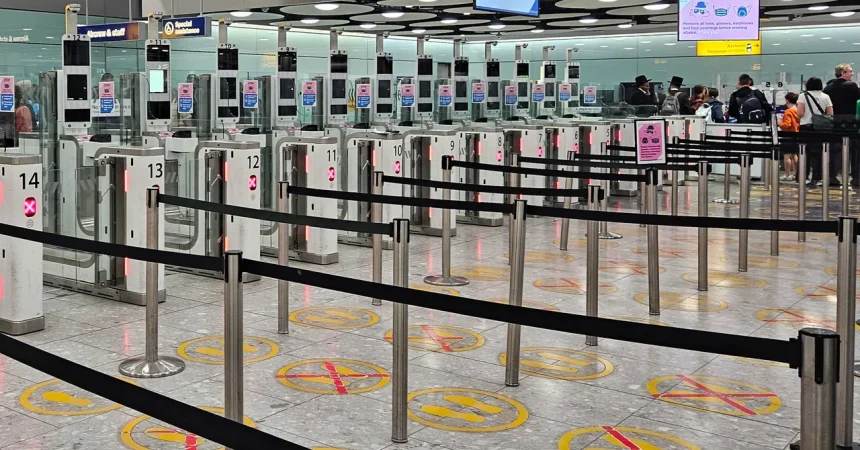
The UK government’s decision to integrate AI-driven facial age estimation (FAE) into its border control protocols represents a significant, albeit contentious, shift in how the Home Office handles asylum seekers. Initially announced in 2025 and delayed until 2027, the rollout is framed by officials as a necessary tool to prevent adults from “gaming the system” by posing as minors. While the Home Office insists this technology serves only as an “additional” layer of oversight that will not override human judgment, the lack of transparency regarding its real-world implementation—and how it might influence biased decision-making—remains a major point of concern for human rights advocates and technical experts alike.
The mechanics of facial age estimation are deceptively simple: these algorithms are trained on vast datasets of age-labeled photos to infer a person’s age based on facial geometry. While manufacturers often highlight laboratory success rates—where top-tier systems can predict age within a margin of roughly 2.5 years—the leap from a controlled environment to the chaotic reality of a border crossing is massive. Factors such as poor lighting, the trauma of dangerous travel, and the physical exhaustion experienced by migrants can distort the very features the software is designed to measure. Historically, these systems have been prone to ridicule and failure, with instances of algorithms being fooled by video game characters, highlighting a fragility that makes them questionable tools for life-altering legal determinations.
Perhaps most alarming are the internal findings from a leaked April 2025 Home Office report, which conducted extensive stress tests on seven different algorithms. The results were far from reassuring. The report explicitly noted that even the “best-performing” software struggled significantly when analyzing the faces of Sub-Saharan Africans, showing “substantial deviations” that raise urgent questions about racial bias. Furthermore, the testing revealed a dangerous trend: the system consistently skewed toward overestimating the maturity of 17-year-olds, effectively flagging minors as adults. These inaccuracies were compounded when analyzing female faces, suggesting that the technology carries built-in prejudices that could lead to the wrongful classification and potential detention of vulnerable children.
The human cost of these technical failures cannot be overstated. Currently, the process of determining an asylum seeker’s age is already a high-stakes, subjective affair involving assessment of demeanor, interviews, and physical appearance. Since 2010, nearly 40 percent of those assessed have been officially classified as adults, a statistic that underscores just how high the pressure is to correctly identify minors who are often traveling alone, traumatized, and lacking documentation. By introducing an algorithm that is inherently flawed and prone to demographic bias, the government risks institutionalizing systemic discrimination under the guise of “objective” scientific accuracy.
Furthermore, the Home Office’s assertion that their tests were conducted on “high-quality” images creates a dangerous paradox. If the technology displays significant error rates under perfect conditions, there is every reason to believe it will perform significantly worse when applied to the grainy, real-world images captured during the “first encounter” at a border site. The government’s willingness to push forward with a program that its own internal data shows is biased against specific ethnic groups and genders suggests a prioritization of migration control over the protection of children’s rights. Relying on an algorithm to assist in making “initial age estimations” risks creating an environment where officers defer to the machine’s output, thereby codifying injustice into the asylum system.
Ultimately, the move toward automated age verification reflects a broader global trend of digitizing borders at the expense of human empathy. While the Home Office claims that “individuals will always be treated as children until a further assessment is conducted” in cases of uncertainty, the presence of a biased machine in the room creates an immediate imbalance of power. A child’s future—their access to social care, education, and legal protection—should not be dictated by an algorithm that struggles to accurately identify 17-year-olds or that struggles with basic demographic diversity. True border security should be built on nuance and human judgment, not on the fragile foundations of a technology that is still struggling to get the basics right.