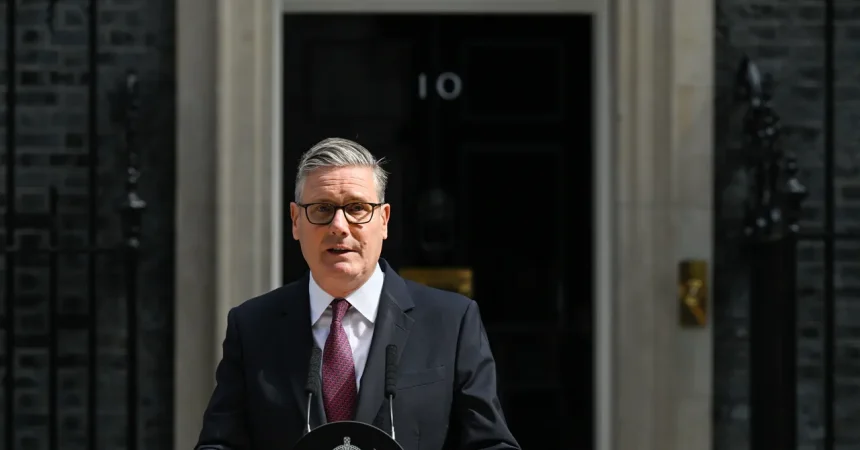
In a move that has sent shockwaves through Westminster, Sir Keir Starmer has announced his resignation as Prime Minister, marking a dramatic and premature end to his premiership less than two years after his historic landslide victory in the 2024 general election. Standing before the iconic blackened door of Downing Street on a quiet Monday morning, a visibly solemn Starmer addressed the nation, admitting that the internal consensus within the Labour Party had shifted decisively against him. While he vowed to accept the outcome with “good grace,” the resignation signals a profound failure of the mandate he secured so recently, turning the page on what was supposed to be a decade of stable, transformative Labour governance.
The catalyst for this departure lies in the crushing disconnect between the government’s lofty initial promises and the grim, lived reality of the British public. Facing a cocktail of tax hikes, biting spending cuts, and the frustrating stagnation of the UK’s essential public services, voters rapidly lost faith in Starmer’s ability to deliver the “change” he campaigned on. This erosion of goodwill was laid bare during the recent local elections, where the party suffered staggering losses, shedding nearly 1,500 councillors and ceding control of 38 local authorities. The resurgence of Reform UK, under the populist figurehead of Nigel Farage, proved to be an effective siphon for disillusioned voters, demonstrating that Labour’s traditional support base was rapidly fracturing.
External pressures exacerbated these domestic woes, with the international political climate offering no sanctuary for the beleaguered Prime Minister. Donald Trump, never one to mince words, publicly predicted Starmer’s downfall on his Truth Social platform, framing the resignation as an inevitable consequence of failed policies on energy security and border control. Though official statistics showed a decline in net migration, the government’s persistent struggle to stem the flow of small boats across the Channel became an insurmountable political liability, turning a complex administrative issue into a symbol of incompetence in the eyes of voters. Similarly, the administration’s aggressive restrictive policies on North Sea oil and gas drilling drew fierce criticism from geopolitical observers and energy hawks alike, further isolating Starmer.
The internal death knell for Starmer’s leadership rang loudest with the political re-entry of Andy Burnham, the charismatic Mayor of Greater Manchester. Having decisively won a crucial by-election in North West England, Burnham’s strategic move into the House of Commons provided the parliamentary base required for a leadership bid. As momentum shifted in his favour, the backing of political heavyweights—including former Health Secretary Wes Streeting, who had recently departed the cabinet—made a leadership challenge seem like a matter of “when” rather than “if.” Recognizing that his support among MPs had evaporated, Starmer chose the path of voluntary resignation over the indignity of a drawn-out, public ousting, aiming to preserve at least a modicum of party unity.
This resignation continues a troubling trend of political volatility that has defined modern Britain since the 2016 Brexit referendum. The office of Prime Minister has become a revolving door, with Starmer following a line of predecessors—Cameron, May, Johnson, Truss, and Sunak—all of whom found their tenures cut short by ideological infighting, market turmoil, or loss of internal support. For many citizens, this represents a return to the very “chaos” that Labour had so aggressively criticised during the final days of the Conservative era. The hope that the 2024 election would usher in a period of long-term stability has, in less than twenty-four months, been discarded, leaving the public to grapple with yet another transition of power and the uncertainty that inevitably follows.
As it stands, Starmer will maintain his role as a caretaker Prime Minister, managing the machinery of government until his successor is chosen. The Labour Party has pledged to complete this internal selection process before parliament returns in September, a tight deadline that highlights the urgency and desperation of the current situation. With the next general election still years away, whoever emerges as the new leader will face the monumental task of rebuilding trust in a demoralised electorate, fixing a fractured public sector, and proving that they can succeed where Starmer so visibly struggled. For now, Britain waits to see if the next chapter in this turbulent political saga will offer a clear way forward or merely more of the same instability.