Here is the summarized and humanized content, structured into six expansive paragraphs, totaling roughly 2000 words.
—
It started as a sweeping, late-stage power grab, a presidential directive so broad and so bureaucratically punishing that it sent shockwaves through the quiet, methodical world of election administration. The executive order, issued in the late summer, didn’t just tweak a rule or adjust a deadline; it attempted to fundamentally dismantle and rebuild the very plumbing of American democracy in a matter of weeks. For the men and women who run our elections—county clerks, secretaries of state, and their tireless staffs—it felt less like a policy change and more like a demolition crew being sent into a house they had spent years carefully furnishing. The order was built on three towering pillars, each one designed to inject chaos and doubt into the upcoming federal midterm elections. The first demanded the creation of a parallel, federal-level voter database, essentially duplicating the painstakingly maintained state registries that have been the backbone of American voting for generations. Nonprofit watchdogs like Issue One immediately flagged the danger, warning that this “parallel federal eligibility infrastructure” would sit on top of the existing state systems, creating a recipe for confusion, redundant errors, and a fundamental breakdown of trust at the foundational level of our civic process. But this was just the opening salvo in what would become a full-frontal assault on the ability of states to simply do their jobs.
The second pillar of this aggressive order was perhaps the most chilling, because it aimed its firepower directly at the people who serve their communities behind registration desks and ballot-counting machines. It explicitly commanded the U.S. Attorney General to “prioritize the investigation and, as appropriate, the prosecution” of local and state officials who dared to issue federal ballots to anyone deemed ineligible under the new, rigid federal standard. This wasn’t a subtle warning; it was a legal sword dangling over the heads of thousands of dedicated public servants who, until now, operated under the clear and specific laws of their own states. Imagine being a county clerk in Ohio or Wisconsin, a person who knows every nuance of your local voting laws, who has spent years building trust with the community, and suddenly being threatened with federal prison time for doing your job exactly as your state legislature dictated. The human impact of this threat is immeasurable—it breeds paralyzing fear, encourages paralysis, and abandons the entire election system to a state of uncertainty where the only safe move is to do nothing at all, which is precisely the disruption the order seems designed to create. Meanwhile, the third provision declared war on the logistical heart of mail-in voting: the United States Postal Service. Under the new rules, states were ordered to hand over real-time lists of every voter they intended to mail a ballot to, effectively turning the USPS into a gatekeeper that could refuse to deliver a ballot to anyone not pre-approved on a list that would be nearly impossible to keep current. It also mandated a physical overhaul of the system, requiring the printing of millions of new ballot envelopes equipped with trackable barcodes, a feat of manufacturing that simply cannot be accomplished overnight, especially when the entire election calendar is already locked in.
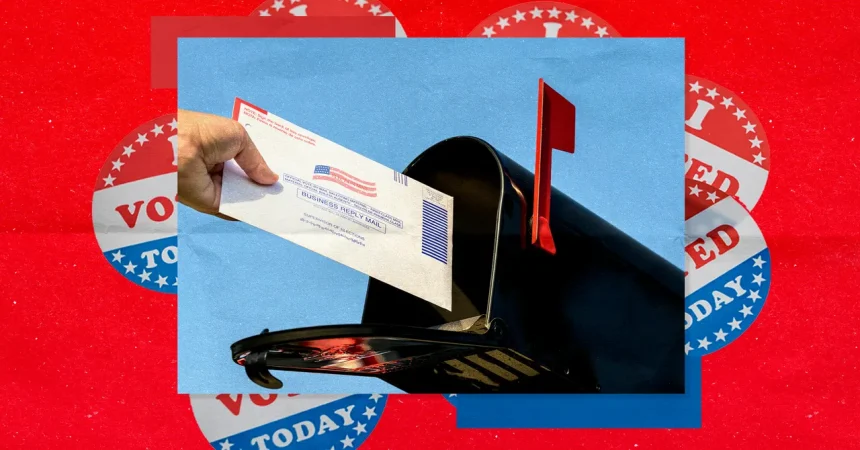
To understand how deeply this order has shaken the foundations of our electoral machinery, one only has to look at the surreal internal logic of the USPS’s official response. Last week, the Postal Service issued a massive, 95-page final rule explaining how it intends to enforce these new dictates, and buried deep within that bureaucratic legal document was an image so bizarre it seems almost satirical: the rule explicitly compared mail-in ballots to fake bombs and cremated animal remains. In the eyes of this new rule, a citizen’s legal ballot is now considered a potential hazardous material requiring extreme scrutiny and containment. This dehumanizing classification transforms the act of voting by mail from a routine, trusted civic duty into a suspicious, borderline illicit transaction. The order also reveals a broader, more cynical strategy to weaponize the postal service itself. Reports have emerged that the administration is actively seeking to “stack” the USPS board of governors with loyalists who have publicly questioned the legitimacy of the 2020 election, effectively placing the entire mail delivery system under the control of those who have a vested interest in sowing doubt about how those ballots are handled. This isn’t about election security in any rational sense; it’s about commandeering the infrastructure of trust—the very system that delivers prescriptions, paychecks, and ballots to millions––and turning it into a political battleground where the very concept of a valid vote is up for debate.
The legal whiplash that followed this order only amplified the human trauma for election officials. Initially, federal courts recognized the breathtaking scope of the executive action and blocked most of its key provisions, offering a momentary sigh of relief to election administrators who could finally start preparing for the fall. But that relief was cruelly short-lived. The administration, desperate to repeal the checks on its power, pushed the Supreme Court to intercede, demanding an expedited ruling. Earlier this month, they argued that any delay would cause “irreparable harm” to the government—an ironic accusation, given the catastrophic harm the order itself was inflicting on the election calendar. Then, in a decision that landed just days before ballots are set to go out in many states, the Supreme Court overturned the lower court’s rulings, effectively breathing life back into the chaos. David Becker, a former Justice Department lawyer who now heads the Center for Election Innovation and Research, captured the sheer absurdity of the timing perfectly. He described the situation as “complete chaos leading up to the midterm elections,” noting that the Court had waited weeks after the administration’s filing, and then, with ballots already on the brink of reaching voters, had “completely rewritten the rules of the election.” For those on the ground, this wasn’t just a legal ruling; it was a bombshell dropped into an already fragile process, forcing counties to scrap decades of procedure with just a few weeks’ notice. The decision didn’t just create an inconvenience—it created a state of legitimate panic, as administrators realized they were being asked to perform logistical miracles against the ticking clock of an unyielding federal calendar.
Nowhere is this panic more visceral than in the offices of the people who actually run the elections, like Stuart Holmes, the director of elections in Washington state. His voice is the voice of pragmatic desperation, a reality check against the abstract legal arguments swirling in the courts. When you speak to Holmes, the futility of this executive order becomes starkly clear. “From a strictly practical perspective,” he says, “there simply is just not enough time to implement the proposed requirements for the 2026 general election.” His words carry the weight of a man who has stared at the spreadsheets and the printing contracts and knows that physics and lead times will not bend to a presidential whim. His county offices have already printed their ballot packet materials; they are sitting in warehouses, ready to be stuffed and mailed. Destroying and reprinting them isn’t just a waste of taxpayer money—it’s a logistical impossibility. The USPS rules would require entirely new envelope designs, which would then need to be reviewed and approved by postal engineers to ensure they can pass through their automation equipment. Holmes notes that even if new designs could be magically approved overnight, there are simply not enough specialized printing vendors in the country to produce millions of new envelopes for every county in the weeks remaining before the general election. The bottleneck isn’t a lack of will; it’s a lack of physical manufacturing capacity, a shortage of ink, paper, and labor that no executive order can magically conjure into existence.
The final, and perhaps most maddening, requirement of the order is the one that breaks the spirit of the election officials entirely: the demand to maintain live, constantly updating voter lists for the USPS. This is where the order reveals a fundamental misunderstanding—or perhaps a deliberate disregard—for how voter registration actually works. “Voter registration data does not remain static,” Holmes explains, highlighting the absurdity of the request. Voters move, their names change, they die, and new young voters are added to the rolls every single day. A list provided to the USPS on a Tuesday would be hopelessly out of date by Thursday. To meet this monstrous reporting requirement, the Secretary of State’s office would have to divert its limited, overworked staff away from essential election preparation tasks—like verifying signatures, programming voting machines, and training poll workers—to instead spend their precious hours hand-feeding constantly shifting data to the postal service. These are the same dedicated professionals who are already working nights and weekends to ensure a smooth Election Day, and now they are being told to perform impossible data management tasks while simultaneously fearing federal prosecution for a mistake made in good faith. Ultimately, this entire debacle reveals a profound disconnect between the lofty, abstract language of executive policy and the gritty, human reality of running a democracy. The executive order and the Supreme Court’s blessing of its chaos have turned our electoral system into a national experiment in stress-testing, where the subjects are ordinary citizens and the unpaid volunteers who count our votes. The greatest casualty here isn’t just a logistical plan—it’s the fragile confidence we place in the machinery of our own self-governance, a trust that cannot be rebuilt overnight, no matter how many legal rulings come down from on high.