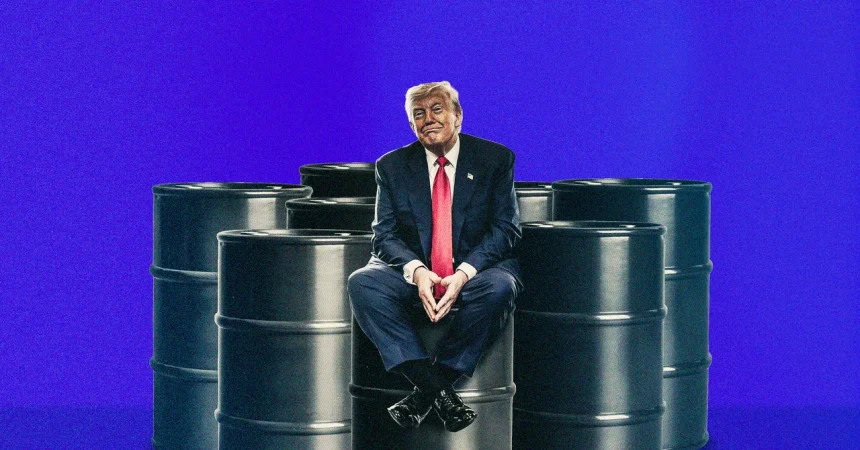
The recent assertion by President Donald Trump—that a shadowy US mission successfully smuggled 100 million barrels of oil through a blockaded Strait of Hormuz—has ignited a firestorm of speculation within the energy sector. In truth, the global oil market has entered a period of unprecedented opacity, where the “dark trade” of ghost tankers masquerading in the night has made accurate accounting nearly impossible. Industry experts like Matt Stanley of Kpler describe a logistical cat-and-mouse game where ships disable their tracking transponders and rely on naval escorts to navigate the geopolitical minefield. While analysts have spotted tell-tale signs of restricted crude oils appearing in unconventional markets, proving the scale of this clandestine movement remains an exercise in informed guesswork rather than hard data.
Despite the sensational headlines, market veterans view the 100-million-barrel figure with a sense of perspective. Before the current conflict paralyzed the region, the Strait of Hormuz acted as a conduit for roughly 20 million barrels of oil every single day. Seen in that light, the contested 100 million barrels—spread over more than a month of disruption—represents only about five days’ worth of pre-conflict traffic. It is a drop in the ocean, a tactical flicker against the vast, complex machinery of global energy. While the claim may serve political narratives, the real story lies not in the success of a secret mission, but in the unsettling reality that the world’s most vital maritime artery has been effectively silenced for over 100 days.
This silence has created a paradox that leaves many observers scratching their heads: if the Strait is 95 percent shuttered, why haven’t gas prices skyrocketed into oblivion? The answer, according to experts like Iman Nasseri of FGE NexantECA, lies in a carefully managed transition and the existence of massive, hidden buffers. China, for instance, has been systematically drawing down its gargantuan 1.3-billion-barrel stockpile to insulate its economy, effectively masking the severity of the supply void. Meanwhile, producers in the Americas—the US, Brazil, and Canada—have stepped forward to plug the gap, creating a temporary equilibrium that has kept Brent crude surprisingly stable at around $87 per barrel.
However, this stability is built on a foundation of sand, and the clock is irrevocably ticking. Analysts warn that we are rapidly approaching “operationally critical levels,” the point where strategic reserves are depleted and must be replenished to prevent a broader systems failure. The window for this makeshift solution is closing; as winter approaches, the United States will be forced to pivot, prioritizing its own domestic heating needs over acting as the world’s “swing producer.” The market is currently banking on a resolution by mid-August, fueled by a collective hope that the current pressures will break before the consequences of the storage depletion become irreversible.
The scale of the damage to the global energy infrastructure suggests that even if the blockade were lifted tomorrow, the path to normalcy would be brutal. With over 80 energy facilities reported as damaged and global production numbers staggering under a loss of over 10 million barrels per day, the “restart” is not a flick of a switch. Experts estimate that internal field repairs alone could take anywhere from ten weeks to seven months, provided they can even be accessed. Some, such as the UAE’s national oil company, are looking at a much bleaker horizon, projecting that the Strait may not return to full operational capacity until as late as 2027.
Ultimately, the confusion surrounding secret oil missions acts as a distraction from a sobering reality: we have entered an era of energy fragility that we are ill-equipped to manage. The oil that remains on the market today is a dwindling inheritance of past stability, supplemented by heroic but unsustainable efforts from non-OPEC producers. As the buffers run dry and the damage to infrastructure becomes increasingly apparent, the facade of normalcy will likely crumble. The coming months will be a test of global resolve, forcing world powers to confront the fact that our reliance on this narrow, volatile maritime corridor is far more precarious than we ever dared to imagine.