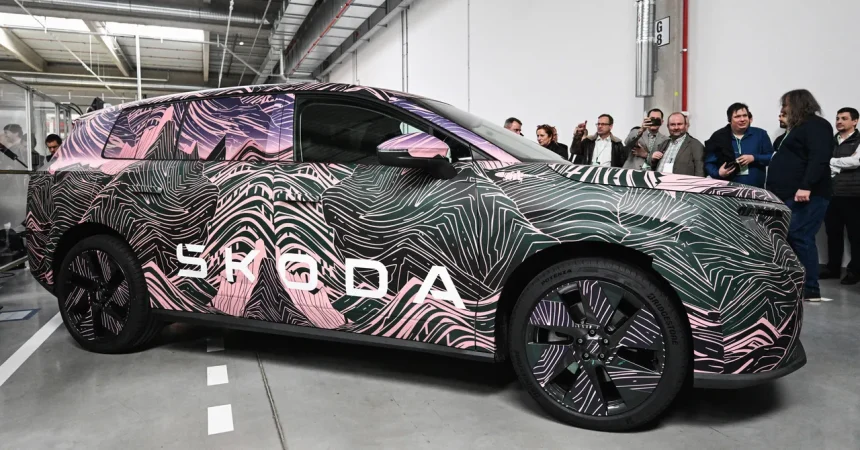
For years, the automotive industry has been gripped by a palpable sense of anxiety regarding the inevitable transition to electric vehicles. In Europe, and particularly within the Czech Republic—a nation with a centuries-old tradition of automotive excellence—many critics forecasted a “doomsday” scenario where the shift to battery power would hollow out local manufacturing and cost thousands of livelihoods. Yet, standing defiant against this tide of pessimism is Škoda. Operating out of its historic headquarters in Mladá Boleslav, the company has managed to do the improbable: turn the challenges of electrification into a success story. By focusing on practical design and approachable engineering, Škoda has solidified its position as one of Europe’s most dominant and resilient electric vehicle manufacturers, proving that heritage brands can successfully evolve without losing their soul.
The journey toward this renaissance began with the Enyaq, a vehicle that resonated with drivers because it prioritized comfort and utility over gimmicks. Following that triumph, Škoda captured lightning in a bottle once more with the Elroq, a smaller, more accessible sibling that recently earned the title of Europe’s best-selling electric car. However, the company isn’t resting on these laurels; they are already looking toward the horizon with the Epiq. Designed to break down the primary barrier to EV adoption—price—the Epiq is set to enter the market at roughly $30,000. It is a masterclass in packaging, boasting an exterior footprint similar to a compact Fabia while offering a cavernous interior volume that rivals much larger SUVs. While North American drivers won’t see this model on their shores, its expected popularity in Europe proves that the demand for “affordable green” is the industry’s next great frontier.
Navigating the competitive landscape of the budget-EV sector, Škoda is preparing to go head-to-head with some of the biggest names in the business, including Kia, Renault, and even its internal stablemates within the Volkswagen Group. Cars like the upcoming VW ID.Polo and the Cupra Raval represent the heat of this battle, yet Škoda’s approach remains uniquely pragmatic. They have wisely decided to skip the ultra-miniature car segments, opting instead to leverage the Volkswagen Group’s “MEB” platform to reach for something more ambitious. Rather than diluting their brand by chasing every single niche, they are focusing their engineering prowess on a vehicle that occupies the opposite end of the spectrum from their smaller models—a move that signals maturity and a clear vision for the future of the brand.
Enter the Škoda Peaq, a vehicle poised to be the crown jewel of the company’s current engineering efforts. While the market is flooded with compact electric crossovers, the Peaq is being designed for those who need genuine space. Measuring in at an impressive 16 feet and 5 inches, this large family SUV is expected to offer a seven-seat configuration, filling a massive gap in the current electric market. It is an assertive statement from a company once branded purely as a budget alternative; with the Peaq, Škoda is signaling that it can compete—and arguably lead—in the premium-adjacent space where interior utility is the greatest luxury of all.
Technically, the Peaq is expected to be a powerhouse of the MEB platform, taking lessons learned from the Elroq and Enyaq and scaling them up. Because of its elongated wheelbase, industry insiders are anticipating a high-capacity battery—likely in the 89-kWh range—similar to the specs teased in the Vision 7S concept vehicle. By utilizing this proven, reliable platform, Škoda is minimizing the risks of early adoption while maximizing the range and performance drivers actually care about. This strategy of “proven technology, expanded size” creates a reliable, family-oriented workhorse that doesn’t feel like a science experiment, but rather like a natural evolution of the family road-trip vehicle.
As we await the official unveiling, the narrative surrounding Škoda has shifted from one of industry survival to one of industry leadership. They have successfully bridged the gap between the austerity of a budget brand and the innovation of a high-tech manufacturer. The Peaq, like its siblings, represents a human-centric approach to engineering: it acknowledges that while the world is changing, the core needs of drivers—space, reliability, and value—remain the same. In moving from the nimble, low-cost Epiq to the expansive, family-ready Peaq, Škoda is not simply building cars; they are proving that the European automotive industry still has plenty of fuel in the tank to navigate the electric era.