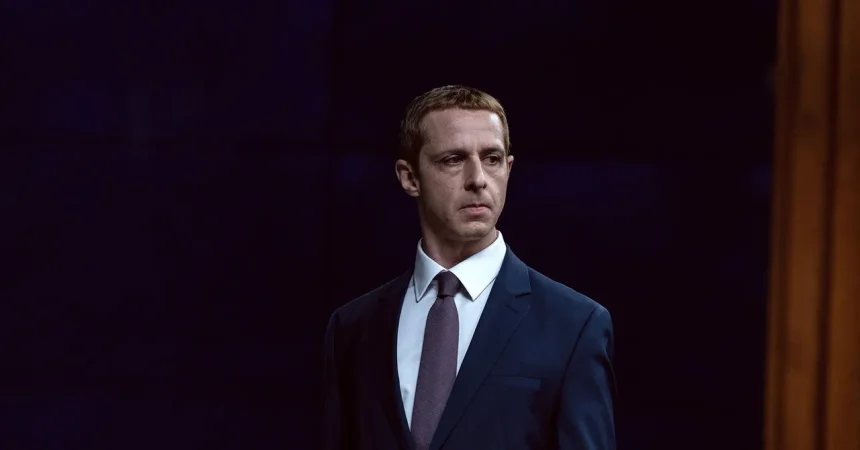
When The Social Network hit theaters in 2010, it felt less like a historical drama than a photograph developing in real time. Facebook had only been born six years earlier, in a Harvard dorm room, and none of us truly understood what it would become. Could a movie about a website, a lawsuit, and a socially awkward young programmer possibly matter before the story had even begun to unfold? It was a fair question, and the film itself seemed to acknowledge its own audacity. Aaron Sorkin’s screenplay crackled with the nervous energy of a hundred simultaneous instant messages, Trent Reznor and Atticus Ross supplied a score that felt like the hum of a server farm late at night, and Jesse Eisenberg delivered a performance that somehow made Mark Zuckerberg both repellent and magnetic. Directed by David Fincher, the movie played like a slick corporate thriller, but the stakes were strangely intimate: who owned what percentage of the platform, who could call themselves a founder, and who had been betrayed along the way. It was electrifying, and it seemed to strip away the mythmaking around Silicon Valley’s newest generation. Yet watching it then, you couldn’t help but wonder if the real drama was still ahead. The film ended with Zuckerberg alone, refreshing his laptop, waiting for a connection that would never come. The audience left the theater feeling that the story was incomplete—not because the movie failed, but because life was moving faster than cinema could keep up with. In hindsight, that feeling was almost prophetic. The lawsuits at the center of the film were real, but they were also just a prelude to something far bigger: a global experiment in connection, manipulation, outrage, and desire that no one, not even its creators, seemed fully in control of. The Social Network didn’t come too soon because it captured a moment; it came too soon only in the sense that we had no idea how much more there was to capture.
Sixteen years later, of course, we know. Facebook—now Meta—has accumulated more scandals than Hollywood could possibly dramatize in a single film or even a series of films. There have been data breaches, election interference, misinformation campaigns, mental health crises, and endless congressional hearings. Sorkin, for his part, says he was approached many times over the years with pitches for a sequel. He listened, considered, and struggled to find an angle that felt like a story rather than a headline. “Before a film can be anything else, before it can be relevant or thought-provoking, it has to be good,” he tells WIRED. “It has to work as something that you watch while you’re eating popcorn.” That distinction matters. Sorkin isn’t dismissive of the material; he’s protective of the craft. A movie can be important, urgent, and righteous, but if it fails to function as drama, if it feels like an essay or an indictment rather than a living thing, then it won’t move anyone except the already converted. The challenge for a sequel was not a lack of material—there was almost too much—but a lack of shape. The story of Facebook’s rise had a clear arc: ambition, betrayal, lawsuits, victory, loneliness. The story of Facebook’s adulthood was a sprawling mess of competing failures, ambiguous motives, and systemic harms. How do you make a movie out of that? How do you give it a human face, a single moment of choice, a door that swings open and refuses to close? Sorkin has spent a career finding the human engine behind public events, and he knew that a sequel could not be simply a chronological list of sins. It needed a character, a turning point, a cost. It needed to be a story, not a sermon.
Then Sorkin met Frances Haugen, and the story began to take shape. Haugen was the former Facebook data engineer who leaked a cache of damning internal memos to investigative reporter Jeff Horwitz. Horwitz’s reporting became known as the “Facebook Files,” a sweeping 2021 series for The Wall Street Journal that exposed not only what the company knew about the harms it was enabling, but how often it chose growth over safety. The documents revealed an organization aware of the hate speech spreading on its platform, the medical misinformation poisoning public health, the body image issues devastating teenage users, and even the human trafficking facilitated by its tools. In case after case, internal researchers would identify a problem, quantify it, and offer recommendations—only to be overruled or ignored by executives who prioritized engagement and profits. It was a devastating portrait of institutional indifference, and Haugen became both a whistleblower and a public figure, testifying before Congress and speaking to journalists around the world. For Sorkin, meeting her was an opportunity to move from policy to people. He knew the broad outlines of the story, but he still wasn’t sure he had a film. A whistleblower is a compelling figure, but the act of leaking documents is not inherently cinematic. There is no car chase, no courtroom showdown, no single moment of confrontation—just a person, a USB drive, and a decision. Sorkin needed something more intimate, something that would allow an audience to feel the weight of Facebook’s failures in a visceral way. He needed a face. He needed a moment. He needed an opening scene that would make the abstract suddenly concrete. And so he asked Haugen a simple question: why did she finally decide to go to the media? What was the tipping point?
The answer, at first, seemed almost too casual to be meaningful. Haugen told Sorkin, in an offhand way, that she had a friend who had been “radicalized by Facebook after spending too many hours on the platform.” That’s it. No dramatic manifesto, no elaborate explanation. Just a quiet, devastating observation about someone she knew and cared about, someone whose mind had been slowly reshaped by the algorithm. Sorkin recognized that this was the seed of the movie. The story of Facebook’s reckoning could not be told solely through internal memos and congressional testimony; it had to be told through the people who were changed by the platform, sometimes without even realizing it. That friend became the inspiration for the opening scene of The Social Reckoning, Sorkin’s written and directed sequel. It’s a brilliant way into the material because it grounds the systemic in the personal. We are not asked to understand the entire architecture of social media’s harms all at once. Instead, we meet a woman, and we watch while something terrible happens to her. It feels small at first—a roadside encounter, an angry outburst, a moment of humiliation—but it echoes outward. The algorithm doesn’t just feed content; it finds people who are vulnerable, isolates them, validates their anger, and pushes them toward extremes. Haugen’s friend wasn’t recruited by some shadowy propagandist. She was a regular person, attending pilates classes, holding progressive views, living a normal life. Then she spent too many hours on Facebook, and the platform did what it was designed to do: it kept her engaged by feeding her rage. By the time she was pulled over on the side of a road, she was no longer the person she once was.
The cold open of The Social Reckoning is thus a small, tightly wound story in itself. We are in San Mateo, California, at night. A woman is pulled over on the side of the road, her car overheated, and she is clearly intoxicated. When police officers approach, she doesn’t cooperate. Instead, she becomes combative, pulling out her phone and recording the encounter, hurling racist abuse at the cops. The situation spirals until she threatens to kill one of them and is arrested. It is an ugly, uncomfortable scene—not because we are watching a villain in a cartoon, but because we are watching a person unravel. And then Sorkin does something quietly devastating: he shows us that woman’s video appearing on a Facebook page dedicated to far-right content. It is there that Frances Haugen, played by Mikey Madison, finds it in 2019. She recognizes the woman as an acquaintance from her pilates class, someone who once held progressive views, someone who seemed like the last person who would end up in such a situation. Haugen also learns that this woman is a “superuser,” intensely active on Facebook, spending enormous amounts of time on the platform every day. The connection is not theoretical. This is not a distant statistic or an anonymous user. This is someone she knows, someone whose transformation happened under the influence of an algorithm designed to keep her watching, scrolling, and seething. In that single scene, Sorkin has accomplished what thousands of articles, hearings, and internal investigations could not fully convey: the human cost of a system that profits from division. The woman on the side of the road was not born a radical. She was cultivated, nourished, and eventually harvested by a machine that understood her weaknesses better than she did. The opening scene is not just a hook; it’s a thesis. Facebook’s reckoning is not a legal battle or a regulatory challenge. It’s a story about people who were failed by a platform that was supposed to connect them.
That is what The Social Reckoning seems to understand with rare clarity. Sorkin has always been drawn to stories about power, language, and the systems we build to justify ourselves, but here he is reaching for something more uncomfortable. He is asking us to look not just at Mark Zuckerberg, or at the executives who made terrible decisions, but at the Tom-in-the-middle nature of social media itself. The film’s title carries a kind of moral weight. A reckoning is not just an exposure of facts; it is an accounting of consequence, a moment when the bill comes due. For Facebook, the bill has been accumulating for years. It is in the hate speech that metastasized into violence, the misinformation that left people sick and dead, the body image anxieties that consumed young minds, the human trafficking that found shelter in private groups. It is in the radicalized friend, the superuser, the countless individuals who were quietly changed by forces they could not see. Sorkin’s sequel cannot possibly tell all of their stories, but it can tell one story with enough specificity and emotional force to make the larger crisis feel real. And that, ultimately, is the job of cinema. The best films don’t just inform; they transform. They give us a way to feel what we already know, to make abstract harm unbearable, to turn a nameless statistic into a face we cannot look away from. Whether The Social Reckoning succeeds on its own terms remains to be seen, but Sorkin has found the right entry point. He hasn’t written a corporate thriller this time. He has written something that begins with a broken woman on the side of a road and then widens, slowly, terrifyingly, into the story of how we all got here. It may have taken sixteen years, but the reckoning is finally ready for its close-up.