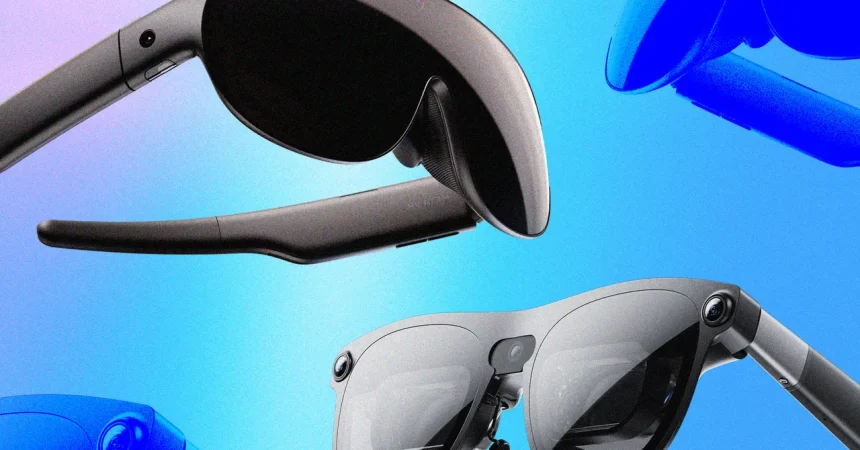
Look, I’ll start with an honest confession: I wanted to hate Meta’s $1,299 mixed-reality glasses. Not because I have anything against the company’s hardware, but because Meta has earned more than its share of suspicion, especially when it comes to smart glasses and recording. The idea of wearing a camera and sensors on your face, connected to a company with a complicated history of privacy missteps, is exactly the kind of product that makes people uneasy. I’ve had those conversations, the ones where someone glances at your glasses and asks, “Is that thing recording me?” and you’re not totally sure how to answer. So I walked into the demo at Meta’s Connect event with my defenses up. But then I spent somewhere between 30 and 45 minutes wearing the glasses, and I have to admit: I was astounded. The video quality is genuinely beautiful. Virtual screens appear crisp and colorful, text is sharp enough to read comfortably, and images look like they’re floating in the air rather than pasted on top of it. More importantly, for a gadget like this, I forgot I was wearing them—at least as much as you can forget a computer strapped to your face. For years, face computers meant huge, heavy, hot headsets. You know the ritual: put on a Vision Pro or a Quest, spend the first ten minutes adjusting the strap, and then spend the rest of the demo trying not to think about the pressure on your cheekbones. The Meta glasses are a different animal. They’re light, they don’t fog up, and they don’t make you feel like a cyborg auditioning for a sci-fi movie. The experience isn’t perfect, and the privacy questions are far from resolved. But after years of hearing that mixed reality was just around the corner, I finally felt like the hardware had caught up with the hype. It’s an uncomfortable feeling to admit, because it’s so much easier to be cynical about a $1,299 pair of glasses than to say they’re actually very good. So I’m saying it anyway. They might just be the real deal.
But Meta is not the only big dog in the face-computer world, and that’s maybe the most exciting part. Xreal, a company that made its name with virtual-display glasses, has partnered with Google to build mixed-reality smart glasses on the Android XR platform. The result is called the Xreal Aura, and earlier this week the company finally announced a firm price: it starts at $1,279, which is exactly $20 cheaper than Meta’s glasses. That’s not a dramatic difference, but at this price range, every dollar feels like a negotiation. The Aura also has a significant advantage for people who don’t want to wait: it’s coming out this year. You can’t just preorder one yet—only people who already placed paid reservations are eligible at the moment—but Xreal says general preorders will open “in the coming weeks.” The starting price gets you a model with 12 GB of RAM and 256 GB of storage, which sounds like a lot until you remember that these glasses are essentially a full computer you wear on your face. The first shipments will go to the United States, Canada, Japan, and South Korea, and more regions will have to wait until 2027. I know what you’re thinking: another high-tech gadget that costs more than a flagship phone and requires a spreadsheet to understand the specs. But the timing says something important. Meta and Xreal are racing to define what the next decade of personal computing looks like, and they’re betting that glasses, not headsets, will be the hardware we end up living with. Whether that’s amazing or terrifying is up for debate, but the fact that these two products are arriving at nearly the same price, with nearly the same vision, tells me the industry is serious. And as someone who has spent years trying out “the next big thing” that always turned out to be a disappointment, I find the competition encouraging. It means neither company can afford to rest, and it means consumers will soon have a real choice.
I tried both, by the way. I attended a demo of the Xreal Aura, and Xreal deliberately held it a day after Meta announced its VR glasses at Connect, which felt less like coincidence and more like a declaration of war. So I had the strange experience of wearing two very similar products within about 24 hours, and my immediate takeaway was that these are direct competitors. They offer very similar experiences: put on a pair, and you can watch videos, play games, or project a multi-monitor workstation setup in front of you. Some of those experiences work better on one device than the other, and some of the differences are subtle enough that you’d have to be a reviewer with too much time on your hands to care. But the fact that both companies have arrived at the same fundamental design—a pair of glasses tethered to a small puck that does the heavy lifting—says a lot about where the industry thinks computing is heading. For a long time, augmented reality was split between two extremes: on one side, weak smart displays that could only show notifications and directions; on the other, bulky headsets that blocked out the world entirely. These new glasses want to split the difference. They want you to see the real world, but also see a movie, a spreadsheet, or a video game floating right there in your field of view. It’s the kind of thing that sounds gimmicky when you describe it, but when you’re actually standing in a conference room with a giant virtual screen hovering in the air, you quickly stop thinking about the marketing and start thinking about all the ways this could actually be useful. The key question, of course, is whether normal people will want to wear something like this in their daily lives. And that’s where the competition matters. If only one company were building these, it would be easy to dismiss it as a billionaire’s toy. With two companies pushing in the same direction, you have something that begins to look like a category.
It’s also important to put these devices in context, because not all smart glasses are created equal. There are simple display glasses that plug into your phone or laptop and basically act as a portable monitor, saving you from craning your neck on a long flight. Then there are glasses like the Ray-Ban Meta, which feature cameras, speakers, and an AI assistant you can talk to, but don’t put any visual pixels in front of your eyes. They can capture photos, record video, and answer questions, but they won’t show you a map or a floating dashboard. The next tier includes display versions of those glasses, which add a visual component so you can see real-time captions when people speak, translations of foreign signs, navigation instructions, and more. Google and Samsung are reportedly working on their own versions of this concept. But mixed-reality glasses go a step further, bridging the world of virtual and augmented reality. They’re more like headsets such as the Apple Vision Pro or the Meta Quest, except they’re packed into slimmer, lighter designs that don’t make you feel like you’re strapping a gaming console to your forehead. Snap, the company behind Snapchat, also recently announced a competing pair called Specs that costs $2,195 and is shipping later this year. So there is genuinely a spectrum here, and it’s growing fast. You can buy a pair of smart glasses that mostly display a tiny heads-up screen, or you can spend more than two thousand dollars on a pair that tries to do almost everything a computer does. The fact that consumers now have to distinguish between these different categories is sort of amazing. A few years ago, the entire smart-glasses genre was essentially a punchline. Now we’re debating RAM, storage, field of view, and which company’s ecosystem is better, as if we’re talking about laptops.
In terms of design, neither Meta’s nor Xreal’s glasses can be mistaken for everyday eyewear, and it’s worth being clear about that. Meta’s futuristic frames fit like the front half of a VR headset. They’re not subtle. They look like you’re about to dive into a neural network. The Xreal frames are a bit more glasses-forward: chunky, yes, but nowhere near as thick and heavy as Snap’s Specs. You definitely wouldn’t leave them on when you’re trying to look inconspicuous, but they’re closer to the shape of a normal pair of acetate frames than anything we’ve seen before. Both devices also require an attached wired compute puck, which is a small block of hardware that houses all the memory and processing power. You’re supposed to put it in your pocket, which means your glasses are physically connected to a small computer at your hip. That is a compromise, but it’s also a practical one. The reason these glasses are so much lighter and cooler than a full VR headset is because the hard stuff has been moved off your face. You can feel the weight of the cables, but it’s not terrible, and you quickly start to appreciate how much processing power is happening in that little puck. If you’ve ever worn an early VR headset and felt your face heat up after twenty minutes, you’ll understand why this matters. The trade-off is that you’re slightly tethered, and if you want to move around a lot, the puck is going to bounce in your pocket. But the larger point is that these devices are finally comfortable enough to imagine wearing for long stretches. When I put them on, I didn’t immediately look for the nearest couch. I just stood there, looking at screens floating in the air, and thought about how far this technology has come.
So what’s the final reaction after all this hands-on time? I’m genuinely impressed, but I’m also still cautious. The $1,299 and $1,279 price tags are not small, and the privacy issues that make people uneasy about Meta’s products don’t disappear just because the glasses are well made. There is something inherently unsettling about a camera attached to a company that has historically been a little too eager to collect data. And even if Xreal’s partnership with Google brings a different set of values to the table, Google is hardly a saint when it comes to tracking and profiling its users. But if you can put aside the big-tech dystopia, there’s reason to be excited. The experience of wearing a pair of these glasses, watching a movie on a virtual screen that stays perfectly still while you move your head, is the kind of thing that feels like the future. I remember the first time I used a laptop instead of a desktop, and the first time I read from an e-ink screen instead of paper. There was a moment when I realized that the old form factor was just a scaffold for the new one. I think we’re approaching a similar moment with face computers. The hardware is still imperfect, the price is still too high, and the social acceptance of wearing a computer on your face is still shaky. But the direction is clear. The question is no longer whether these devices can be good. They can. The question is whether we’ll trust the companies that are building them, and whether we’ll find a way to wear them without turning ourselves into walking surveillance devices. For now, I’ll just say this: the next time someone tells me that mixed reality is a dead end, I’ll remember the day I stood in a conference room and watched a sharper, brighter screen hang in the air in front of me, held in place by nothing but a pair of glasses. It’s easy to be skeptical from the outside. But once you’ve worn them, you understand why Apple, Google, Meta, and Snap are all betting their futures on this.