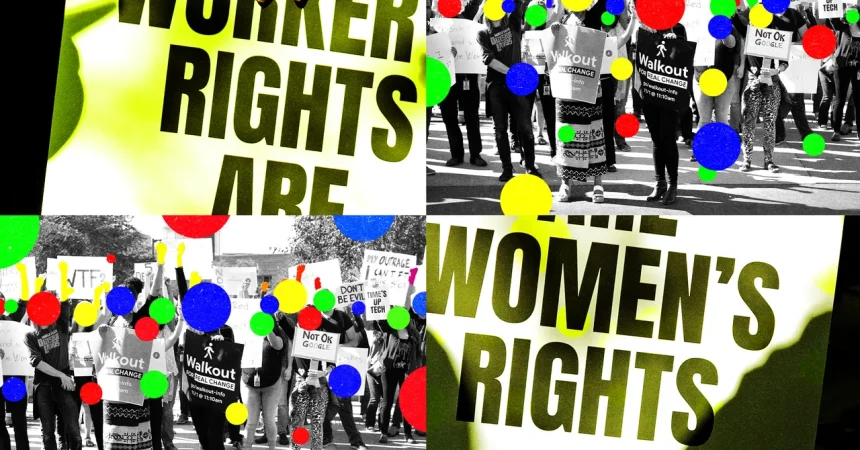
In late 2018, Claire Stapleton was navigating the precarious tightrope of modern motherhood and a high-stakes marketing career at Google. While she was ostensibly focused on the corporate grind, her internal landscape was shifting rapidly. The catalyst for this transformation was not a professional project, but a quiet, early-morning realization that the company’s internal culture—particularly regarding how it handled sexual harassment—had become morally unsustainable. Sitting in her home in New York before her son, Malcolm, had even woken up, Claire found herself staring at an inbox full of “urgent” corporate directives that suddenly felt hollow. The contrast between her employer’s demands and the urgent need for a reckoning within the tech giant became the crucible in which a historic movement was forged.
Stapleton’s disillusionment was compounded by the corporate bureaucracy she was expected to uphold. While her managers pressured her to lobby against EU legislation like Article 13—a policy designed to increase platform accountability—Claire recognized the cynical nature of Google’s opposition. She understood that Google’s desperate push to overturn the law wasn’t about protecting the internet for users; it was about maintaining a consequence-free environment that prioritized unchecked growth and the consolidation of power. This realization stripped away the veneer of corporate “do-gooding” that she had once bought into, making it impossible for her to continue compartmentalizing her professional output from her personal conscience.
The turning point arrived when she took the risk of creating a Google Group titled “womens-walk.” Within hours, what she expected to be a small thread of like-minded colleagues exploded into a digital gathering of hundreds of women. The anonymity that often characterized internal tech discourse vanished; people were tired of hiding. They began signing their real names to emails, sharing their grievances, and documenting their anger. For Claire, this was the moment the solitary frustration of a single employee transformed into a collective, tangible force. The group became a “ground zero” for a new kind of belonging, a sanctuary for women who were exhausted by the status quo and ready to demand a seat at the table of accountability.
In those intense, sleep-deprived hours over that October weekend, the group moved from venting to strategy with remarkable speed. Claire sent out a defining email, refusing to hide behind a pseudonym or a corporate alias. She put her own name on the line, asking her peers to articulate their “why” and determine their endgame. The responses flowed in, shifting from raw, visceral rage to a calculated, unified plan of action. They quickly realized that timing was everything; they needed to strike while the momentum was high, choosing to walk out just five days later, before the U.S. midterm elections could dilute their message. They were no longer just employees; they were architects of a cultural insurrection.
The week leading up to the walkout was, in Stapleton’s words, “psychedelic.” She found herself living in two distinct realities: the performative, mundane world of corporate marketing, and the electric, urgent world of the walkout planning. While she was tasked with churning out lackluster Halloween-themed tweets and social media content for the brand, her real work was being done in the shadows of email threads and strategy meetings. The juxtaposition was jarring. Every minute spent on the “rigmarole” of her job felt like an act of cognitive dissonance, highlighting just how far removed Google’s public-facing image was from the lived experiences of its female workforce.
Ultimately, this account serves as a poignant reminder of how grassroots change happens within massive, monolithic structures. It begins with the simple, courageous act of opening a laptop at 6:00 a.m. and asking a room full of strangers, “Why are you here?” By documenting her journey, Stapleton humanizes the “Women’s Walkout,” moving it away from news headlines and back into the realm of the deeply personal. It wasn’t about complex algorithms or lobbyist infighting; it was about people deciding that their integrity was worth more than their career trajectories. Through her story, we see that the most powerful tools for change are not corporate policies, but the human connections formed when people stop being quiet and start demanding better for themselves and their communities.